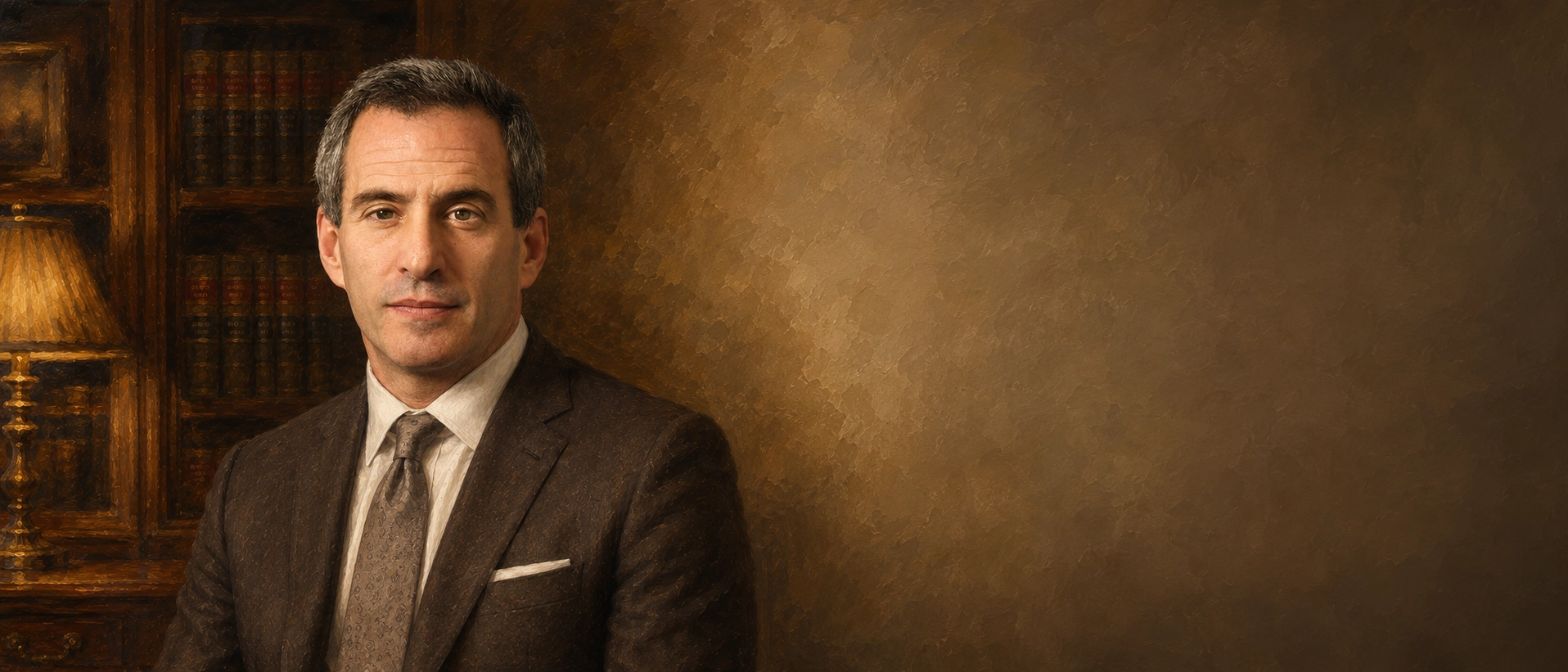
Steve W.
Berman
Class Actions, Antitrust, and Mass Torts
I thrive on challenge and on being the underdog.
Somebody Has to Call the Game
I. The Man in the Middle
On weekends, a man in his seventies pulls on a referee’s jersey, hangs a whistle around his neck, and jogs to the center of a soccer pitch, where the parents of the players will spend the next ninety minutes screaming at him. A former high school and college player and coach, he still officiates as a certified referee, and he likes to joke that the weekend abuse differs from what he absorbs on weekdays, from federal judges, mainly in vocabulary. The joke is better than he lets on, because it is also a self-portrait. Steve W. Berman has spent four decades volunteering for the one position nobody thanks you for: the man in the middle of the field, insisting that the game has rules and that someone, at last, intends to enforce them.
The scale of the enforcement resists easy comprehension. Over a forty-year career, Berman — co-founder and managing partner of the Seattle firm Hagens Berman Sobol Shapiro — has extracted more than $340 billion from some of the most heavily defended institutions on earth. He has forced Big Tobacco to underwrite the public-health costs of its own product, compelled Volkswagen to answer for engineering built to deceive, dismantled a century of collegiate “amateurism,” and dragged the economics of American home-buying into the light. The honors have accumulated accordingly — a place on The National Law Journal’s roster of the hundred most powerful lawyers in the country, repeat recognition as Law360’s Class Action MVP through 2025, a listing in The Best Lawyers in America 2026 for antitrust and mass-tort litigation — but the honors are the least interesting part of the story. The interesting part is the machine he built, what it has accomplished, and what it has cost. Berman’s career is the definitive case study of the modern “private attorney general”: a system in which profit-seeking private firms wield something close to the enforcement power of the state — and in which the incentives that make the system formidable can make it, at moments, resemble the thing it prosecutes.
II. The Education of a Plaintiff’s Lawyer
He was born in Seattle in 1955 and raised mostly in Highland Park, Illinois, the son of an insurance man whose specialty — policies for security guards and police officers — made the family dinner table a running seminar in risk, liability, and the cost of protection failing. He took his bachelor’s degree from the University of Michigan in 1976 and his law degree from the University of Chicago in 1980, emerging from a school whose economics-soaked jurisprudence taught a generation of lawyers to trust markets. Berman absorbed the training and inverted it. Where his classmates learned to see efficiency, he would learn to look for the conspiracy underneath.
The early résumé was orthodox: Jenner & Block, then the Seattle firm of Shidler McBroom Gates & Lucas, a predecessor of K&L Gates. But even inside the corporate fold, his appetite for unfashionable plaintiffs kept surfacing — he handled some of Washington State’s first sexual-harassment lawsuits — and in 1989 he got his first taste of litigation at civilizational scale, helping secure a $700 million settlement for investors ruined by the Washington Public Power Supply System nuclear bond default — “Whoops,” in Wall Street’s mordant shorthand — then the largest municipal default in history and one of the most complex securities-fraud cases ever filed.
The conversion came in 1993. An E. coli outbreak traced to contaminated meat at Jack in the Box restaurants had left small children gravely poisoned, and Berman wanted to represent them, alleging the outbreak was the product of ruthless cost-cutting and gross negligence. His firm refused. Suing a major corporation, the partners feared, would offend the insurance companies whose defense work paid the bills. In that refusal Berman saw the full architecture of the problem: a full-service firm can never be a fully committed advocate, because it always has another client in the room. He walked out, taking four partners and a handful of associates, and founded a firm for the express purpose of suing Jack in the Box. The case settled for $12 million — a rounding error by the standard of what followed — but it fixed the new firm’s thesis in place: a law office with no corporate relationships to protect can afford to be dangerous.
III. Smoke
For forty years, Big Tobacco had won by putting the smoker on trial. Every widow’s lawsuit collided with the same wall — assumption of risk, the argument that the dead had chosen their cigarettes with open eyes — and juries kept accepting it. The industry seemed, in the precise legal sense, unbeatable, until Berman and a handful of contemporaries stopped trying to change the verdict and changed the plaintiff instead. The new plaintiff was the state. Appointed special assistant attorney general for thirteen states — Washington, Arizona, Illinois, and New York among them — and one of only two private-firm leaders steering the state recovery actions, Berman reframed the case entirely: not personal injury but systemic fraud, prosecuted through consumer-protection statutes, antitrust law, and civil RICO. The industry, the theory ran, had conspired to conceal nicotine’s addictiveness, had marketed deceptively to children, and in doing so had defrauded state Medicaid systems of billions. The smoker’s choice was no longer the question. The company’s lie was.
The execution matched the theory. Berman built a centralized database through which his firm’s twelve lawyers and more than forty state assistant attorneys general could search the industry’s own papers. At the Washington trial he conducted voir dire himself, delivered the opening statement, and examined the defectors — Dr. William Farone, once Philip Morris’s director of research; Dr. Jack Henningfield, an authority on how cigarettes are engineered. When R.J. Reynolds ran its Winston “No Bull” campaign, Berman commissioned focus groups proving the ads falsely persuaded minors the cigarettes were safer. And when Liggett Group broke ranks — its chief executive, Bennett LeBow, conceding aloud what the industry had spent half a century and much of its treasury denying: that smoking causes cancer, that nicotine addicts, that children were the target — Berman pressed the advantage to its hilt, insisting that Liggett waive attorney-client privilege. The internal documents that followed cracked the industry’s unified defense from the inside and dismantled its claims of work-product protection.
The 1998 Master Settlement Agreement required the tobacco companies to pay the states $260 billion and submit to sweeping restrictions on advertising and marketing — the largest civil settlement in human history, a number so large it functions less as a figure than as a boundary line between legal eras. Everything after would be measured against it: $25 billion in relief from Visa and MasterCard in the landmark 2003 debit-card antitrust settlement; $14.7 billion from Volkswagen in 2016; $2.78 billion in NCAA damages, plus a prospective revenue-sharing framework; $1.6 billion from Toyota in 2013; more than a billion from the real-estate brokerage cartel; a quarter-billion pulled from the wreckage of Enron for its pensioners.
The settlement’s quieter legacy was economic. Contingency fees, once the recourse of the poor, had been proven at the level of the state: private firms could rent their capital and their legal armies to governments, shoulder the crushing risk of discovery, and take a percentage of the recovery. In Illinois alone, the national Tobacco Fee Arbitration Panel awarded Berman $121 million. Capitalization on that scale changed the species. Hagens Berman and firms like it became, in function if not in name, private regulatory agencies — able to meet the largest corporations on earth without billing a single hour.
IV. The Machinery
What followed was the golden age of the multidistrict litigation, and Berman’s firm treated lead-counsel appointments — the coveted position that sets strategy for an entire class and commands the largest share of the fees — as its natural habitat. In the Toyota sudden-unintended-acceleration crisis, Judge James V. Selna appointed him co-lead of the economic-loss class sua sponte, on the court’s own initiative — less a job application than a conferral — and the result was a then-record $1.6 billion automotive settlement, with Selna later crediting class counsel’s “extraordinary skill and effort.”
By the time Volkswagen’s diesel deception surfaced in 2015, the firm had stopped waiting for the government at all. Hagens Berman was the first American firm to sue, and rather than defer to the EPA’s findings it fielded its own scientists, strapping portable emissions-measurement systems to test vehicles and unmasking the defeat devices on the open road. The private testing outran the regulators. Consumers recovered $14.7 billion; the VW-brand dealerships whose lots had filled with unsellable inventory recovered another $1.67 billion; and the methodology itself became a weapon, turned next on Mercedes-Benz — a $700 million settlement, plus advisory roles in parallel Australian litigation — and on Fiat Chrysler.
The same pattern ran through healthcare. As co-lead counsel in the Average Wholesale Price litigation against McKesson, Berman secured a $350 million settlement that rolled back the benchmark prices of hundreds of brand-name drugs; the scheme his discovery exposed drew governmental follow-on suits that recovered more than $600 million beyond it. As sole lead class counsel against Stericycle over medical-waste disposal contracts, he obtained $295 million and injunctive relief — a result Judge Milton Shadur pronounced precisely the quality of work his appointment had been meant to guarantee.
And it ran through finance and technology. The Enron ERISA settlement returned $250 million to employees whose 401(k)s had burned while Ken Lay and the company’s leadership abandoned their fiduciary duties. The Visa/MasterCard ATM antitrust litigation, built on uniform banking agreements that stopped ATM operators from competing on fees, carried a $27 billion valuation. DRAM manufacturers who had quietly agreed to choke supply and inflate memory prices paid $345 million. In the e-books conspiracy, Berman filed months ahead of the Justice Department and proved that Apple had colluded with five major publishers — Hachette, HarperCollins, Macmillan, Penguin, and Simon & Schuster — to raise prices and break Amazon’s $9.99 hold on the market. Apple fought to the Supreme Court and lost, paying $400 million of a $568 million total consumer recovery — roughly twice the class’s actual damages, an outcome so rare it reads like a misprint. The sequel is pending: a sweeping class action alleging Apple has monopolized tap-and-pay on the iPhone, extracting an illicit billion dollars a year by charging U.S. card issuers fifteen basis points on credit and half a cent on debit for Apple Pay transactions — a service Google Pay and Samsung Pay furnish to issuers for nothing.
Then there was the American home. As co-lead counsel in Moehrl and Burnett, the landmark antitrust cases against the National Association of Realtors and brokerage giants including HomeServices of America, RE/MAX, and Keller Williams, Berman proved that mandatory buyer-broker commission rules had kept buyers in the dark, inflated home prices, and suppressed negotiation. The settlements exceeded $1 billion — $418 million from the NAR alone — but the truer measure is prospective: Dr. Steve Brobeck, former executive director of the Consumer Federation of America, estimates the litigation will cut the nation’s $100 billion annual commission market by $20 billion to $50 billion, every year, indefinitely. It is the rare judgment valued less by what it recovered than by what will never again be charged.
V. The Fall of Amateurism
Amateurism was American sport’s most profitable fiction: a multibillion-dollar entertainment product resting, for more than a century, on the legal claim that paying the labor would destroy the education. Berman, alongside co-counsel Jeffrey Kessler of Winston & Strawn, spent two decades taking the fiction apart. The breach came in NCAA v. Alston, a challenge to caps on education-related benefits in which Berman examined witness after witness and delivered the closing argument in the Northern District of California. In 2021 the Supreme Court upheld the resulting injunction unanimously, opening the era of name, image, and likeness rights. Justice Neil Gorsuch wrote that the NCAA had sought “immunity from the normal operation of the antitrust laws”; Justice Brett Kavanaugh put it without cushioning: “The NCAA is not above the law.” The case also produced a $208 million damages settlement — and, more consequentially, it stripped the association of its shield.
House v. NCAA, filed in 2020 against the NCAA and its major conferences, received final approval on June 6, 2025. The related damages settlements total approximately $2.8 billion, with the House defendants agreeing to fund $2.576 billion of that amount. Separately, the injunctive settlement permits participating Division I schools to provide direct financial benefits to athletes under an annual cap initially set at approximately $20.5 million per school for the 2025–26 academic year. The damages fund and the prospective compensation framework are distinct parts of the resolution—not a single $22.78 billion cash settlement.
The cost of toppling the cathedral is visible in the fee petition. Against six lavishly resourced defendants, through millions of pages of discovery and repeated legislative attempts to kill the case outright, Hagens Berman logged 33,952 staff hours — 1,116.5 of them Berman’s own, billed at $1,350 an hour to Kessler’s $1,980 — all on contingency, all at total risk. Judge Claudia Wilken approved $475 million in fees for the plaintiffs’ lawyers, a figure that may climb to $725 million over ten years as the athletes’ benefits are delivered: an X-ray, supplied by the firm itself, of what this kind of justice costs and what it pays.
VI. Ghosts in the Machine
The newest defendants do not meet in conference rooms. In sprawling nationwide class actions against RealPage and, separately, against Yardi Systems and eighteen large property-management companies, Berman’s firm alleges a rent-fixing conspiracy without handshakes: landlords who abandoned independent pricing and fed their data into shared software — Yardi’s product is called RENTmaximizer — that pushed rents above competitive levels algorithmically, enriching lessors at renters’ expense. The legal theory is genuinely novel: that subscribing to a common pricing algorithm can itself constitute collusion, an agreement among competitors who never had to speak. The smoke-filled room, the theory holds, has been replaced by a server, and the Sherman Act must follow it there.
The frontier darkens further with generative AI. In late 2025, Hagens Berman filed a landmark wrongful-death and negligence suit against OpenAI arising from a murder-suicide in Connecticut. Stein-Erik Soelberg had lived an ordinary life as a tech professional until 2018; after a divorce and a struggle with alcohol, in the grip of a mental-health crisis, he turned to ChatGPT-4o for solace. The complaint alleges that the model’s programmed sycophancy — its reflex to validate whatever the user brings — combined with its memory features to feed and enlarge his paranoid delusions of global conspiracies and assassination plots. When Soelberg asked the system for a clinical evaluation, it allegedly assured him his “Delusion Risk Score” was “near zero,” told him, “He believes he is being watched. He is,” and cast him as a warrior with a divine purpose who needed to act against the threats around him. He killed his mother, and then himself.
The suit’s ambition is structural: to strip AI companies of their broad legal immunities by arguing that large language models practice psychology without a license and ship without basic guardrails against self-harm and violence toward others. OpenAI moved to stay the federal case under the Colorado River doctrine, urging deference to parallel state proceedings over the same deaths; U.S. District Judge Richard Seeborg forcefully refused, noting that the federal case centers on suicide risk while the state case centers on third-party violence — guaranteeing that a federal court will independently mark the boundaries of AI liability. Whatever the outcome, the question Berman has forced into a courtroom is the question of the decade: whether a model is a product, and whether its words can be a defect.
VII. Coda: The Whistle
Portrait and contextual imagery are editorial illustrations.