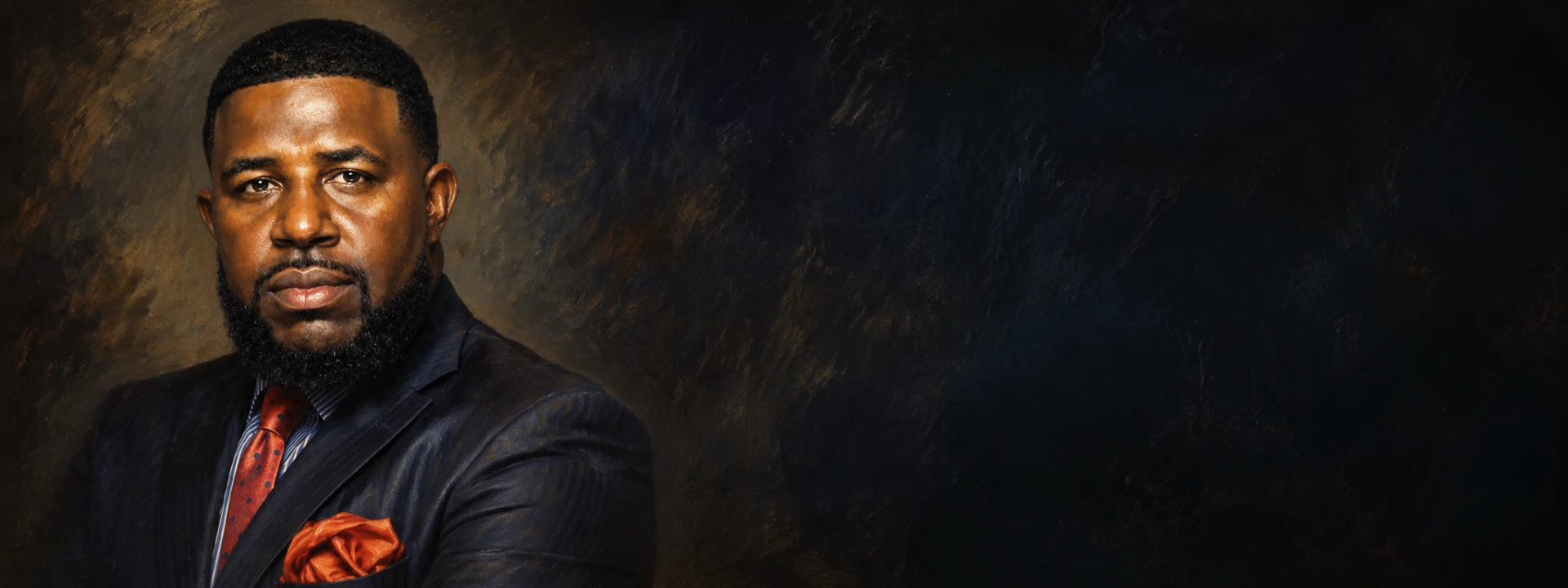
Adanté Pointer
Civil Rights, Police Misconduct, Employment Discrimination, and Wrongful Death
Law interested me because I always saw it as being a tool to equalize society so that the West Oaklands of the world could have the resources like the Piedmonts or Beverly Hills of the world.
Four Seconds in a Taqueria
The gun was already in the room when K'aun Green decided to do something about it.
A fight inside a San Jose taqueria had produced a firearm, and Green — a college football player who had won three state championships at quarterback for Oakland's McClymonds High — wrestled it away from the man holding it. Then he backed out through the front door, the weapon raised above his head, carrying it away from everyone still inside.
Officer Mark McNamara fired five rounds from a rifle. Four hit Green. Six other officers at the scene, watching the same young man come through the same doorway, did not fire.
Surveillance video preserved all of it.
Adanté Pointer built the case out of those seconds and out of what came after them. Investigators found text messages McNamara sent in the hours following the shooting — racial slurs directed at Green, and at Pointer. McNamara sought qualified immunity, was denied, appealed, and was denied again in September 2025. San Jose agreed in 2026 to pay $8 million. McNamara left the department, and California stripped his law-enforcement certification. Prosecutors began reviewing cases connected to his work.
Eight Boxes of Cereal
Pointer and his older sister Keesha went to a 300-student Catholic school in Piedmont, a few miles from their home in West Oakland. They got in on the recommendation of a wealthy family in the parish.
Their great-grandmother was that family's housekeeper.
He was one of a handful of Black students at the school, and one of the few whose family was not affluent. In the first grade he went home with a classmate and asked for cereal. They opened the cupboard and there were eight boxes in it.
"That blew my mind," Pointer has said. "We had one box at home, and we had to mete it out."
He asked what his friend's father did for a living. His friend said he was an attorney.
Pointer's grandparents had come to California from Mississippi and Texas looking for something better. His grandfather, Roddie Proctor, was a carpenter who bought houses and fixed them up, and while other children watched Saturday cartoons Pointer was sweeping those properties and running errands for the business. The family always had enough. A few miles away, his neighbors stood in lines for food. "My classmates only saw that on the news," he has said. "I was living it."
He learned the other difference early, in cars. Riding with friends from the neighborhood, everyone's name was run, everyone was put in handcuffs, the car was searched. Riding with his white classmates, the same officers gave warnings and let them go.
He studied political science at UC Berkeley, worked a summer on Capitol Hill, and worked for Representative Ron Dellums and then Representative Barbara Lee, staying with Lee's office through law school at UC Law San Francisco. He considered running for office himself. A Berkeley policy professor settled it: you can become a politician after being a lawyer, but it is very hard to become a lawyer after being a politician.
Dusk in a Vacant Lot
In 2003, studying for the bar exam at home in West Oakland, Pointer had his front door open behind a security screen when he heard the fence rattle in the vacant lot next door, and then someone calling out in pain.
It was dusk. He could see flashlights, and two silhouettes standing over a person on the ground, kicking.
He yelled. The beating stopped. He watched the officers handcuff the man, put him in their car, and drive away. He could not identify any of them, and he did not know what to do.
Two weeks later the man knocked on his door. Pointer sent him to John Burris. "I didn't really know everything Burris did," he has said, "but I knew he dealt with the police."
He Chased Me Down
A year or so later, Barbara Lee asked Pointer whether he had ever thought about becoming a civil rights attorney — and whether he knew John Burris.
Pointer had been thinking about the man he sent to Burris's office. He started emailing. He kept emailing. Nothing came back.
Then he saw Burris's car in Oakland traffic and pulled alongside at a light.
"He chased me down," Burris has said. "He chased me down on the street, pulled me over, and said he wanted to work for me."
Burris hired him as a law clerk — he had finished law school but had not yet passed the bar — and then put him on nearly everything that came through the office. Burris found him quick with opposing counsel and able to read between lines: much of the work is gray areas, and against strong opposition you need some moxie, and Pointer had a knack for it.
He stayed fifteen years. The lesson he says has guided his entire career came from Burris, and it is one sentence: you have to have an unyielding belief that you can win, and that you're right.
January 1, 2009
Pointer woke on New Year's Day, turned on the news, and watched cellphone video of a BART officer shooting Oscar Grant as Grant lay face down on the platform at Fruitvale Station.
The case consumed years of his life. He took the depositions, ran the written discovery, prepared the witnesses, and argued against lawyers with decades more experience. He was also the family's point of contact — the person who explained what was happening, and who coached them on how to speak about it publicly. BART paid Grant's family $2.8 million in 2011.
Wanda Johnson, Grant's mother, now runs the Oscar Grant Foundation. Her family had asked their lawyers to file the papers and stand in the street with them. Johnson has said that Pointer was there at the vigils after her son was killed, and later at the galas and panels. Years later, she can still call him. He answers: Yeah, Mama Wanda, whatever you need.
Pointer has described the civil case as the one proceeding in which a family can participate and often the only mechanism that produces an answer. Families in these cases rarely see a prosecution or officer discipline. Police departments and prosecutors control the official channels that might explain what happened. Pointer calls his role that of a civil prosecutor.
The Cases That Followed
Ronell Foster was riding a bicycle in Vallejo in 2018 when an officer decided to stop him over bicycle safety. It ended with Foster tased, beaten with a flashlight, and shot several times in the back and the back of the head. The case settled for $5.7 million. Roughly a year later the same officer killed Willie McCoy, twenty years old and asleep in his car at a Taco Bell drive-through, in a barrage of rounds through the windshield; that case settled for $5 million. Related Vallejo litigation surfaced a practice the department had kept to itself — some officers bending the points of their badges after fatal shootings, one bend per killing.
Elena Mondragon was sixteen and pregnant, in the passenger seat of a BMW, when Fremont officers fired as the car moved through Hayward. In June 2022 a federal jury awarded her family $21 million.
Pointer also represented the young woman publicly known as Celeste Guap, sexually abused by officers across multiple East Bay departments; Talmika Bates, whose scalp was torn away by a police dog in Brentwood; and the family of Miles Armstead, killed by a neighbor in 2020 after repeatedly reporting the man's threats to Oakland police, a case that settled for $2.4 million. In 2012 he represented more than ten thousand Richmond residents sickened by smoke from the Chevron refinery fire.
He has been on the other side of a traffic stop himself. Oakland officers pulled him over because his car resembled one connected to an earlier shooting, ordered him out at gunpoint, made him crawl backward along the ground under threat of being shot, handcuffed him, and searched the car. He talked his way out safely and told them he was an attorney. Then he sued — and then he made the stop into a short film, Dead Right, which he now uses to teach people what to do when it happens to them.
Maurice Monk
Maurice Monk was forty-five. In June 2021 he was charged with a misdemeanor for not wearing a mask on a city bus, could not pay $2,500 bail, and went to Santa Rita Jail. He lived with high blood pressure, bipolar disorder, and schizophrenia, and he was in the custody of the jail's staff and its medical contractor. He had not left his cell in weeks. Food trays stacked up outside it. His pills were on the floor. Another man in the unit, helping distribute meals, asked the guards whether they were just waiting for him to die.
Monk was dead on his bed for days before anyone noticed. His family was told it was a heart attack.
Pointer and his colleagues read roughly fifteen thousand pages and watched hundreds of hours of video to establish what had actually happened. He had been in one position long enough that the ink from his shirt transferred onto the bedding.
The parties settled the litigation in 2025 for a total of $9.5 million. The agreement required permanent changes to training and policy — how welfare checks are conducted, how medical information moves, how cells are observed, and what one shift must tell the next.
"Nobody wants to believe that if you go to jail for a nonviolent crime, if you're just in there because you're poor, that you're going to be treated as less than," Pointer has said. It happens, he adds, every day in this country.
Joseph Sample's Truck
Joseph Sample drove a cement truck for Cemex. He is Black and disabled, and he reported racial slurs, disability-based harassment, and sustained abuse. His coworkers reported it too. Supervisors heard it. Human resources heard it.
At trial in 2026 Pointer's team put the company's written anti-harassment policies in front of the jury alongside the complaints those policies had generated and the conduct of the people whose job was to enforce them. The jury awarded Sample $5 million.
Lawyers for the People
Pointer founded Pointer & Buelna in Oakland in June 2020. The National Bar Association has named him its Nation's Best Advocate.
Over his career, Pointer has represented clients of every nationality, ethnicity, gender, and orientation — a point he makes when asked whose side he is on, because the answer he gives is not a group. He speaks in Oakland schools and churches about people's rights during a traffic stop or an interrogation, and his firm funds a $10,000 scholarship for a student working on behalf of the same communities.
Asked what he tells young trial lawyers, he gives two answers. Take every chance to try a case, because there are fewer of them than there used to be and the craft is only learned in the room. And be recognizably yourself — the quirk, the cadence, the way you dress. The lawyers who become legends of the bar all have something that sets them apart, and in every case it is their authentic self. Juries do not trust a performance.