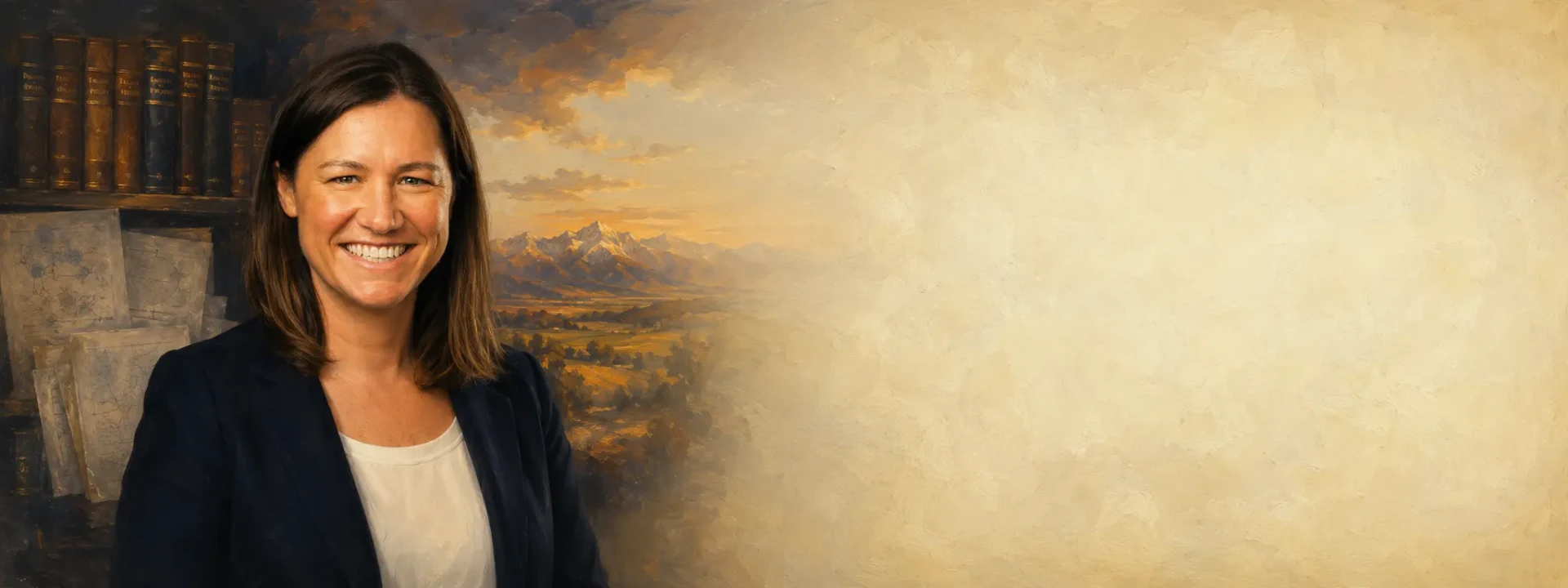
Aimee H. Wagstaff
Product Liability, Pesticide Exposure, and Multidistrict Litigation
It’s now up to juries across America to make the pattern stop.
A Trial Cut in Half
Judge Vince Chhabria did something unusual with Edwin Hardeman's case: he split it in two.
Phase one would be science and nothing else. The jury would hear no internal company documents, no corporate correspondence, no argument about what Monsanto knew or when. It would decide one question — whether Roundup was a substantial factor in causing Hardeman's non-Hodgkin lymphoma — and if the answer was no, the trial would end there and the rest would never be heard.
The order required Wagstaff to prove causation before the jury could see the company-conduct evidence. She was lead trial counsel, and it was the first case tried in the federal Roundup multidistrict litigation, where she also served as national co-lead. The result would shape thousands of cases behind it.
Twenty-Six Years of Weekends
Edwin Hardeman started using Roundup in the 1980s on his Sonoma County property — some fifty-six acres of it — spraying poison oak and weeds. He mixed it and sprayed it into 2012. In 2015 doctors diagnosed him with non-Hodgkin lymphoma.
The scientific evidence in the case was global — epidemiology, toxicology, the contested glyphosate classifications, dueling readings of the same studies. Wagstaff's phase-one work connected that literature to Hardeman: how much he used, how often, over how long, on what ground, and how many years passed between his first exposure and his diagnosis. Her team rebuilt a quarter-century of one property's weekends in enough detail that general science could be tested against a specific human being.
The jury found causation.
Everything Else
Phase two was the part Monsanto had wanted kept out.
Now the jury saw the internal communications, the company's response to research unfavorable to its position, its dealings with regulators and with the authors of scientific literature, and the absence of a cancer warning on the label.
In March 2019 the jury returned a unanimous verdict for Hardeman: $5,267,634.10 in compensatory damages and $75 million in punitive damages — $80,267,634.10 in all.
Judge Chhabria then cut the punitive award to $20 million, for an entered judgment of $25,267,634.10. He was explicit that the reduction was not a rebuke of the jury's findings. Monsanto deserved to be punished, he wrote, on the evidence that came in at trial; the company had been more concerned with tamping down safety inquiries and managing public opinion than with establishing that its product was safe. The problem was arithmetic and constitutional: the jury's punitive award was roughly fifteen times the compensatory award, and a ratio of that size exceeded what due process permits.
Monsanto appealed, arguing that federal pesticide law preempted Hardeman's California failure-to-warn claim outright — a ruling that would have foreclosed the theory nationwide. Wagstaff cross-appealed to restore the jury's original $75 million. In Hardeman v. Monsanto Co., 997 F.3d 941 (9th Cir. 2021), the Ninth Circuit affirmed the liability finding and the reduced judgment and rejected the preemption argument. The Supreme Court declined to disturb it.
The Colorado Trial Lawyers Association voted it Case of the Year.
To date it remains the only federal Roundup trial. In the years since, Monsanto has paid roughly fifteen billion dollars to resolve similar claims — including more than a billion dollars for Wagstaff's clients.
Four Women, One Courtroom
Several years before Hardeman, Wagstaff joined a trial team representing four women implanted with Boston Scientific's Obtryx pelvic-mesh sling. Their cases were tried together in federal court in West Virginia over roughly a month.
The product evidence was shared — the mesh material, the pore size, how it contracted and eroded, what physicians were told. What could not be shared was the operating table: each woman had her own surgeon, her own implantation, her own years afterward, and each had to be proved separately. A joint trial demands that a lawyer hold a common scientific case and four separate human ones in front of the same jury at the same time without either collapsing into the other.
The jury awarded a combined $18.5 million.
The Rooms Where Leadership Is Decided
In mass-tort litigation, the consequential appointments happen early and quietly. A judge names a plaintiffs' steering committee, and that committee directs discovery, chooses experts, negotiates settlements, and picks which cases go to trial first. Women were representing enormous numbers of injured clients and trying major product cases. They were not being named to those committees in anything like proportion.
Wagstaff founded Women En Mass in 2013 and held the first retreat in Aspen. It was built to do a specific thing: connect women who tried these cases to one another, so that co-counsel relationships, referrals, trial teams, and leadership applications could be assembled from a network that already knew each other's records.
In November 2015, Judge Kathryn Vratil appointed Wagstaff co-lead counsel of the federal power-morcellator litigation in the District of Kansas. Its plaintiffs' steering committee was the first in the history of major multidistrict litigation to be majority women.
By forty, she had been appointed to co-lead four national litigations.
Kansas
Wagstaff grew up on a working ranch in Kansas, riding horses and moving cattle. Her favorite childhood memory is of weekends in the center of the state, out of range of cell towers and television.
She studied marine science and communications, earned her law degree at the University of Denver, and began her career at a defense firm, where she learned how defendants build cases. In 2010 she became a founding partner of her own firm, now the Wagstaff Law Firm, and she has spent the years since on pesticide exposure, product liability, medical devices, and mass torts in federal and state courts. Most of her professional time now goes to litigation against Syngenta and Chevron over paraquat.
She lives in Boulder.