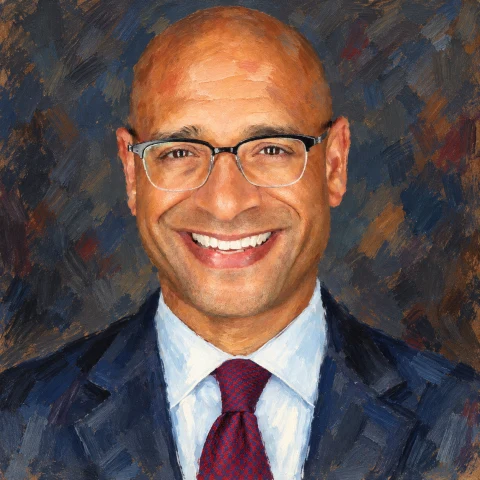
Antonio M. Romanucci
Civil Rights · Police Misconduct · Wrongful Death
The killing of George Floyd is a textbook example of inappropriate training, an officer who should not have been policing, and a department that ratified his behavior.
George Floyd’s $27 Million Settlement With Minneapolis and Renee Good’s Ku Klux Klan Act Suit Against Federal Officials
Antonio Romanucci helped George Floyd’s family sue Minneapolis under the 1871 civil-rights statute, and the city agreed to pay $27 million. In October 2026, for Renee Good’s family, his firm sued the United States, the ICE agent who shot her, and senior federal officials under the Tort Claims Act and another section of the same 1871 law.
“That’s fine dude. I’m not mad at you. I’m not mad at any of you.” Renee Good spoke those words, her family alleged, from behind the wheel of her car on Portland Avenue in Minneapolis on the morning of January 7, 2026. She was thirty-seven and a mother of three, and she had stopped in the middle of the street, honking to alert her neighbors, where masked federal immigration agents were working during Operation Metro Surge. Jonathan Ross, an agent of Immigration and Customs Enforcement, had gotten out of a Tahoe recording her on his phone and circled her car. Two other agents ordered her out, and one tried to open her door. She turned her wheels away from Ross and eased forward. Ross fired once through the lower left corner of her windshield, then twice more through the open driver’s window as the car kept turning away from him. One of those bullets entered her left temple.
As the car crashed, the family alleged, Ross said, “fucking bitch.” No agent gave her aid. When a bystander offered to help, an agent told him, “No, back up, now!” The man said he was a physician. “I don’t care,” the agent answered. Becca Good, Renee’s partner, had been standing a few feet from the car. Renee Good reached Hennepin County Medical Center at 10:03 a.m. in cardiac arrest and was pronounced dead at 10:30.
Her family set out those allegations on October 1, 2026, in two complaints filed in the U.S. District Court for the District of Minnesota by Romanucci & Blandin, the Chicago firm of the trial lawyer Antonio Romanucci, and Kevin Riach, a Minneapolis lawyer. Brent Ganger, her brother, sued as trustee for her next of kin, and Becca Good sued in her own right. The first complaint, No. 0:26-cv-04230, names only the United States and seeks damages under the Federal Tort Claims Act for wrongful death and for battery, assault, false imprisonment, negligence, and emotional distress under Minnesota law. The second, No. 0:26-cv-04231, names Ross, Stephen Miller, Kristi Noem, Corey Lewandowski, Thomas Homan, Todd Lyons, Gregory Bovino, and ten unidentified federal agents, each individually, and asks for a jury. “These two civil complaints seek to remedy two distinct, but related wrongs,” Romanucci said. One was the “unconscionable and unconstitutional use of force by a federal agent.” The other, he said, lay with those “in the highest rungs of power” who authorized armed, masked men to terrorize Minnesotans.
The second complaint invokes the Ku Klux Klan Act of 1871, which Congress passed, the family alleged, to reach “the acts of individuals who ride the public roads with their faces covered.” Its conspiracy provision, now 42 U.S.C. § 1985, draws on the second section of the act of April 20, 1871. The first section of the same act is now 42 U.S.C. § 1983, and Romanucci had used it in Minneapolis before. George Floyd died there on May 25, 2020, near 38th Street and Chicago Avenue, held face down by Minneapolis police officers while Derek Chauvin knelt on his neck, less than six years before Good was shot. For Floyd’s family, Romanucci and his co-counsel sued the City of Minneapolis and four of its former officers under § 1983, and less than eight months later the city agreed to pay $27 million.
Section 1983 does not allow the same kind of suit against a federal immigration agent such as Ross. In the nine months between the shooting and the filings, Romanucci investigated Good’s death for her family, waited out six months of federal silence on her claims, and asked Congress to add four words to the 1871 statute.
Sixty Relatives in a Hotel Conference Room
Romanucci met Floyd’s family less than two weeks after the killing, just after the memorial service, in a hotel conference room with about sixty relatives. Ben Crump, already the family’s lawyer, introduced him. “They knew Ben Crump, but they didn’t know me. I was an unfamiliar face. I had to ingratiate myself and have them trust me pretty quick,” Romanucci later said.
Once the firm was retained, he told his ten-lawyer team, “Throw out the playbook.” The team, he said, was ready to try the case within five weeks. It retained more than ten experts, ran focus groups and mock trials, and built presentations for settlement talks with city officials. “Every single base was covered,” Romanucci said. “We were aggressive in our retention and finding the best police practice experts.”
Policy 5-311, David Smith, and the Case Against the City
Kaarin Nelson Schaffer, as trustee for Floyd’s next of kin, filed the complaint on July 15, 2020, in the U.S. District Court for the District of Minnesota against Derek Chauvin, Tou Thao, Thomas Lane, J. Alexander Kueng, and the City of Minneapolis. Romanucci and two lawyers from his firm, Bhavani Raveendran and Nicolette Ward, appeared on the complaint pending admission pro hac vice, alongside Ben Crump, Chris Stewart, and lawyers from four other firms, two of them in Minneapolis. The complaint sought money damages under 42 U.S.C. § 1983 for a death at about 8:00 p.m. on May 25. Count I accused the four officers of using excessive force in violation of the Fourth Amendment. Counts II and III sought to hold the city itself liable.
The complaint set down what Floyd said beneath the officers: “Please, please- I can’t breathe! Please, man.” A bystander called out, “You got him down- let him breathe at least, man.” Floyd cried for his mother. His last words, the family alleged, were “Please- I can’t breathe.” When an onlooker asked the officers to check his pulse, Thao answered, “Don’t do drugs, guys.”
Romanucci’s statement that day began with a definition of liberty. “W.E.B. DuBois defined liberty, in part, as the ‘right to breathe.’ For decades, the Minneapolis Police Department’s practices have unlawfully stolen the basic liberties of Black citizens, leaving them afraid and unable to breathe,” he said. “The most recent example of this is the brutal, public, and unjustifiable killing of Mr. Floyd by police officers under the color of state law, which galvanized a nation to demand real change and achieve real justice.” He described the claim against the city as a claim about training. “Police encounters are based on learned behavior that violates individual constitutional rights, and the behavior is ratified by authoritarian failure to discipline police officer misconduct,” he said.
Against the city, the family had more to prove. Under Monell v. Department of Social Services, a city is liable under § 1983 when the execution of its own policy or custom inflicts the injury, and it cannot be held liable on a respondeat superior theory, for the bare fact that it employed the officer. Under City of Canton v. Harris, inadequate police training supports liability only where the failure to train amounts to deliberate indifference to the rights of the people police encounter. Department policy 9-111.01 provided that when any restraint technique is used, the subject “shall not be left in a prone position and shall be placed on their side as soon as they are secured.” The family alleged that Chauvin, Lane, and Kueng kept Floyd prone, with their body weight on him, for nearly nine minutes.
The family’s lawyers built the claims against the city from the department’s own training, policies, and data. They alleged that from at least April 15, 2012, until June 8, 2020, Policy 5-311 defined a neck restraint as “non-deadly force” and did not warn that it could cause death, while officers were taught that the technique worked by compressing the veins, arteries, nerves, and muscles of the neck. They alleged that training materials offered in 2014 to officers including Chauvin and Thao showed an officer placing a knee on the neck of an arrestee handcuffed in a prone position, and that the city’s own data recorded neck restraints on 428 people since 2012, about one a week, 14 percent of whom lost consciousness.
Floyd’s lawyers reached back to the death of David Smith. On September 9, 2010, they alleged, two Minneapolis officers responded to the Minneapolis YMCA, where Smith was experiencing the effects of mental illness. They subjected him to five Taser deployments, handcuffed his hands behind his back, and held him prone for at least four and a half minutes, one officer kneeling on his back. Smith never regained consciousness and died on September 17. Andrew Baker, the Hennepin County chief medical examiner, ruled the death a homicide and traced it to mechanical asphyxia. Minneapolis settled with Smith’s family in 2013 and agreed to train its sworn officers on positional asphyxia in the 2014 training cycle. Floyd’s lawyers alleged that the department continued internally to minimize that risk and to “promote a false narrative that deaths like David Smith were the result of ‘excited delirium.’” Lane, the family alleged, said, “I am worried about excited delirium, or whatever,” and later asked, “Want to roll him on his side?”
Chauvin, the family alleged, had been the subject of 17 citizen complaints from 2006 to 2015, and only one had led to discipline, a letter of reprimand. He was also Kueng’s field training officer, and the family alleged that city policy barred probationary officers from asking their field training officers questions or seeking their advice while under their supervision. Beyond damages, the family asked the court to appoint a receiver or similar authority to ensure that Minneapolis properly trained and supervised its officers.
Settled as Chauvin’s Jury Was Chosen
The family instructed its lawyers, Romanucci said, that it would not settle for less than a “ground-breaking” amount, one that would make other municipalities “take pause” before letting officers go untrained and kill people. On March 12, 2021, with jury selection under way in Chauvin’s murder trial at the Hennepin County Government Center, the Minneapolis City Council voted 13–0 to approve a $27 million settlement. The agreement set aside $500,000 for the community around 38th Street and Chicago Avenue, where Floyd died.
That day the family’s lawyers announced the agreement in Minneapolis with Mayor Jacob Frey, Council President Lisa Bender, and Council Vice President Andrea Jenkins. Romanucci told the room that “what you see here on this stage today doesn’t happen”: lawyers who fight each other in court were announcing a settlement together. He said the $500,000 would go to businesses around 38th and Chicago, with the family directing how it was used, and added, “we are challenging the corporations of this state and of this city to match those $500,000.” Philonise Floyd, George Floyd’s brother, spoke after the mayor. “Because if I could get him back, I would give all of this back,” he said.
“In the Floyd case, we didn’t take a deposition, we didn’t go to trial,” Romanucci said. He called the settlement “the optimal outcome” for the family and added, “I know for the lawyers it was a difficult mental game to discuss finality on a case where we felt so confident.” The family’s lawyers pointed to changes Minneapolis had made since Floyd’s death: comprehensive use-of-force reporting, body-worn cameras required to stay on at all times, a policy directing officers to de-escalate nonthreatening encounters by disengaging or walking away, and recruiting that favored officers who lived where they would police and had social-service experience.
Romanucci said at the announcement that the city had more to do. “Police in Minneapolis, they need to commit themselves to substantial improvements in culture and practices,” he said. He called for a panel to review whether each use of force was reasonable and necessary, a quality-assurance unit to see that reforms were followed, an early-intervention system that would use data to identify and remove officers with troubling patterns, and changes to union arbitration so that chiefs could make discipline stick. “But as we say in the courtroom, partial justice is no justice.” Chauvin was convicted of second-degree murder and sentenced to twenty-two and a half years. Romanucci and Crump later wrote a white paper, “A Model Approach to Comprehensive Police Reform,” and took it to bar groups, legal organizations, and law schools.
Misdemeanor Trials at 13th and Michigan
Romanucci started trying misdemeanor jury cases while still a student at John Marshall Law School in Chicago, and he stayed with the Cook County Public Defender’s office until 1987. Many of those trials, at the courthouse at 13th and Michigan, took place before Mary Jane Theis, then a judge there and later a justice of the Illinois Supreme Court. “She forced me to trial on many cases,” he said. “One of the greatest lessons that I learned from Justice Theis was to not be afraid.” He had come to John Marshall from the University of Wisconsin–Madison. As a student clerk in the defender’s office he worked in gun court and then in drug court, and the police reports he read there, he said, showed him marginalized people in Chicago being victimized. “It solidified for me one of my guiding principles,” he said.
He then spent three years in general trial practice with Richard F. Pellegrino, handling workers’ compensation, personal-injury, and criminal cases, and eight years with Donald J. Nolan, litigating personal-injury and workers’ compensation claims. He and Stephan Blandin, who had worked alongside him for a year, founded Romanucci & Blandin in Chicago; Blandin has said that each of them was planning his own firm and each thought first of the other. After Michael Brown was shot in Ferguson, Missouri, in 2014, Romanucci started the Police Misconduct Litigation Group, now part of the American Association for Justice, so that lawyers could handle misconduct cases together. He chaired it from 2014 to 2018, served as president of the Illinois Trial Lawyers Association in 2019–2020, and, after serving on the Illinois Supreme Court’s Rules Committee from 2012, chaired it in 2020.
A Sheriff’s Deputy in Sangamon County, the SCORPION Unit in Memphis
Sonya Massey, thirty-six, called 911 on July 6, 2024, to report a suspected prowler at her home near Springfield, Illinois. Sean Grayson, a Sangamon County sheriff’s deputy, responded and pointed out a pot of boiling water on her stove. Massey picked it up, saying twice that she rebuked him in the name of Jesus. Grayson ordered her to drop the pot, and as she ducked he fired three shots, one of which struck her beneath her left eye. Romanucci and Crump represented her family. On February 11, 2025, the Sangamon County Board unanimously approved a $10 million settlement to be paid by the county, and Romanucci said the money would go to Massey’s two children, with a court to decide the lawyers’ fees. He called the amount significant because of where it was paid: “we’re not in Minneapolis, we’re not in Memphis, we’re not in Louisville.”
In Memphis, Romanucci is among the lawyers for RowVaughn Wells, whose son, Tyre Nichols, died on January 10, 2023, three days after Memphis police officers beat him following a traffic stop. On April 19, 2023, in the U.S. District Court for the Western District of Tennessee, Wells sued the city, its police chief, the officers, and the emergency medical technicians who responded. Wells alleged that officers from SCORPION, a unit the department formed in November 2021 and deployed as four roving teams of about ten officers each, saw Nichols driving at about 8:20 p.m. on January 7, boxed in his car at a red light, pulled him out, and pepper-sprayed him, and that he ran; his parents’ home was about half a mile away. Officers caught up with him, she alleged, at Bear Creek Cove and Castlegate Road, about 100 yards from the house and directly beneath a SkyCop camera, and for about seven minutes five officers punched, kicked, and pepper-sprayed him and struck him with a baton while he shouted for his mother.
Wells pleaded four counts of municipal liability under Monell: official policy, a custom of tolerance, failure to train, and failure to supervise. Her lawyers listed earlier SCORPION encounters, including one on January 4, 2023, in which officers allegedly punched Monterrious Harris and threw him to the ground, and alleged that the unit was frequently sent out with no supervisor on the team. They alleged that the three EMTs failed to provide aid for 19 minutes, and that a Memphis police lieutenant went to the family’s home that night and told Wells that her son was under arrest for driving under the influence, although he had no evidence that Nichols had been driving impaired.
The federal government indicted the five officers on September 12, 2023, and the court stayed the civil claims against them while their criminal cases proceeded. In March 2026 Wells moved to drop the five from her lawsuit. Chief Judge Sheryl H. Lipman granted the motion on April 17, 2026, but kept discovery from them stayed until their criminal cases end and stayed the trial date, because the city needed discovery from them to defend against the Monell counts. The city’s ability to defend itself, she wrote, “rests, at least in part, on its ability to demonstrate that the Stayed Defendants were not acting consistent with a custom or practice of the Memphis Police Department.” The jury trial is now set to begin on May 17, 2027, and to last about twenty days.
A Federal Agent Outside Section 1983
Ross shot Good during Operation Metro Surge, a federal immigration operation in Minneapolis. Tricia McLaughlin, an assistant secretary of the Department of Homeland Security, said Good had used her vehicle to block in officers and had turned it into a weapon, and that the agent fired defensive shots. President Trump, Homeland Security Secretary Kristi Noem, and other officials said Ross had acted in self-defense and called Good a domestic terrorist. On January 29, Deputy Attorney General Todd Blanche said there was “currently no basis” for a criminal civil-rights investigation.
Becca Good, Renee’s parents, Tim and Donna Ganger, and her four siblings retained Romanucci’s firm, which opened its own investigation with Kevin Riach as Minneapolis co-counsel. “Be Good. That is the clear message from her family as Renee’s wish to the world,” Romanucci said on January 14. Back in Minneapolis that month, he said, he had a feeling of déjà vu. “Feeling the tension and the city being on edge, for me, it was bone-chilling,” he said. “And part of me was very sad, but I also knew that, okay, this fight ain’t over. We have to keep doing it.” He gave the new team the instruction he had given the Floyd team. “The same edict went out to this legal team,” he said. “We are going to be creative.”
He described Good as a mother, a daughter, a committed partner, an animal lover, and a parent active in the PTA, and said the family would “rule nothing out.” He disputed that she had turned her car into a weapon, pointing to the video, the car’s speed and direction, and what she had said to the officers.
On January 14, a week after the shooting, the firm sent a nine-page, single-spaced preservation demand to ICE, the Department of Homeland Security, Customs and Border Protection, the FBI, the Justice Department, the U.S. Attorney’s Office, and Ross, asking them to preserve Good’s car, Ross’s cell phone and statements, text messages between agents, and his employment and disciplinary records, and to respond within five days. Romanucci said the car had been taken from the scene on a flatbed truck. “Now, if they want to risk spoliation, let them,” he said. “But they’re on notice.” By early March no agency had confirmed receiving the demand. “We’ve not received anything back from them,” Sarah Raisch, one of the firm’s lawyers, said on March 6.
On January 27, Romanucci said he had seen no sign that the government was rethinking its handling of Good’s case. Alex Pretti, an intensive-care nurse, had since been shot and killed by federal immigration agents in Minneapolis. “Renee’s case was the breaking of the dam,” Romanucci said. “And now Alex’s case is the waterfall.” On January 30 the Justice Department said it would open a civil-rights investigation into Pretti’s death.
The firm also arranged an independent autopsy. “At the family’s request we conducted an independent autopsy of Renee’s body, so we better understand her injuries and her experience in those final moments,” Romanucci wrote in a February statement to members of Congress. The findings the firm released in January identified three gunshot wounds, to the left forearm, through the right breast, and into the left side of the head near the temple, exiting the other side, as well as a graze wound. Romanucci said the findings supported the family’s account that Good was shot while moving away from the agent who fired.
In January, Romanucci questioned what Ross had done before firing. “Even if that law enforcement officer was in front of the vehicle, did he place himself there?” he asked. “And if he did, that is considered officer-related jeopardy.” In Barnes v. Felix, decided unanimously in May 2025, the Supreme Court rejected the Fifth Circuit’s rule confining review of an officer’s use of force to the moment the officer perceived a threat: “A court deciding a use-of-force case cannot review the totality of the circumstances if it has put on chronological blinders.” The Court did not decide “whether or how an officer’s own ‘creation of a dangerous situation’ factors into the reasonableness analysis.”
The federal government had refused to share its evidence with state investigators, and in March the Hennepin County Attorney’s Office and two state agencies sued the administration for access to the evidence in Good’s and Pretti’s deaths. In May Romanucci said the family’s requests since January had gone unanswered. In late June, federal authorities began turning over body-camera footage, officer statements, and the Honda Pilot in which Good was killed to Minnesota investigators and prosecutors; Hennepin County Attorney Mary Moriarty and Attorney General Keith Ellison were weighing criminal charges. Romanucci called the transfer an “important and meaningful step towards justice and accountability.” As of October 1, no one had been charged in Good’s death.
Adding “or the United States” to Section 1983
Section 1983 applies to a person acting under color of a statute, ordinance, regulation, custom, or usage “of any State or Territory or the District of Columbia.” The Supreme Court recognized a separate damages claim against federal officers in the Bivens case, but in Egbert v. Boule, in 2022, it declined to extend that remedy to a Fourth Amendment excessive-force claim against a Border Patrol agent and directed courts to leave new damages remedies to Congress whenever there is any reason to think Congress might be better equipped to create one. Romanucci calls the Federal Tort Claims Act the only option. A claimant must first present the claim to the federal agency; if the agency does not decide it within six months, the claimant may treat the silence as a denial and sue.
On February 3, in Washington, Romanucci spoke at a forum on the use of force by Homeland Security agents convened by Senator Richard Blumenthal and Representative Robert Garcia. Two of Good’s brothers, Luke and Brent Ganger, had been added to the witness list the day before. Luke Ganger told the members of Congress about trying to explain his sister’s death to his four-year-old daughter, and Brent Ganger read the eulogy he had given for her. “The occupation by ICE and CBP in our cities is way beyond their mission,” Romanucci said.
“If the government must give you permission to seek accountability for violation of Constitutional rights, then your rights are just words on paper,” Romanucci wrote in a February 3, 2026, statement to members of Congress. “Rights are not rights without remedies.” He proposed amending § 1983 to add “or the United States” to the governments whose officers can be sued, and pointed to Illinois, which in December 2025 enacted HB 1312, allowing suits for constitutional violations committed during civil immigration enforcement.
On April 16 he testified before the House Judiciary Subcommittee on Oversight, in Room 2141 of the Rayburn House Office Building, at a hearing titled “The Human Toll of Sanctuary Policies: Stories from Victims and Families.” He was one of four witnesses; the other three were mothers. He read from the testimony Good’s brother had given in February. “All Americans should feel safe in their own cities,” he said. “And all American cities should be sanctuaries where citizens are free from harm by their own government.” In his statement to the subcommittee he objected that the Tort Claims Act provides only “a trial before a judge, not a jury of a person’s peers,” and asked Congress to amend § 1983 or the Act to guarantee the right to a jury trial.
Standard Form 95, Six Months of Silence, and a Jury Demand
By then the family’s administrative claims were pending. Brent Ganger presented his Standard Form 95 to ICE, Homeland Security, and Customs and Border Protection on March 11, and Becca Good presented hers on March 17, each by certified mail and email. Six months passed with no written decision, and under the statute the silence counted as a final denial. “We are here today because we have not heard from the government, either that they will accept the claim, or not,” Romanucci said in Minneapolis on October 1. Good’s parents and her brothers Luke and Brent attended the news conference, and Becca Good spoke in public for the first time since the shooting. “I’m here today because last January, the whole world had to watch as our entire universe was destroyed,” she said. Brent Ganger said, “I deeply regret that it took the death of Renee to wake me up to the fact that no one in this country is untouchable.”
The complaint against Ross and the officials pleads a conspiracy under §§ 1985(3) and 1986, a Fourth Amendment excessive-force claim against Ross under Bivens, and Minnesota claims for emotional distress. It alleges that Ross’s shots were “the predictable and intended product of the operation,” and it points to a Minnesota statute, § 609.735, that forbids concealing one’s identity in a public place “by means of a robe, mask, or other disguise,” with no exception, the family alleged, for law enforcement. “Our government is killing our citizens without any legal justification,” Romanucci said. Benjamin Berkman, one of the family’s lawyers at his firm, said of the conspiracy claim, “It reaches the agent who fired those shots at Renee and it reaches every official who put him on the street that day.” Lauren Bis, a White House spokesperson, said the administration intends “to vigorously defend these baseless civil lawsuits.”
Floyd’s family sued Minneapolis in a federal court where a jury would have decided its claims, and Wells’s claims against Memphis are set for a jury trial in May 2027. Under current law, a Tort Claims Act suit by Good’s family against the United States “shall be tried by the court without a jury.” The family filed that suit on October 1 and asked for a bench trial. In the complaint against Ross and the officials, filed the same morning under another section of the 1871 act, they asked for a jury.