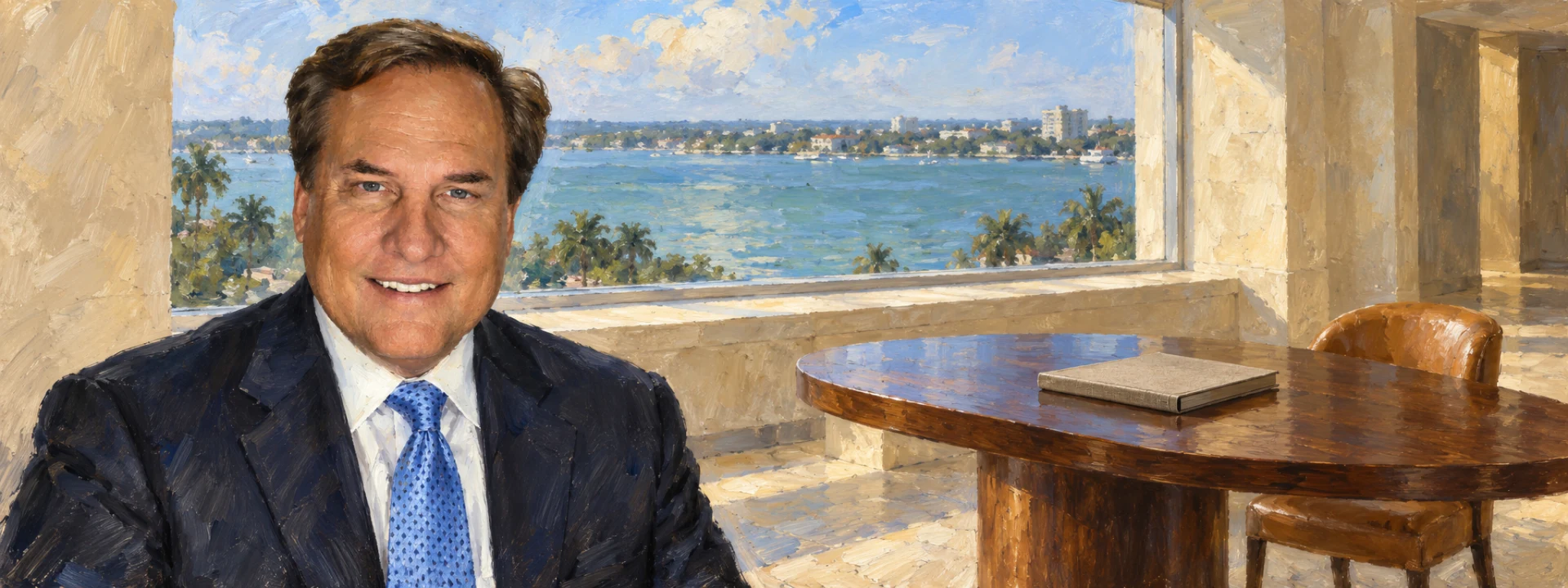
William F. “Chip” Merlin Jr.
Property Insurance · Policyholder Recovery
There was no one on the policyholder side doing this on a regular basis.
Leaving the Insurer Side
Catastrophe property insurance and policyholder recovery — Founder and President, Merlin Law Group, Tampa.
Chip Merlin began his career at a law firm that did only property-insurance defense. The work gave him repeated exposure to claims, policies and carrier strategy, but he later said it also showed him an imbalance: insurance companies had lawyers doing this work every day, while he saw no comparable specialist regularly representing policyholders. “Switching over made sense to me,” he recalled.
In 1985 he opened his own Tampa practice on the policyholder side. His reason was the asymmetry he had seen firsthand: carriers had specialists with daily claim experience, while homeowners and business owners often encountered policy conditions, proof requirements and engineering disputes only after a loss. Merlin Law Group has represented policyholders since, and its current practice is devoted to first-party property claims and bad-faith disputes for homeowners, businesses and public entities.
Andrew, Katrina and Sandy
Merlin represented Hurricane Andrew policyholders after the 1992 storm, and his last Andrew settlement did not resolve until 2000. After Hurricane Katrina in 2005, his firm resolved 103 State Farm claims in a coordinated settlement and later settled twenty-two more. Documents and testimony developed in the earlier cases informed later negotiations, while each policyholder still had a separate property, contents and coverage record.
Katrina also took Merlin physically closer to the claims. In 2006, decades after law school, he sat for the Mississippi bar examination and later recalled being the oldest applicant in the room. His firm opened offices in Bay St. Louis and Gulfport. He also represented the Port of New Orleans in a $150 million insurance claim over Katrina damage to commercial infrastructure.
When Superstorm Sandy struck in 2012, Merlin represented twenty-three municipalities and hundreds of individual policyholders. The work again joined common questions—storm conditions, engineering, policy language and carrier practices—with the proof unique to each building or owner.
What Has to Be Preserved
Merlin's firm often enters a catastrophe zone before a coverage lawsuit exists. Emergency demolition, tarping, gutting and cleanup can change the physical evidence quickly. Photographs, damaged materials, contents records and engineering observations taken early may later help establish what caused the loss and what repairs were necessary.
The policy creates a second record. Property disputes can turn on causation, anti-concurrent-cause clauses, replacement-cost conditions, code-upgrade coverage, matching, appraisal provisions, proof-of-loss deadlines and the line between wind and flood. Policyholders also have duties after a loss, and meeting those requirements can determine whether an otherwise covered claim is paid.
When the dispute concerns claim handling rather than only the amount of covered damage, the firm also brings bad-faith cases. In 2023, a Merlin Law Group trial team obtained a verdict of about $1.4 million in a case centered on delay and the withholding of an engineering report. Merlin wrote afterward that taking such cases to trial develops the experience needed to challenge wrongful claim practices.
Teaching the Claims Process
Merlin has turned much of that specialist knowledge outward. His Property Insurance Coverage Law Blog tracks coverage decisions, claim practices and catastrophe response for policyholders, public adjusters and lawyers. In 2020, he published “Pay Up!,” subtitled Preventing A Disaster With Your Own Insurance Company, a 192-page guide for policyholders dealing with claims.
He serves on the board of United Policyholders and is a past chair of the American Association for Justice's Insurance Bad Faith Litigation Group. The Florida Association of Public Adjusters gave him its Lifetime Achievement Award, and he has explained policyholder rights in cable-news appearances after major storms. He also teaches at seminars and trains public adjusters, explaining policy requirements and the claim practices that owners encounter after a loss. The work addresses the same imbalance that led him to change sides early in his career: the repeat player already knows the process, while the policyholder usually has to learn it in the middle of a disaster.
Merlin graduated from the University of Florida College of Law in 1982. Outside the practice, he has run twenty-six marathons, including eight Boston Marathons.