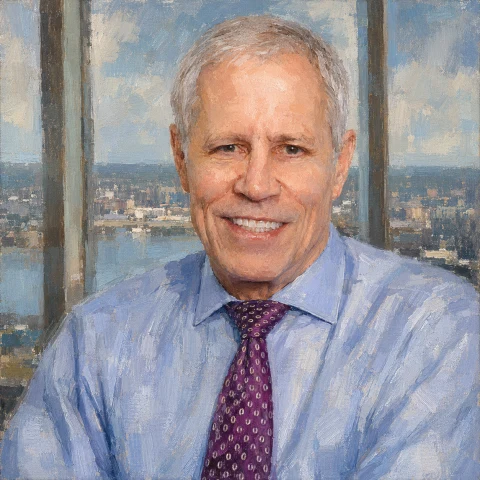
Dan Feinberg
ERISA Fiduciary Litigation · ESOPs · Benefit Claims
There are bubbles, and people and valuations get out of hand. The problem is when you involve in these a pension plan — which is supposed to be governed by a great deal of prudence, care and caution.
Abatie’s Ninth Circuit Conflict Rule and the $84 Million Wells Fargo ESOP Settlement
Dan Feinberg represented Karla Abatie when the en banc Ninth Circuit overruled its test for benefit denials by insurers that pay their own claims. His ESOP class actions over Tribune’s buyout and Wells Fargo’s use of plan dividends ended in settlements of $32 million and $84 million.
Among the papers the Santa Barbara Medical Foundation Clinic produced in discovery was an internal entry for Dr. Joseph Abatie: “[p]remiums waiver requested in January, 1994. Should be receiving confirmation any day.” A handwritten note next to that entry read: “waiver was granted 2/94.” Dr. Abatie, a radiologist, had worked for the Clinic since 1971. In November 1992, after developing non-Hodgkin’s lymphoma, he took a medical leave of absence. He received disability benefits, never returned to work, and died in June 2000.
Alta Health & Life Insurance Company was both the administrator and the funding source of the Clinic’s life insurance plan. Coverage ended when employment ended unless an employee who became totally disabled obtained a waiver of premium. “If the premium waiver applies,” Judge Andrew J. Kleinfeld of the Ninth Circuit later wrote, “then Dr. Abatie’s widow is entitled to $331,500 in life insurance under the group policy.”
Two Reasons for One Denial
After Dr. Abatie’s death, the Clinic wrote to Alta asking it to pay the benefit. The Clinic’s insurance broker acknowledged in a letter that “due to administrative error, the waiver of premium application was not filed.” Alta’s files contained no documentation showing that he had applied, and he was not on the roster of employees granted waivers that Alta had acquired from its predecessor, Home Life.
In March 2001 Alta denied the claim because, it said, no waiver application had been submitted. On reconsideration it kept that ground and, in the en banc court’s words, “stated for the first time that it was denying coverage because there was insufficient evidence in the record that Dr. Abatie had remained totally disabled from the time he left work until his death,” pointing to a partial remission from September 1998 to April 2000. The district court upheld the denial without deciding whether a waiver had in fact been requested, and it declined to consider a declaration from Dr. Abatie’s physician about his continuous disability.
Karla H. Abatie appealed, and circuit precedent stood in her way. Since 1995 the Ninth Circuit had applied the rule of Atwood v. Newmont Gold Co. to benefit denials by an administrator that also pays the benefits: a participant challenging such a denial had to present “material, probative evidence, beyond the mere fact of the apparent conflict, tending to show that the fiduciary’s self-interest caused a breach of the administrator’s fiduciary obligations to the beneficiary.” Alta also had the plan’s grant of discretion, and under Atwood, Karla Abatie needed evidence tending to show that Alta’s self-interest had caused the denial before a court would give the decision less deference. The first lawyer listed for her was Daniel Feinberg of Lewis, Feinberg, Renaker & Jackson in Oakland, with his colleague Cassie Springer-Sullivan and Craig Price of Griffith & Thornburgh in Santa Barbara. Feinberg argued that the conflict had tainted Alta’s review and called for stricter scrutiny.
Fifteen Judges Overrule Atwood
The Ninth Circuit agreed to rehear the appeal en banc, and fifteen judges heard argument in San Francisco on March 23, 2006. On August 15, 2006, the en banc court overruled the test the circuit had applied since 1995 to benefit denials by an administrator that also pays the benefits. The opinion began with the reason for the rehearing: “We took this case en banc to reconsider our approach to ERISA cases in which a plan administrator denies benefits” under a plan that gives it discretion while it operates under a conflict of interest. The court held that “abuse of discretion review, tempered by skepticism commensurate with the plan administrator’s conflict of interest,” governs such a denial.
Judge Susan P. Graber wrote for the court. An insurer that administers a plan must see that those who deserve benefits receive them, she wrote, but it also “has an incentive to pay as little in benefits as possible to plan participants because the less money the insurer pays out, the more money it retains in its own coffers.” The court overruled Atwood “in its entirety.” Where a plan grants the administrator discretion, review remains for abuse of discretion, but the conflict is weighed as a factor, and its weight depends on the record. A court’s skepticism may be low when the conflict comes without “any evidence of malice, of self-dealing, or of a parsimonious claims-granting history,” and a court may weigh it more heavily if the administrator gives inconsistent reasons for denial, fails to investigate a claim adequately or to ask the claimant for necessary evidence, fails to credit a claimant’s reliable evidence, or “has repeatedly denied benefits to deserving participants by interpreting plan terms incorrectly or by making decisions against the weight of evidence in the record.” A district court “may, in its discretion, consider evidence outside the administrative record to decide the nature, extent, and effect on the decision-making process of any conflict of interest.”
The en banc court dropped Atwood’s demand for proof of causation and required the conflict to be weighed whenever a conflicted administrator exercises discretion. It also held that an administrator that adds a new reason for denial in its final decision, leaving the claimant no chance to respond at the administrative level, commits a procedural violation that must be weighed as well. “A procedural irregularity, like a conflict of interest, is a matter to be weighed in deciding whether an administrator’s decision was an abuse of discretion,” Judge Graber wrote. When an administrator “engages in wholesale and flagrant violations of the procedural requirements of ERISA, and thus acts in utter disregard of the underlying purpose of the plan as well,” the court reviews the denial de novo.
The district court had also erred, the en banc court held, in refusing to consider the physician’s evidence “if the court does not first find that Plaintiff’s claim is doomed by a failure to request a waiver of premiums.” The court reversed and remanded, directing the district court to decide whether a waiver application had been submitted and to apply the new standard. Karla Abatie later settled her claim with Alta.
Lawyers who advise plan administrators responded within weeks. On September 18, 2006, Holland & Hart published an alert for plan administrators and insurers titled “New Ninth Circuit Decision May Make It Easier For Participants To Challenge ERISA Benefit Denials.” It told them to make their reasons for denial complete and consistent with what they had told claimants before, and it warned: “Administrators should expect standard discovery requests seeking information beyond the administrative record.”
A Brief for Wanda Glenn
The same conflict reached the Supreme Court through Wanda Glenn, a Sears employee who had been diagnosed with severe dilated cardiomyopathy, a heart condition. MetLife was “both an administrator and the insurer of Sears, Roebuck & Company’s long-term disability insurance plan.” It paid her an initial 24 months of benefits and then refused to continue them, finding her “capable of performing full time sedentary work.” An administrative law judge of the Social Security Administration found that her illness kept her from doing her own job or other work, and the agency awarded her benefits retroactively; MetLife received most of the backdated payments. The Sixth Circuit set aside MetLife’s denial, and on January 18, 2008, the Supreme Court granted MetLife’s petition for certiorari.
On March 31, 2008, Feinberg and Cassie Springer-Sullivan, with Patricia A. Shiu of the Legal Aid Society–Employment Law Center, filed a brief for the Center urging the Court to affirm. The Center, a San Francisco nonprofit, told the Court that employee benefits matter most to low-wage workers, who have no resources of their own to pay for medical care or living expenses during a disability. The brief held up Abatie as the strongest of the circuits’ approaches. “The Ninth Circuit’s approach is an improvement upon the sliding scale test,” it said, because Abatie gave courts concrete kinds of evidence to weigh. Then it asked the Court to go further. “Nevertheless, the Abatie court’s holding falls short of the trust law standard for a conflicted fiduciary,” the brief said, and it urged the Court to adopt the rule of the Restatement (Third) of Trusts for a dual-role administrator, under which “the conduct of the trustee in the administration of the trust will be subject to especially careful scrutiny.”
On June 19, 2008, in Metropolitan Life Insurance Co. v. Glenn, the Supreme Court affirmed the Sixth Circuit’s decision for Glenn. Justice Stephen Breyer wrote that the entity that administers a plan often “both determines whether an employee is eligible for benefits and pays benefits out of its own pocket.” The Court held that when an administrator both decides claims and pays them, “a reviewing court should consider that conflict as a factor in determining whether the plan administrator has abused its discretion in denying benefits,” and that “the significance of the factor will depend upon the circumstances of the particular case.”
PG&E’s Redacted Email
Ruben Sizemore began working at a PG&E power plant in early January 1983 as a contract employee. In 1993 the Engineers and Scientists of California union filed a grievance with PG&E contending that long-term contract workers were actually employees, and a letter agreement reclassified Sizemore as an employee as of May 15, 1989. In June 2010 he filed a claim with the Employee Benefit Committee of PG&E’s retirement plan for pension credit for the years from 1983 to 1989, contending that he had been a common-law employee throughout. The committee denied the claim, and his appeals were denied, the last in November 2011.
Feinberg took the case to federal court in the Northern District of California. The plan and its committee moved for partial summary judgment, arguing that the plan gave its administrators discretion and that their decision deserved deference. Judge William Alsup denied the motion on June 25, 2013. Citing Abatie, he wrote that an administrator’s decision “is entitled to deference only when the administrator exercises discretion that the plan grants as a matter of contract.” He also found the conflict Abatie had addressed: “the same entity that funds an ERISA benefits plan also evaluates claims, as is the case here.”
The plan had redacted portions of two documents in the administrative record. Judge Alsup applied the fiduciary exception to the attorney-client privilege, under which an ERISA fiduciary is “disabled from asserting the attorney-client privilege against plan beneficiaries on matters of plan administration,” and ordered both documents produced unredacted by June 28 at noon. One redacted passage had been written by a PG&E in-house lawyer evaluating Sizemore’s claim: “I am a little troubled by the fact that [plaintiff] is being represented by the Lewis Feinberg firm . . . and that if we lose this in court, there is the possibility that they will be trying to bring claims like this on behalf of other former contract workers.” Feinberg’s firm was then Lewis, Feinberg, Lee, Renaker & Jackson. The document, Judge Alsup wrote, “raises the potential inference that defendants did not exercise their contractual authority in evaluating plaintiff’s claim,” and that their sole concern was avoiding claims and lawsuits by similarly situated employees.
He allowed discovery into five subjects: the defendants’ conflict of interest, the claim review process, the adequacy of the investigation of Sizemore’s claim, the defendants’ potential financial exposure if they accepted his arguments, and a set of resolutions dated June 21, 2006. Abatie had held that a district court may consider evidence outside the administrative record to decide the nature and effect of a conflict, and the discovery Judge Alsup allowed was evidence of that kind. The case later settled on confidential terms.
From the Lewis Feinberg Firm to Feinberg Jackson
Feinberg graduated from Swarthmore College in 1983 and from the law school of the University of California, Berkeley, in 1988, the year he was admitted to the California bar. He worked on Abatie, the Glenn brief, the Tribune case and Sizemore as a lawyer at the Lewis Feinberg firm in Oakland, where he was a shareholder, and since 2015 he has been a partner at Feinberg Jackson Worthman & Wasow in Berkeley. He serves on the board of Legal Aid at Work, the name the Legal Aid Society–Employment Law Center took in January 2016. He has served as an expert witness and as a mediator in ERISA litigation, and the federal court in the Middle District of Florida appointed him special master for settlement purposes in a multi-party ERISA fiduciary class action, which settled after a mediation session he conducted. As a volunteer panel attorney for the AIDS Legal Referral Panel, he took an ERISA claim for one of its clients that ended in a confidential settlement the panel announced in March 2015.
In the Tribune and Wells Fargo cases the employer sat on both sides of the plan’s stock purchases, and the plan’s fiduciary was the same company, GreatBanc Trust.
Tribune’s ESOP and the Eliminated 401(k) Match
Tribune Company, as Judge Rebecca R. Pallmeyer of the Northern District of Illinois described it, “was a publicly traded company worth billions that owned, among other assets, 10 daily newspapers, 25 television stations, more than 50 websites, significant real estate holdings, and, most importantly to some readers, the Chicago Cubs.” In 2007 it went private in a transaction Samuel Zell proposed. On April 1, 2007, Tribune’s newly created employee stock ownership plan bought 8,928,571 newly issued shares at $28 a share. The ESOP paid with a promissory note for $250 million, carrying interest at 5.01 percent and due by April 1, 2037. Tribune would make cash contributions to the ESOP, and the ESOP would use them to pay Tribune back on the note. The employees alleged, and Judge Pallmeyer recounted, that those contributions “were made possible by Tribune’s elimination of matching contributions to the Company’s 401(k) Plan.”
Most of the rest of the transaction was financed with debt. Tribune repurchased 126 million public shares at $34 in a tender offer paid for with $4.284 billion of new borrowing. Zell’s company, EGI-TRB, bought shares at $34, and an Investor Rights Agreement required the ESOP to vote its shares for Zell and two directors of his choosing. On December 20, 2007, Tribune merged with the ESOP and borrowed about $4 billion more to retire the remaining public shares, leaving the ESOP as the sole shareholder of a company with $12.8 billion in total debt. Tribune filed for Chapter 11 in December 2008. By early 2011, Judge Pallmeyer wrote, “the stock is worthless.”
The named plaintiffs were current and former Los Angeles Times writers: Dan Neil, whose reviews of automobiles had won a Pulitzer Prize for Criticism, Corie Brown, Henry Weinstein, Walter Roche Jr., Myron Levin, and Julie Makinen. They sued in September 2008, three months before the bankruptcy, and Eric Bailey, a former Times reporter, later joined Neil as a class representative. Three firms represented them: Feinberg’s; Meites, Mulder, Mollica, & Glink; and Cotchett, Pitre & McCarthy.
The defendants moved to dismiss. They pointed out that the ESOP had paid $28 a share, below the market price, and relied on a letter from Duff & Phelps concluding that the terms were fair to the ESOP. In December 2009 Judge Pallmeyer allowed claims against GreatBanc Trust Company, the ESOP’s trustee, for imprudence and for prohibited transactions to proceed. The court, she wrote, was “reluctant to rely on opinion letters absent discovery regarding the analysis that supports the conclusions stated in them,” and she held that the Investor Rights Agreement could be a prohibited transaction because “[v]oting of shares held by the ESOP constitutes the ‘management’ or ‘use’ of plan assets.” In March 2010 Feinberg said the judge had “indicated she is leaning our way.” “Business goes in cycles,” he said. “There are bubbles, and people and valuations get out of hand.” The trouble came, he said, when a pension plan was drawn in, a plan “supposed to be governed by a great deal of prudence, care and caution.”
Unregistered Shares and the Readily Tradable Rule
The employees then moved for partial summary judgment against GreatBanc on a narrower claim. They argued that the purchase was a prohibited transaction because the shares were not qualifying employer securities; through a chain of cross-references from ERISA into the Internal Revenue Code, that term requires common stock that is “readily tradable on an established securities market.” The ESOP’s shares were unregistered and could be transferred “only pursuant to a public offering registered under the Securities Act of 1933, under Rule 144 or 144A of the Securities and Exchange Commission, or some other, unspecified, legally available means of transfer.” At the time, over 240 million Tribune shares were available for public trading on the New York Stock Exchange.
GreatBanc answered that ERISA’s own definition of stock controlled and the Tax Code’s did not; that the shares became tradable once they were allocated to participants in 2008; that other ESOPs had accepted unregistered securities, for which it offered twelve examples; that legal opinions supported the transaction; that compliance should be judged over the life of the plan rather than on the day of purchase; and that it needed more discovery and expert testimony.
Judge Pallmeyer granted the motion on November 9, 2010. The statute speaks in the present tense, requiring stock that “is readily tradable,” so the test applied when the ESOP bought the shares. “The fact that GreatBanc may not be the only ESOP to have failed to comply with statutory requirements does not change the court’s analysis, however,” she wrote. The K&L Gates opinion letter GreatBanc cited expressly disclaimed any opinion on whether the shares were employer securities under the Tax Code, and because ERISA’s prohibited-transaction rules are per se, a fiduciary that knew the facts of the transaction could not escape liability by showing that it had not intended to violate the statute. Judging compliance over the plan’s whole life, she added, “would allow a trustee to engage in massive self-dealing for one day so long as the ESOP held a sufficient amount of qualifying employer securities for every other day of the ESOP’s life.” In the April 2007 purchase, “the ESOP did not acquire any qualifying employer securities.”
GreatBanc then moved to limit its exposure. Because the ESOP had paid with a note, it argued, the most it could owe was “the $2.8 million cash principal payment made on that note in 2008, or, alternatively, the principal and interest paid at that time, a total of $15.3 million in cash.” On February 28, 2011, Judge Pallmeyer denied the motion. She compared the ESOP to a home buyer who borrows the purchase price from the seller: “No one would seriously contend that the buyer did not purchase the home for $200,000, even if he borrowed the money for the transaction.” She recognized three measures of the plan’s loss supported by trust law and ERISA and left the amount for trial.
A Class Composed in Substantial Part of Journalists
GreatBanc opposed class certification by attacking the representatives. It argued that Neil and Bailey bore personal animosity toward Zell and that their interests diverged from those of participants who had received payments in the transaction. Its evidence of animus included an e-mail. In February 2010, on leaving the paper, Neil had written to the 550-person Los Angeles Times editorial staff about “the jackasses in Chicago who own us.”
Judge Pallmeyer certified the class on March 4, 2011. “This unprompted message does suggest animus on the part of Neil, but the court notes it came in the context of Zell’s own very public use of profanity,” she wrote; Zell had said “f— you” to an Orlando Sentinel photographer in an incident captured on video. If Neil and Bailey spoke with passion about the newspaper, “such passion can be expected from two dedicated longtime employees, and in the court’s view, their language is not more inflammatory or pointed than one might expect from members of a class composed in substantial part of professional journalists.” The class took in the participants in the Tribune ESOP who had received or were entitled to allocations since the 2007 transaction, and their beneficiaries: 11,000 participants, by the plaintiffs’ estimate from plan documents.
The same opinion appointed class counsel. Feinberg’s declaration, the judge noted, “details the work his firm has done to investigate Plaintiffs’ claims,” listed ERISA class actions and other cases in which he and his firm had participated, described his education and ERISA publications, and represented that counsel had “already incurred considerable expense in litigating the case . . . [and has] the means to pay for whatever additional expenses are necessary.” With no objection from the defendants, she appointed all three firms.
In October 2011 Judge Pallmeyer preliminarily approved a $32 million settlement, which Tribune and GreatBanc would pay together. The Labor Department had investigated the 2007 purchase, alleging that it was not made prudently or in the participants’ interest and that ERISA prohibited it, and it joined the settlement with Tribune, GreatBanc, their insurers and the employees. The bankruptcy court in Delaware approved the settlement that October, and the court in Chicago approved it on January 30, 2012. It paid the ESOP $32 million, deposited in an independently managed settlement account, and the payment was allocated to the class members’ 401(k) plan accounts. “I am pleased that participants’ hard earned retirement savings have been returned,” Secretary of Labor Hilda L. Solis said.
Preferred Dividends and Wells Fargo’s Match
Wells Fargo matches its employees’ 401(k) contributions “dollar-for-dollar up to 6% of employees’ eligible compensation” and makes discretionary profit-sharing contributions, and both are invested in Wells Fargo stock through the plan’s ESOP fund. Each year Wells Fargo lent the plan money, the plan used the loan to buy convertible Wells Fargo preferred stock, and the preferred shares were held in a reserve account as collateral. As the loan was paid down, preferred shares were released and converted into $1,000 of Wells Fargo common stock each, at the then-current market price, and the common stock was allocated to participants’ accounts to meet Wells Fargo’s matching and profit-sharing obligations.
The preferred shares paid dividends of their own. In 2018 Wells Fargo paid the ESOP $158,847,743.50 in preferred dividends, and all of them “were used by the ESOP in 2018 to make loan payments.” Each loan payment released more preferred stock, and the resulting common stock went toward the company’s match. Aryne Randall, Scott Kuhn, and Peter Morrissey, former Wells Fargo employees, contended that the dividends belonged to the plan and had been spent on Wells Fargo’s obligation. Their theory of loss ran this way: “[I]f Wells Fargo had not misappropriated the ESOP’s preferred stock dividends and used them to subsidize its employer matching contributions,” Wells Fargo “would have contributed additional shares of common stock to meet its employer matching contribution obligation, and the preferred dividends would have been used to make additional payments on the ESOP loans, converting more preferred stock to common stock for allocation to Plan participants.”
The Labor Department had investigated the plan’s preferred-stock purchases. On September 12, 2022, it announced that from 2013 through 2018 the plan had paid $1,033 to $1,090 a share for Wells Fargo preferred stock built to convert into $1,000 of common stock, and that Wells Fargo had used the dividends on those shares to repay the plan’s loans, reducing its own obligation to contribute. Without admitting or denying the Department’s allegations, Wells Fargo and GreatBanc agreed to restore more than $131.8 million to the plan, Wells Fargo agreed to pay a penalty of nearly $13.2 million, and GreatBanc agreed not to act as a fiduciary in a public company’s leveraged ESOP transaction unless the plan bought only publicly traded stock at no more than fair market value.
The case was filed in the District of Minnesota on September 26, 2022, and Feinberg was admitted to appear in it that week. He was counsel for Randall and Kuhn with lawyers from Nichols Kaster in Minneapolis, and Bailey & Glasser also represented the plaintiffs. The defendants were Wells Fargo; Timothy J. Sloan, its chief executive from October 2016 to March 2019 and the sole member of the ESOP Committee; and GreatBanc Trust Company, which Wells Fargo had appointed to act as a named fiduciary for the ESOP fund, the same trustee whose Tribune purchase Feinberg’s clients had challenged.
The defendants answered that the participants had received all the common stock the plan owed them and so lacked standing to sue. Using preferred dividends to repay ESOP loans, the defendants argued, was neither suspicious nor unlawful. In March 2023 Magistrate Judge Dulce J. Foster allowed jurisdictional discovery after reading plan language that described circumstances in which additional allocations of common stock were “mandatory—not theoretical.” On February 21, 2024, Judge Eric C. Tostrud denied the motion to dismiss. “Assuming Plaintiffs will prevail on their legal claims,” he wrote, “they would receive additional shares of Wells Fargo common stock,” and it made no difference to standing that those shares “might be a windfall stemming from Defendants’ allegedly unlawful conduct.” Whether the dividends had been used lawfully was a merits question. He held that the plaintiffs had plausibly alleged prohibited transactions, including the use of plan assets to offset Wells Fargo’s matching obligation, and had plausibly alleged that Wells Fargo acted as a fiduciary when it controlled how the preferred dividends were used. The facts supporting their loyalty claim, he wrote, also stated a claim under ERISA’s anti-inurement provision, which bars plan assets from inuring to the employer’s benefit.
On January 22, 2025, Judge Laura M. Provinzino certified, without opposition, a class of all participants in the Wells Fargo 401(k) Plan from September 27, 2016 to December 30, 2022 who held any part of their accounts in the ESOP fund. The plan’s fiduciaries, she wrote, “make decisions with respect to the entire Plan and its participants, not on a participant-by-participant basis.” She appointed Feinberg’s firm, Nichols Kaster, and Bailey & Glasser as class counsel. As class representatives, Randall, Kuhn and Morrissey reviewed the pleadings, answered four sets of written discovery, sat for depositions and prepared for mediation.
An $84 Million Fund for 425,851 Class Members
The parties then filed cross-motions for summary judgment. While those motions were pending they mediated before Robert Meyer of JAMS, agreed on principal terms on August 15, 2025, and signed a settlement agreement on November 4, 2025. Wells Fargo would deposit $84 million into a settlement fund by January 7, 2026, and the preliminary approval order entered on December 8, 2025, provided that “neither GreatBanc nor Sloan shall bear any responsibility for funding any part of the Qualified Settlement Fund.”
Judge Provinzino granted final approval on April 20, 2026, after measuring the settlement against the defense. The plaintiffs, she wrote, “candidly recognize that their theory of liability under ERISA is novel and that recent case law relating to plan forfeitures seems to undermine their theory that using plan assets to offset employer matching contributions violates ERISA’s commands.” Citing forfeiture decisions from 2024 and 2025, among them Hutchins v. HP Inc. and Naylor v. BAE Systems, Inc., she concluded that the plaintiffs “would have faced an uphill battle to distinguish the reasoning of the plan forfeitures cases from this case.” The damages were disputed too. The plaintiffs’ expert tentatively calculated losses of about $11 million to $480 million, and the defendants would likely have sought an offset for their $132 million settlement with the Department of Labor in 2022, which would have lowered the range to between $0 and $348 million. “So, even assuming Plaintiffs would be awarded the maximum amount they sought,” she wrote, “Plaintiffs have still recovered 17.5% of their potential damages in settling this case for $84 million.”
Notice went to 425,851 class members on January 23, 2026, and the court received no objections. One class member came to the final hearing; asked whether she wished to be heard, she declined. Each class member’s share is figured pro rata, “based on the total number of vested shares of Wells Fargo stock allocated to each class member during the class period for which the released common stock was used to fund a portion of Wells Fargo’s employer contributions.” Amounts under $10 owed to people who no longer have a plan account are not paid out; that money is redistributed in equal shares to other class members, and none of the fund returns to the defendants. Participants still in the plan receive their payments in their plan accounts; those who have left can take a check or a direct rollover to a tax-qualified retirement account. The settlement administrator issued the distribution on August 13, 2026, with February 9, 2027 set as the deadline for cashing checks.