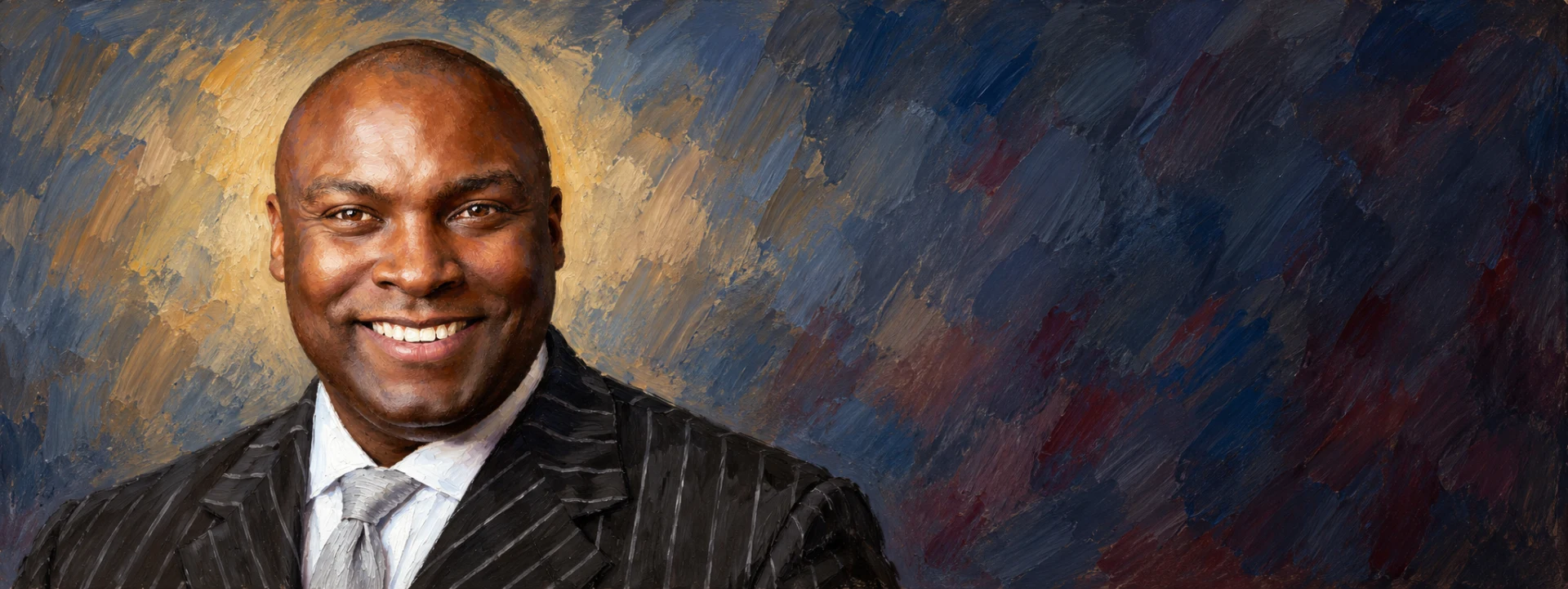
Daryl D. Parks
Civil Rights · Plaintiff Litigation
If Corey had his gun out, he never made any kind of offensive action.
The Call That Kept Recording
Daryl Parks began representing Corey Jones’s family before they had the full investigative file. He pressed for disclosure and challenged the suggestion that possessing a gun explained the shooting. A roadside-assistance call preserved the encounter’s opening and gave the family’s lawyers evidence beyond the surviving officer’s account.
Corey Jones’s vehicle failed on the southbound Interstate 95 offramp at PGA Boulevard after he had performed with his band. A friend and a Road Ranger tried to help. The vehicle would not start. Jones remained beside it because musical equipment was inside and a tow truck was still coming.
Around 3:15 in the morning on October 18, 2015, Jones was speaking with a roadside-assistance operator when an unmarked van approached. Nouman Raja, then a Palm Beach Gardens police officer assigned to an auto-burglary detail, was dressed in plain clothes. The assistance line stayed connected.
Raja did not audibly identify himself as an officer before the exchange escalated. The recording preserved him asking Jones whether he was good and then abruptly commanding him to raise his hands. It captured words, timing and gunshots while leaving the physical scene to be reconstructed through other evidence.
Jones had a concealed-weapons permit and a firearm in the vehicle. He did not fire it. Parks, representing the family with a broader legal team, emphasized the difference between lawful possession and aggression before investigators or courts had resolved the case.
An Account With a Timestamp
Parks’s early work occurred before the family possessed the full investigative file. He spoke publicly about what the medical and firearms evidence showed, pressed for disclosure and resisted the first official characterization of an officer suddenly confronted by an armed subject. He and the family’s lawyers sought an explanation that began with the arrival of the unmarked van.
The call center had preserved the audio independently of the police and the family. Its record of the opening exchange gave investigators and counsel a way to test Raja’s later account. Physical evidence supplied trajectories and distances; the recording established when words and shots could be heard. Together, those sources informed the family’s civil complaint.
Investigators found that the roadside call captured six shots in two volleys, separated by roughly ten to twelve seconds. Raja had described giving commands while on the phone with 911 during the encounter. His recorded 911 call began thirty-three seconds after the final shot. Those timestamps allowed the sequence to be reconstructed without relying on his recollection.
The State’s Criminal Case
The Palm Beach County State Attorney’s Office prosecuted Raja. A jury convicted him in 2019 of manslaughter by culpable negligence and attempted first-degree murder. The convictions applied distinct legal theories to the fatal encounter and its separated volleys of shots.
Raja received a twenty-five-year sentence. Florida’s Fourth District Court of Appeal affirmed in April 2021, rejecting his double-jeopardy, merger and single-homicide arguments. Manslaughter required a death; attempted first-degree murder required a premeditated design to kill. Each offense contained an element the other did not.
Parks and other family counsel pursued the civil case and public demands for accountability over years of litigation. State prosecutors selected the charges, presented the criminal trial and defended the convictions on appeal. Both proceedings drew on the work of investigators, experts and witnesses.
The City in the Civil Record
Clinton Jones Sr., personally and as representative of his son’s estate, sued Raja and the City of Palm Beach Gardens in federal court. The civil complaint asserted constitutional and state-law theories and challenged the city’s responsibility for placing a plainclothes officer into an encounter that became fatal.
The criminal judgment established Raja’s guilt on the counts submitted to the jury. A federal claim against the city required the family’s lawyers to connect the injury to an official policy, an established custom, a deliberately indifferent training failure or another legally attributable municipal decision.
Florida’s sovereign-immunity rules presented a separate question. The district court dismissed several common-law claims against the city because the alleged malicious or wanton conduct fell outside the state’s waiver of immunity. Such conduct could support Raja’s personal liability while foreclosing those claims against his employer. The claim alleging inadequate training, policies and supervision survived the city’s motion to dismiss.
The civil team pursued the city’s preparation of officers for the overnight detail. Two officers’ September 2022 depositions addressed instructions to stop and question people perceived as suspicious and the lack of formal training for that assignment. The family relied on that testimony to connect the city’s decisions to the encounter; the remaining claims required their own proof.
In February 2023, the family and Palm Beach Gardens reached a two-million-dollar settlement through mediation. The amount represented the city’s insurance-policy limit, and the agreement ended the civil case.
After the Civil Settlement
Raja continued to challenge his conviction and sentence. In June 2025, Florida’s Fourth District Court of Appeal affirmed the denial of his Rule 3.850 postconviction motion. Rehearing was denied the following month, leaving the state postconviction order intact. He filed a federal habeas petition in the Southern District of Florida in October 2025; a state response and reply briefing followed through January 2026.
Parks’s work for the family belonged to the separate civil proceeding that had ended in mediation. He practices with Parks Law in Tallahassee. A Haines City native, he earned degrees in economics and political science at Florida A&M University and his law degree at Florida State University. He later helped endow one of the first scholarships at FAMU’s reestablished law school.
At FAMU Law’s May 2024 hooding ceremony, Parks spoke about work that continued after verdicts. He recalled efforts to improve crib safety, change an ordinance to prevent drownings and end Florida’s juvenile boot camps with Governor Jeb Bush. Another effort concerned children left in hot daycare vans: he had pressed for head counts. His advice to the graduates followed those examples: “Make sure you are the lawyer in the room who makes right prevail.”