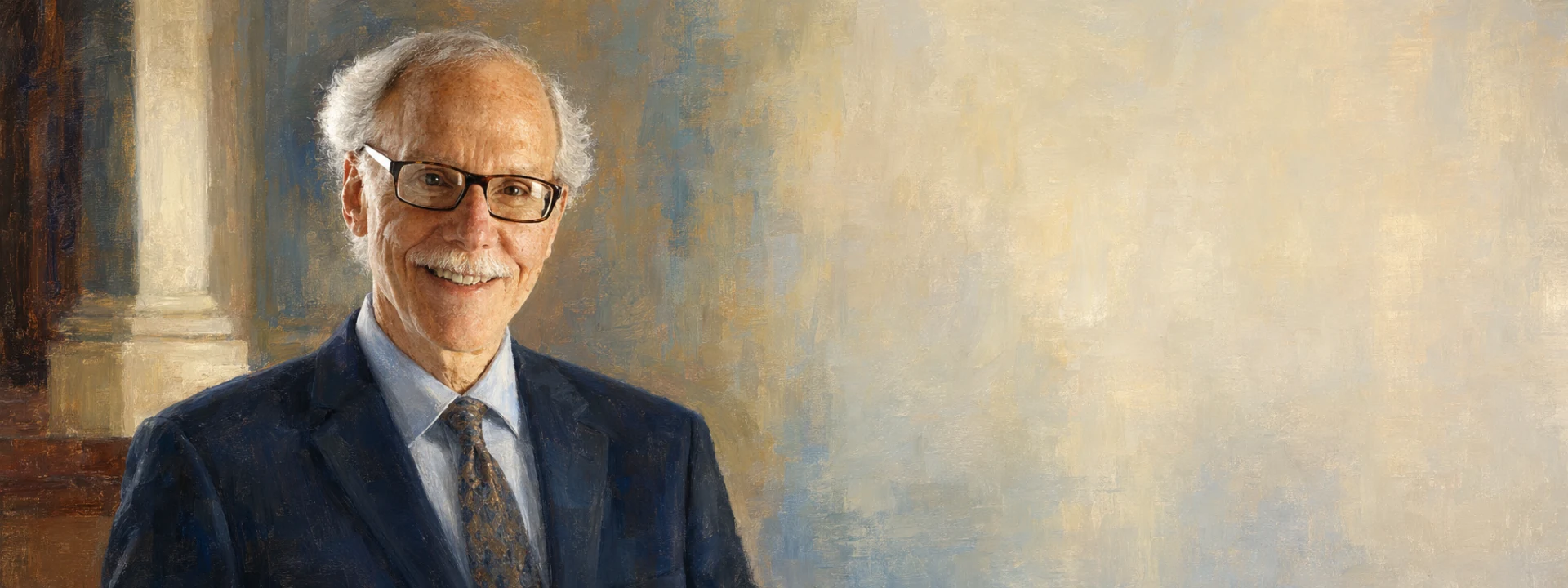
David Rudovsky
Police Misconduct, Wrongful Conviction, Stop-and-Frisk, and Constitutional Law
The police force has gotten used to being able to stop people for virtually no reason.
Five Decades, Two Systems Changed
David Rudovsky has litigated police-misconduct, wrongful-conviction, stop-and-frisk, and municipal-liability cases for more than fifty years. His work includes the Philadelphia stop-and-frisk consent decree and its continuing monitoring program, and a Third Circuit fabricated-evidence precedent — followed by a $12.5 million settlement — that now appears in the court's model civil-rights instructions.
Eight Men
In 2010, eight Black and Latino men challenged a Philadelphia practice they alleged subjected people to stops and searches without reasonable suspicion and, in their own encounters, on account of race or ethnicity.
The parties resolved Bailey v. City of Philadelphia in 2011 through a court-approved settlement and consent decree. The police department agreed to collect stop data electronically, to train and supervise officers, and to submit the results to review by plaintiffs' counsel and an independent monitor.
By requiring officers to record, in writing, the basis for stops and frisks, the decree created documents that could be audited over time and made constitutional compliance measurable across districts, shifts, supervisors, and years.
What a Stop Form Records
The monitoring program used officer stop forms recording location, time, race, the stated reasons for a stop or frisk, and any recovered contraband, then evaluated Fourth Amendment compliance across districts, shifts, supervisors, and years.
An individual suppression motion asks whether one stop was lawful. Aggregated forms can show whether a department, in the ordinary course, is conducting stops it can justify and whether failures cluster in particular districts, on particular shifts, or under particular supervisors.
Data from the second half of 2016 showed officers documenting reasonable suspicion for seventy-five percent of stops and fifty-nine percent of frisks. By 2019, those figures had reached eighty-four percent and sixty-two percent. The city's own statistical expert agreed that the persistent racial disparities reflected bias, and the court approved two additional remedial measures.
3,245 Stops
For 3,245 stops during the third quarter of 2022 and the first half of 2023, officers documented reasonable suspicion for 87.2 percent of stops and 76.7 percent of frisks. Minority residents accounted for 82.4 percent of stops and 87.6 percent of frisks.
The 2023 review therefore recorded two things at once: substantial improvement, and a continuing defect. Nearly one in four frisks remained unsupported or followed an unlawful stop.
PedStat supplied supervisors with officer- and district-level data, and a warning-first program for specified low-level offenses reached all twenty-three police districts in May 2023. Those court-approved measures contributed to higher compliance, and judicial monitoring continued in 2024.
Documented stop compliance rose from seventy-five percent to eighty-seven percent across seven years while remaining short of the governing standard. The decree recorded both the improvement and the remaining shortfall in the city's own stop forms.
Twelve Hours in Plainfield
Byron Halsey was twenty-four years old, had a sixth-grade education, and was visibly limited when investigators questioned him about the 1985 murders of two children in Plainfield, New Jersey.
He spent more than twelve hours at the station before an examiner found him too sleep-deprived to be given a polygraph. The test administered the next morning was reported as deceptive, though a later expert analysis scored it as strongly truthful. More questioning followed.
Then he signed a statement.
Four Nails, and Then Five
The statement attributed to Halsey contained nonpublic details. It also repeated what investigators believed before later testing corrected them.
It described four nails driven into one child's head. A later x-ray found five.
It omitted another assault that only later testing revealed.
Those mismatches became part of Halsey's fabrication theory. The statement tracked investigators' then-current understanding of the crime, including details later shown to be wrong and omissions corresponding to facts they had not yet discovered. The pattern supported his allegation that investigators had supplied the statement's contents.
A prosecutor testified that the statement was critical: without it, no physical evidence and no eyewitness tied Halsey to the crimes. He was convicted and received two life terms plus twenty years.
Nineteen Years, and a DNA Test
DNA testing in 2006 excluded Halsey and connected the crime-scene evidence to another person. Prosecutors moved to vacate his convictions and dismiss the indictment.
The confession attributed to him had tracked several investigators' then-current beliefs but conflicted with significant facts established by later testing. The prosecutor acknowledged that it had been critical to the charging decision; without it, no direct evidence linked Halsey to the crimes.
Fabricated Evidence Is a Due Process Violation
Rudovsky represented Halsey in civil litigation addressing whether investigators had manufactured the confession used in the prosecution.
In 2014, the United States Court of Appeals for the Third Circuit reinstated Halsey's fabricated-evidence and malicious-prosecution claims. It held that an officer who fabricates evidence to obtain a conviction violates due process — and, critically, that a prosecutor's intervening charging decision does not necessarily break the causal chain when officers supplied the false material.
The court also rejected the argument that a prosecutor's charging decision necessarily severed the officers from what followed when the allegedly false material supplied the basis for that decision.
The court also held that a rational jury could find that investigators had coerced Halsey into signing the confession, making summary judgment on that claim improper.
Halsey's claims later settled for $12.5 million.
The Model Instruction
The published Third Circuit decision remains precedent, and it appears in the court's March 2026 model civil-rights instructions, which recognize a stand-alone Fourteenth Amendment claim where fabricated evidence causes a prosecution or conviction.
The model instruction places the doctrine recognized in Halsey within the Third Circuit's standard guidance for civil-rights trials. Future fabricated-evidence cases can begin from a published circuit formulation of the claim, while each plaintiff still must prove the required elements on the facts of that case.
William Johnson
William Johnson left prison on June 8, 2023, after a federal court vacated his Philadelphia murder conviction and prosecutors dismissed the charges.
Rudovsky joined Jonathan Feinberg, Grace Harris, and Emma Freudenberger as counsel in Johnson's civil action. The complaint concerns alleged witness coercion, suppression of evidence bearing on credibility, and municipal training and supervision — drawing on the two bodies of work that have defined Rudovsky's practice, wrongful conviction and municipal liability, in a single case.
How Records Become Rules
Rudovsky's constitutional cases begin with ordinary records that courts can test under governing doctrine.
A stop form becomes evidence of citywide seizure practice. A fabricated interview report becomes the direct link between an innocent man and a prosecution. A training policy becomes the basis — or the limit — of municipal liability. A withheld letter can reopen the history of a conviction.
He has argued at the Supreme Court over the standards governing those records. In Mitchell v. Forsyth, decided in 1985, he challenged the claimed immunity of a United States Attorney General for warrantless electronic surveillance. In City of Canton v. Harris, decided in 1989, he addressed when a municipality's failure to train its officers makes the city itself answerable for the constitutional violations that follow — the doctrine that still frames nearly every municipal-liability claim filed today, including the training and supervision counts in the Johnson complaint.
He has also spent years in district courts assembling the records those doctrines require. Appellate doctrine determines what must be proved, while trial practice determines whether the evidence exists in a form the doctrine can recognize. Rudovsky's work has addressed both questions across five decades.
Practice and Teaching
Rudovsky and David Kairys founded their public-interest practice in 1971, after working as public defenders — two young lawyers who agreed to give the venture six months and see where they stood. The firm, now Kairys, Rudovsky, Messing, Feinberg & Lin, has continued its civil-rights practice in Philadelphia for more than half a century.
His work in civil rights and criminal justice earned him a MacArthur Foundation Fellowship in 1986. He is also the author of Police Misconduct: Law and Litigation and The Law of Arrest, Search, and Seizure in Pennsylvania, treatises maintained through multiple editions for practitioners and courts.
He has taught constitutional criminal procedure, criminal law, and evidence at the University of Pennsylvania since 1987 while continuing his trial and appellate practice. He has also served as president of the board of the Defender Association of Philadelphia and vice president of the board of the Pennsylvania Innocence Project.