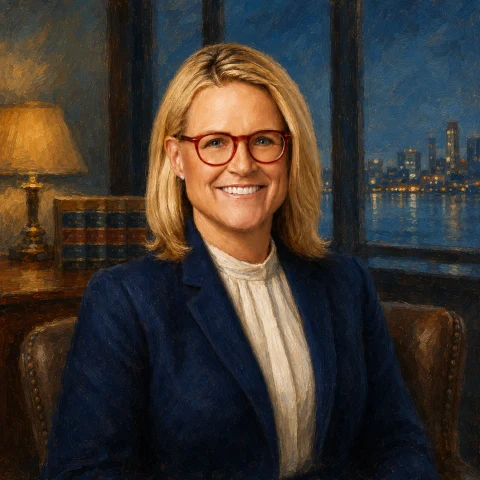
Edward A. Wallace
Mass Tort Litigation · Multidistrict Litigation · Class Actions
I knew that I wasn’t the right fit for defense, and that I wanted to be on this side of the law, bringing cases on behalf of those who, in many cases, could not otherwise afford representation.
12,129 Claims, One Liaison, and Judge Rowland’s Hair-Relaxer MDL
Edward A. Wallace has served since March 2023 as the sole Plaintiffs’ Liaison Counsel in the federal litigation consolidating more than twelve thousand claims that chemical hair relaxers caused cancer in the women who used them. Judge Mary M. Rowland’s court has set the first bellwether trial for September 7, 2027.
On May 14, 2026, a week before a status conference in Chicago, the lawyers for the women suing the makers of chemical hair relaxers and the lawyers for the manufacturers filed a joint report to Judge Mary M. Rowland on the disputes still open between them. One concerned Bridget Boatwright, whose case was among the ten the judge had chosen on April 2 to prepare for trial. “Put simply, Defendants have asked for photographs from each year from 1964 to the present,” the plaintiffs’ side wrote. That came to sixty-two years of pictures. The manufacturers had already received representative photographs every time they had asked, the plaintiffs answered; these were new requests, and the plaintiffs would respond within thirty days. Boatwright’s daughter, Dwanna, was among the witnesses whose depositions were still being scheduled.
The first signature under the plaintiffs’ name on that report read “/s/Edward A. Wallace,” Plaintiffs’ Liaison Counsel. He had signed the joint report for the August 29, 2024 status conference the same way, the only electronic signature in the plaintiffs’ block, above the names of the four co-lead counsel.
Every plaintiff in the federal litigation over chemical hair relaxers has to reach Judge Rowland through one of five lawyers. Four hold the title of Plaintiffs’ Co-Lead Counsel: Benjamin L. Crump, Fidelma Fitzpatrick, Michael A. London, and Diandra “Fu” Debrosse Zimmermann. The fifth, named alone to the position, is Edward A. Wallace.
Judge Rowland signed the order creating that leadership on March 2, 2023, in In re: Hair Relaxer Marketing, Sales Practices, and Products Liability Litigation, MDL No. 3060, Case No. 23 C 818, in the Northern District of Illinois. It named thirty-five lawyers to the litigation’s leadership and gave the one liaison seat to Wallace, of Wallace Miller in Chicago. She chose them against five criteria she had announced in advance: willingness and availability to commit to a time-consuming project, ability to work cooperatively with others, experience in this type of litigation, resources to move it forward in a timely manner, and diversity. The order requires: “All communications from Plaintiffs with the Court should be through Plaintiffs’ Co-Lead Counsel or Liaison Counsel.” A lawyer who needs to write the judge directly must copy Wallace and the four co-lead counsel by email at the same time. Every appointment lasted one year, and every appointee had to apply again to keep the seat.
The litigation those five speak for has kept growing. In November 2023 it held more than 8,000 lawsuits, and by May 2026 more than 11,000. By September 2026, the litigation held 12,129 pending claims, brought by women who allege that a chemical hair relaxer or straightener they used caused uterine, ovarian, or endometrial cancer, uterine fibroids, or endometriosis.
A Doubling the NIH Called Concerning
The litigation follows an epidemiological finding. Alexandra White, an epidemiologist who heads the Environment and Cancer Epidemiology group at the National Institute of Environmental Health Sciences, was lead author of the analysis behind it: the Sister Study, a cohort of 33,497 U.S. women ages 35 to 74 followed for nearly eleven years, in which 378 women developed uterine cancer. Women who reported using chemical hair straighteners more than four times in the preceding year were more than twice as likely to be among them. NIEHS projected that 1.64 percent of women who never used the products would develop uterine cancer by age 70, against 4.05 percent of frequent users. About sixty percent of the straightener users in the study identified as Black women. The institute published the finding on October 17, 2022, with White’s own caution attached: “This doubling rate is concerning. However, it is important to put this information into context”—uterine cancer, she added, “is a relatively rare type of cancer.”
Four days after the release, on October 21, 2022, Jenny Mitchell filed one of the first suits tying the products to uterine cancer, in federal court in Chicago. Mitchell, a Missouri woman and a military veteran with no family history of cancer, had started using relaxers in about the third grade, around age ten, and kept up the routine for eighteen years. In August 2018, while she was seeking fertility treatment, doctors found cancer in her uterus. Six weeks later, at twenty-eight, she had a full hysterectomy. “I was devastated because having a family, having a child of my own, has always been a dream of mine,” she said after filing. Her lawyers were Crump and Debrosse Zimmermann, two of the four who now lead the litigation.
The complaints filed since name L’Oréal USA—through its SoftSheen-Carson division and brands including Optimum Care, Dark & Lovely, and XTenso—along with Revlon, whose products include Conditioning Crème Relaxer and Crème of Nature, Strength of Nature, maker of Motions and Soft & Beautiful, Dabur International, and other manufacturers. Plaintiffs allege the companies knew or should have known of the cancer risk and marketed the products to Black women anyway. The master complaint alleges that the relaxers contain endocrine-disrupting chemicals and that the companies “[i]ntentionally target[ed] Black and Brown women, including Black and Brown teenaged girls and children.”
Sheila Bush, a cosmetologist from the St. Louis area, joined the litigation in August 2023, at sixty-nine, about a decade after she was diagnosed with uterine cancer. “I would like to see that relaxers were taken completely off the market,” she said.
Nine Suits in Four Districts
Within a month, lawyers were petitioning to consolidate the growing number of nearly identical filings. On November 15, 2022, Mitchell and three other women, Rugieyatu Bhonopha, Diane Grant, and Bernadette Gordon, asked the Judicial Panel on Multidistrict Litigation to send nine suits pending in federal courts in Illinois, California, New York, and Georgia to a single judge in Chicago. The Panel heard argument in Miami on January 26, 2023, and in February 2023 it created MDL 3060 in the Northern District of Illinois and assigned it to Judge Rowland.
The plaintiffs’ leadership filed a master long-form complaint in May 2023. Judge Rowland accepted the master complaint in June 2023 and, that August, in Case Management Order No. 7, approved a short-form complaint that let a new plaintiff join the litigation without re-pleading the underlying allegations from scratch. The form works as a checklist. A woman marks her injury—uterine, endometrial, or ovarian cancer—then the manufacturers she is suing and the brands she used, from Motions and Crème of Nature to Hawaiian Silky and Just For Me, and the form closes: “Plaintiff(s) demand(s) a trial by jury as to all claims in this action.”
Each woman then owes the court a Plaintiff Fact Sheet, signed under penalty of perjury. It asks for every address and employer for ten years, her pregnancy and menstrual history, her family’s cancer history, the relaxers she used and how often, the salons that applied them and the stores that sold them, and representative photographs of how she wore her hair for the ten years before her injury.
Defendants Bear the Burden
The manufacturers’ first answer was a motion to dismiss. They argued that federal law governing cosmetics preempted much of the master complaint, that the women had not identified the products they used or when, and that the negligence and design-defect allegations were conclusory. On November 13, 2023, Judge Rowland turned back the core of it. “In this circuit, it is settled that preemption is an affirmative defense, meaning Defendants bear the burden of proof,” she wrote, and the manufacturers had not carried it. She rejected the argument that the women had failed to identify their products. They had stated claims for negligence, design defect, and failure to warn, and she found “the factual allegations supporting the claim for punitive damages adequate.” On the Sister Study and the rest of the science, she wrote: “At a later stage of the litigation, Defendants will be able to challenge the studies.”
The manufacturers’ position on that science was already public. A Revlon representative said the company did not “believe the science supports a link between chemical hair straighteners or relaxers and cancer.” L’Oréal had said after the first suits that it was “confident in the safety of our products and believe the recent lawsuits filed against us have no legal merit.”
Six weeks after the pleading ruling, the fight moved to documents. The women’s lawyers wanted what the manufacturers had told regulators abroad, the labels and instructions they used in other countries, and the safety studies and journal articles in their files, including those held by L’Oréal USA’s foreign parent, L’Oréal S.A. On December 27, 2023, Judge Rowland held that “the documents sought from L’Oréal S.A. are within the control of L’Oréal U.S.A.,” pointing to common ownership, overlapping executives, and a patent and marketing the two companies shared, and ordered those four categories produced. Every defendant had to produce the same four categories for relaxers sold outside the United States.
Getting the documents took more. By August 2024 the plaintiffs had moved to enforce that December order and a second one entered March 4, 2024. Revlon had subpoenaed the National Institutes of Health for data and documents, and the court had entered a protective order covering the subpoena on July 24, 2024. Namasté Laboratories said that certain custodial files had been deleted before the first hair-relaxer lawsuit was served on it, and the plaintiffs asked for a briefing schedule on the files that no longer existed. Wallace signed the report that laid each of those disputes before the court.
Thirty-Two Cases, Then Ten
Two years of discovery followed the pleading ruling. The parties had spent much of 2023 failing to agree on a bellwether plan, the handful of representative cases that would go to juries first. They had long agreed on one number: sixteen cases for bellwether discovery. On January 31, 2025, Judge Rowland called that number “far too low” and ordered forty. “This is not an opportunity for one side’s advocacy to win the day and put forward their strongest cases,” she wrote; the parties were to “select and try representative cases.”
The forty became thirty-two. By May 2025, plaintiffs’ and defense counsel had each identified twenty cases they considered representative of the litigation as a whole, and each side had struck four of the other’s selections, leaving a pool of thirty-two cases for bellwether discovery. Fact discovery in those thirty-two cases was set to close February 16, 2026, with general-causation discovery, the science connecting the products to cancer apart from what happened to any one plaintiff, to close two weeks later. The manufacturers had deposed twenty-nine of the bellwether plaintiffs by March 2026, and by May the close of fact discovery in the remaining bellwether cases had moved to June 10.
On April 2, 2026, Judge Rowland picked ten of the thirty-two for early trial preparation: Bridget Boatwright, Carrie Chattman, Charlene Fennell, Gloria Ford, Areecia Jackson, Joanne Jones, Rosa Robinson, Karla Smith, Roxanna Wade, and Janette Wallace. She excluded cases naming only one or two defendants, cases in which the plaintiff had memory loss, a mental health condition, or a learning disability, and cases in which the same plaintiff was also pursuing a talcum-powder claim involving a similar reproductive cancer. The next cut, the parties told her in May, would likely take the ten down to five for possible trial.
The manufacturers resisted along the way. In February 2024 they moved to dismiss the economic-harm class claims as preempted by federal law. In October 2024 they told the court that the litigation was not yet mature enough to move toward bellwether trials, citing delays in collecting documents and medical records. And as the bellwether cases moved toward trial, they pressed individual plaintiffs to produce proof of purchase, product containers, and old photographs that many women testified they had thrown out years earlier. In three of the ten cases, Chattman’s, Fennell’s, and Smith’s, they sought the women’s original handwritten fact sheets, which the plaintiffs said were privileged. The bellwether selection went forward anyway.
A Special Master for the Other Twelve Thousand
Ten cases are being prepared for trial; the other roughly twelve thousand are not, at least not yet. On April 22, 2025, Judge Rowland appointed Ellen K. Reisman, of Reisman Karron Greene, as special master to oversee settlement negotiations “with the goal of facilitating settlements by and between the parties,” aimed at resolving more than 12,000 of the claims without thousands of individual trials.
The leadership seats came up for renewal each year. On April 22, 2024, Judge Rowland reappointed Wallace as Plaintiffs’ Liaison Counsel, with Crump, London, Fitzpatrick, and Debrosse as co-lead counsel. In late May 2026, Judge Rowland reappointed the litigation’s leadership for another year—the four co-lead counsel, the single liaison counsel, an eight-member Plaintiffs’ Executive Committee, and a twenty-five-member Plaintiffs’ Steering Committee.
Wallace’s firm took two other places in that leadership in the spring 2023 appointments. His partner, Mark R. Miller, was named co-chair of the Law and Briefing Committee, and Molly Condon Wells was named to the Leadership Development Committee. On March 27, 2025, Wallace Miller appeared and argued issues for the plaintiffs at hearings before Judge Rowland and Magistrate Judge Jantz.
Twenty-Six Years on the Plaintiffs’ Side
Wallace did not start on the plaintiffs’ side. He earned his law degree from DePaul University in 1995, after a bachelor’s degree from Eastern Illinois University in 1991, and went to work at a large firm defending companies and professionals in litigation. Of those years he has said, “I was mentored by some phenomenal lawyers, some that I still have as friends and hold in the highest esteem.” But “I knew that I wasn’t the right fit for defense,” he has said, “and that I wanted to be on this side of the law, bringing cases on behalf of those who, in many cases, could not otherwise afford representation.”
He crossed over in February 2000. For almost two decades he and Mark R. Miller practiced at the same firm, Wallace building a practice in mass torts, class actions, and personal-injury cases. Of Miller in those years, Wallace has recalled: “Mark would show up at seven dressed in a suit and tie, and stay dressed in a suit and tie until at least seven that evening.” On why the two of them started a firm together, he has said: “Mark could see pieces of a case that I couldn’t, and vice versa.” They left on November 1, 2021, to found Wallace Miller. His advice to lawyers starting their own practice: “If you’re going to go, you better go all in, because there’s a lot of people counting on you.” The firm has since grown to more than sixty employees, with offices in Chicago and Edwardsville, Illinois.
Months before that move, on February 18, 2021, Judge Leigh Martin May of the Northern District of Georgia named Wallace, then of Wexler Wallace, to the five-member Plaintiffs’ Executive Committee in the federal litigation over the Paragard T380A, a copper intrauterine device that the plaintiffs allege can break when it is removed and leave pieces embedded in the uterus. Fidelma Fitzpatrick, later one of the hair-relaxer co-lead counsel, sat on the same committee.
For five years, from 2007 to 2012, Wallace co-chaired the American Association for Justice’s Kugel Mesh Litigation Group, the trial lawyers’ working group organized around the wave of suits over Davol’s recalled hernia patch, whose internal plastic ring was prone to breaking inside patients and causing bowel perforations—litigation consolidated before Judge Mary M. Lisi in federal court in Rhode Island alongside more than 1,700 further cases filed in that state’s superior court.
Davol, a division of C.R. Bard, began recalling the patches in December 2005. Its former president, Daniel LaFever, testified that management realized that year that “stresses to put the device in may cause ring breaks.” In 2010 a jury in Rhode Island awarded Christopher Thorpe, a North Carolina man who had spent about five years in surgeries after his 2005 implant, $1.5 million, and his wife, Laure, $200,000, finding that Davol and Bard had inadequately designed the patch and failed to warn him or his doctor. In a filing on June 30, 2011, Bard disclosed that it would pay $184 million to resolve a majority of the suits.
He is admitted to the Illinois bar, to federal district courts in Illinois, Michigan, Wisconsin, Colorado, and Nebraska, and to the First, Third, Fourth, Seventh, and Ninth Circuit Courts of Appeals, and is a guest lecturer on class-action and mass-tort practice at Loyola University Chicago School of Law.
The Later Stage
In January 2026 the science came before Judge Rowland directly. She set aside January 8 for a Science Day on whether relaxers cause uterine cancer, fibroids, and other reproductive harms: the plaintiffs’ experts in the morning, the defense in the afternoon, no sworn testimony and no cross-examination. Judges presiding over the related state-court cases could attend.
The challenges she had anticipated in 2023 followed. Motions under Federal Rule of Evidence 702 to exclude general-causation experts were due April 1, 2026. The manufacturers moved to exclude ten of the plaintiffs’ general-causation experts, and the plaintiffs moved against six of the defense’s, with oppositions due June 2 and replies June 16. Those rulings will decide which scientists a jury may hear on whether chemical relaxers cause the cancers the women allege. Class-certification briefing ran on the same calendar, and motions for summary judgment and case-specific expert challenges were due November 16, 2026.
The schedule set in early 2025 pointed toward a first bellwether trial by mid-2027. As of September 2026, no trial date had been set. By early October, the first bellwether trial was on the calendar for September 7, 2027, and Judge Rowland had not yet chosen which of the ten women’s cases would be tried first.
As the hair-relaxer litigation moves toward its first trial date, the single liaison seat Judge Rowland gave Wallace in March 2023—the one requiring his name, with the four co-lead counsel’s, on any letter that reaches her directly—is the same seat her May 2026 reappointment of the litigation’s leadership kept in place.