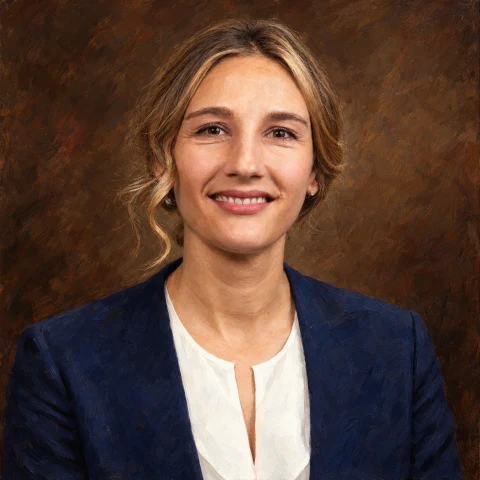
Hilary Harris Klein
Voting Rights · Ballot Access · Voter List Maintenance
The real election integrity issue in our state is that North Carolina makes it too difficult for some people to exercise their fundamental right to vote.
Democracy North Carolina v. State Board of Elections and the Notice Owed Before an Absentee Ballot Is Rejected
As lead counsel in Democracy North Carolina’s 2020 suit, Hilary Harris Klein won relief for Walter Hutchins, a blind voter locked down in a Wilmington nursing home, and a federal injunction against rejecting fixable absentee ballots without due process. The cure process that followed is now written into state law, and at the Southern Coalition for Social Justice she has pressed the state over the voters it removes.
Walter Hutchins’s first presidential ballot, in 1952, went to Dwight D. Eisenhower, and he voted in every election that followed. An industrial engineer, he helped design the M16 rifle and invented tools of his own. A year after that first vote he married Margaret, a teacher and ordained Episcopal minister, and when he became blind and hard of hearing she helped him in the voting booth.
By the summer of 2020 he had lived for two years at the Davis Community nursing home in Wilmington, which had barred visitors since March. Margaret, living in a retirement community nearby, could not get in to help him, and neither could their four children or eight grandchildren. State law barred the home’s staff from helping him mark a ballot. That spring a friend of Margaret’s at the local League of Women Voters chapter asked whether Walter would join a lawsuit against North Carolina’s vote-by-mail restrictions and ballot-access laws. “I thought that he’d be willing, and that I better call him and ask him,” Margaret said. He agreed, and he was the only plaintiff in the case who lived in a nursing home.
Hilary Harris Klein, now senior counsel for voting rights at the Southern Coalition for Social Justice, was lead counsel for the plaintiffs and one of Hutchins’s lawyers. She said of the nursing home’s staff, “He trusts these people and wants them to help,” and of the law that kept them from helping, “The government is denying his choice by enforcing this ban on staff assistance.”
On August 4, 2020, Judge William Osteen of the U.S. District Court for the Middle District of North Carolina enjoined several nursing-home voting rules that would have disenfranchised Hutchins. In the same order he found that “[t]here are currently no procedures in place statewide that would either notify a voter that their absentee ballot has a material error nor allow such a voter to be heard in challenging such a rejection.” He enjoined “the disallowance or rejection . . . of absentee ballots without Due Process as to those ballots with a material error that is subject to remediation.” Seventeen days later the State Board of Elections sent county boards a written cure procedure, under which a voter could fix certain defects on the return envelope by signing and returning an affidavit. By the Southern Coalition’s later count, nearly 20,000 North Carolina voters whose mail ballots had problems that fall either fixed them or learned of the problem in time to vote another way.
Proof That the Errors Could Be Fixed
The plaintiffs filed on May 22, 2020, and moved for a preliminary injunction on June 5. Alongside the two organizations, both nonpartisan groups devoted to encouraging voting and voter education, they included North Carolinians whose health conditions could make COVID-19 more dangerous for them—Donna Permar, John P. Clark, Margaret B. Cates, Lelia Bentley, Regina Whitney Edwards, Robert K. Priddy II, and Walter Hutchins—and Susan Schaffer, a volunteer who helped people register and complete absentee ballots. On June 10, Senate President Pro Tempore Philip E. Berger and House Speaker Timothy K. Moore moved to intervene as defendants. Klein’s name went on the plaintiffs’ papers with those of her Southern Coalition colleagues Allison J. Riggs and Jeffrey Loperfido, beside co-counsel from the Fair Elections Center, including Jon Sherman, and from WilmerHale, including George P. Varghese.
Donna Permar, who is completely blind, as is her husband, alleged that she had to take public transportation to reach her polling place. When the plaintiffs amended their complaint in July 2021, John P. Clark of Cary was eighty; he had lived with severe chronic obstructive pulmonary disease for fourteen years, had been diagnosed with lung cancer in 2020, and by his own recollection had voted in every presidential, state, and local election since 1968. Robert K. Priddy II of Brunswick County, seventy-one, had received a kidney transplant in 2011 and took medication that suppressed his immune system. Regina Whitney Edwards of Durham County, thirty-one, had type 1 diabetes. Lelia Bentley, sixty-three, lived alone in Wilkesboro and had high blood pressure. Hutchins was ninety-two and legally blind.
The General Assembly then passed House Bill 1169. Under the prior law, an absentee voter needed two witness signatures, and the witnesses did not have to print their names or addresses. The new law required one witness, who had to print a name and address, and it amended provisions on poll workers and multipartisan assistance teams, known as MATs. The plaintiffs answered with a second amended complaint and an amended motion for a preliminary injunction.
Osteen held an evidentiary hearing on July 20 and 21 and heard argument on July 22. The court took videotaped testimony from Megan Murray, an epidemiologist at Harvard Medical School, on how COVID-19 is transmitted, and live testimony from Karen Brinson Bell, the State Board’s executive director and a defendant. Bell told the court that the Board was preparing an absentee voting guide for the county boards that would include a standardized curing procedure, with notice to voters whose absentee applications could not be approved. Osteen called her testimony “both credible and thoughtful,” and he noted that those procedures were not yet in place.
In their 2020 federal suit, Democracy North Carolina and the League of Women Voters of North Carolina put forward figures from that March’s primary. Around 15 percent of the absentee mail-in ballots had been rejected, and at least 41 percent of the rejections were for noncompliance with form requirements. The Southern Coalition later put the form-defect rejections at 1,843 ballots and the rejection rate for Black voters at 19 percent.
The State Board and its officials attacked the causal link. The plaintiffs, they argued, “conclude that the lack of a standardized curative process is the reason these ballots were rejected. But they provide no evidence to suggest that this is true.” Osteen answered with the plaintiffs’ own figure: at least 41 percent of the rejected ballots had failed on form requirements, and those ballots, he reasoned, could presumably have been cured. He held that the two organizations had standing to press the claim and granted the injunction on it.
A Locked-Down Nursing Home and Who Could Help a Patient Vote
Walter Hutchins lived alone in a nursing home that was locked down during the pandemic. His disability was uncontested, and he needed in-person help to vote, but under the lockdown neither his wife nor a MAT could come in to give it. His wife requested an absentee ballot on his behalf. Emails put into evidence showed that Hutchins and other residents might not be able to count on a MAT at all, and that at least two counties had no teams; one of the emails came from Katelyn Love, the State Board’s general counsel, writing to a disability rights group.
North Carolina law made it unlawful for any owner, manager, director, employee, or other person, other than the voter’s near relative or verifiable legal guardian, to request an absentee ballot for a patient in a hospital, clinic, nursing home, or rest home, to sign as the patient’s witness, or to mark the voter’s absentee ballot or help mark it.
Berger and Moore argued that Hutchins lacked standing or a ripe claim: a MAT member could witness his ballot under House Bill 1169, MATs would be available to help him, and his injury was speculative because the facility might not be locked down by November. Osteen held that Hutchins had standing. His need for help while locked down, the court found, was not based “upon a hypothetical state of facts,” and he could challenge the restrictions in N.C. Gen. Stat. §§ 163-226.3(a)(4)–(6) and 163-231(b)(1) under the Voting Rights Act, the Americans with Disabilities Act, and the Rehabilitation Act. The August 4 order enjoined several nursing-home rules that would have disenfranchised him.
The relief ran to Hutchins by name. The order barred enforcement of those statutes against him so that the nursing home’s staff could help him mark and complete his absentee ballot, and it was to stay in force, Osteen wrote, “until such time as a plan exists that would reasonably allow a disabled individual affected by these statutes to vote.” That summer Hutchins told ProPublica in an email, “I’m a very patriotic guy,” and added, “I’m very, very pleased to have participated in this lawsuit.”
How the Cure Worked in the Fall of 2020
On August 12, the plaintiffs wrote to the State Board’s officials setting out what, in their view, due process under the court’s order required, including “[p]rompt identification and notice” for “those issues easily identified on the face of the absentee ballot envelope . . . .” Any law or rule, they wrote, should “provide voters with timely notice of any issues that would cause their ballot to be rejected.” On August 21, Bell issued Numbered Memo 2020-19, “Absentee Container-Return Envelope Deficiencies,” to the county boards. The memo sorted envelope defects into two groups. A voter who had not signed the certification, or had signed in the wrong place, could fix the problem with a cure affidavit. Defects in the other group could not be cured that way; the county had to reissue the ballot with a notice, and the voter could also vote in person. In October, Osteen wrote that the memo had “laid out statewide procedures by which absentee ballots with reasonable, minor deficiencies could be cured by voters,” and he found that the guidelines in the original memo “sufficiently addressed errors ‘subject to remediation.’”
In September, with ballots already in the mail, Klein went on NC Newsline’s radio program with practical advice for voters who wanted to be sure their ballots counted. By September 29, Durham County’s elections director, Derek Bowens, had found 387 deficient envelopes among 16,150 returned absentee ballots.
The Board revised the memo on September 22 and again on October 17, the second time citing orders in Democracy North Carolina’s case and in a Wake County Superior Court case, North Carolina Alliance for Retired Americans v. North Carolina State Board of Elections. As revised, four defects were curable: a missing voter signature, a voter signature in the wrong place, a witness or assistant who failed to print a name or address, and a witness or assistant who signed on the wrong line. County boards had to write to the voter within one business day of identifying a defect, enclosing a cure certification or a new ballot. If the voter had an email address on file, the board also emailed the cure certification; if the voter had given a phone number but no email address, the board called to say the certification was in the mail.
Curing had been on hold since October 4 because of pending litigation. On October 19 the State Board told the county boards to resume, with Bell directing them “to immediately begin reaching out to voters.” About 10,000 ballots statewide were waiting on a cure. In Mecklenburg County, staff worked late into the night through about 1,000 deficient ballots and began notifying the voters who could fix theirs with an affidavit.
The certification needed no wet-ink signature, only one “unique to the individual,” and the voter, a near relative, a legal guardian, or a MAT could return it by fax, email, mail, commercial carrier, or in person by the deadline for receipt of absentee ballots. A ballot with an unsigned witness or assistant attestation, or an unsealed envelope, was spoiled, and the county sent a new one.
In July 2021 the Southern Coalition published an analysis of how the cure had worked, with Klein among its authors. In the November election, 9,461 voters had cured their ballots, and another 10,006 had been told of a problem and voted another way. Black voters cast 7,183 of the ballots with material errors; 1,946 of those were cured, and 4,313 of the voters found another way to vote, so that more than 87 percent of the Black voters with flawed ballots had their votes counted, against about 83 percent of all voters with flawed ballots. “As we continue to fight for a permanent cure process for mail-in ballot envelopes, we celebrate the tens of thousands of North Carolina voters empowered to make their voices heard in 2020 as a result of our lawsuit,” Klein said.
Bioengineering, Tanzania, and a Clerkship in the Same Court
Klein earned a B.S.E. in bioengineering, magna cum laude, at the University of Pennsylvania and spent two years as a Peace Corps volunteer in Tanzania before law school. She graduated with honors from Georgetown University Law Center, where she was a Global Law Scholar and received Pro Bono Pledge recognition.
She practiced commercial litigation, arbitration, and global investigations in the New York office of Freshfields Bruckhaus Deringer. There she was a co-lead of the firm’s U.S. Pro Bono Associate Counsel and twice received a pro bono award from the Legal Aid Society for leading prisoners’ rights and anti-human-trafficking matters.
In 2018 she moved to North Carolina and clerked for U.S. District Judge Catherine C. Eagles of the Middle District of North Carolina, the court in which Democracy North Carolina filed its suit two years later. She joined the Southern Coalition for Social Justice in 2020. Her work there is trial and appellate advocacy for voters and nonpartisan voting organizations—voter registration list maintenance, ballot access, and challenges to gerrymandering, including prison gerrymandering—and legal support for coalition partners across the South.
A Purge Suit Built on Registration Rates
In 2020 Judicial Watch sued the State Board, Bell, the State of North Carolina, and the election boards and officials of Mecklenburg and Guilford counties in the U.S. District Court for the Western District of North Carolina. The two counties are among the state’s largest, and each has a significant population of voters of color. Judicial Watch sought removals from their rolls, arguing that high voter registration rates showed a violation of the National Voter Registration Act.
The complaint, filed in Charlotte on April 9, 2020, alleged that both counties had registration rates above 100 percent of their age-eligible citizens, relied on the U.S. Election Assistance Commission’s survey of 2018 registration data, and counted nearly one million inactive registrations statewide. It named Mecklenburg’s elections director, Michael G. Dickerson, and Guilford’s, Charlie Collicutt, and asked the court to order the state and both counties to develop and carry out a “general program” to remove ineligible registrants.
The Southern Coalition and Dēmos moved to intervene for the League of Women Voters of North Carolina and the North Carolina A. Philip Randolph Institute. In August 2021 the magistrate judge recommended dismissing Judicial Watch’s claims. The recommendation rejected the argument that high registration rates alone proved an NVRA violation, noted that the report Judicial Watch relied on advised that its data “be used with caution,” and warned against drawing conclusions about compliance from registration rates “because of the long time period involved in removing ineligible voting records required by the NVRA.” Klein said that September: “We are grateful for the Court’s recommendation to halt yet another undemocratic attempt by partisan activists to remove eligible North Carolina voters from the voter rolls without due process.”
Judicial Watch asked the court to vacate the recommendation. On February 17, 2022, Judicial Watch and all the defendants stipulated to dismiss the action with prejudice. On March 7 the court dismissed it with prejudice, ruling that vacating the recommendation was not appropriate; because the dismissal mooted the motions the recommendation addressed, the court did not adopt it either. Klein said afterward that Judicial Watch had “failed to show any evidence that ineligible voters were able to cast ballots.” Melvin Montford, who heads the North Carolina A. Philip Randolph Institute, said: “Groups like Judicial Watch seek to challenge the integrity of elections and use inaccurate data to create barriers to voting access for communities of color.”
State Courts and the Elections Clause
Common Cause was one of several groups of plaintiffs, with the North Carolina League of Conservation Voters and individual voters, that sued in state court over North Carolina’s congressional map. Its attorneys were the Southern Coalition and Hogan Lovells. When the legislative defendants took the dispute to the U.S. Supreme Court, Klein was among Common Cause’s counsel on the brief for the non-state respondents, filed October 19, 2022, and Neal Katyal of Hogan Lovells argued for Common Cause. The brief began by arguing that the legislators read the Elections Clause in a way that “flouts that document’s most fundamental premise—that a government’s power derives from ‘We the People’ and is limited by the constraints the people impose on their government.”
The legislators argued that because the Federal Constitution gives state legislatures the power to regulate congressional elections, only that Constitution could restrain them. On June 27, 2023, the Court rejected the argument, six to three. Chief Justice John G. Roberts Jr. wrote for the majority: “The Elections Clause does not insulate state legislatures from the ordinary exercise of state judicial review.” Klein said that day that the decision would “ensure that voters will continue to have the full protection of state constitutions against harmful and anti-democratic voter suppression and election manipulation.”
A Removal Hearing in the Surry County Courthouse
After the 2022 general election, two members of the Surry County Board of Elections, Jerry Forestieri and Timothy DeHaan, brought a letter they had both signed to the county’s certification meeting. “I don’t view election law per NCSBE as legitimate or Constitutional,” it read. Forestieri refused to certify, and DeHaan agreed only on a technicality; the two later refused to certify a special election held on March 7, 2023, as well. On November 28, 2022, Bob Hall of Orange County, a former executive director of Democracy North Carolina, filed complaints with the State Board seeking their removal. Klein represented him. “Faithful execution of the law by election officials is a keystone to our political system,” she wrote to the Board in support of his complaint.
The State Board heard the complaints on March 28, 2023, at the Surry County Courthouse in Dobson. The courtroom was packed, with dozens of the two men’s supporters in the crowd. Forestieri called what they had done a free-speech issue. Stacy Eggers, the only Republican board member present, made both motions to remove them. “We cannot substitute our own opinions,” he said, for “what the law actually is.” Each motion passed four to zero, and a woman in the courtroom said, “The law is perverted! The law is perverted!” The Board found that the two men’s refusals were “impermissible collateral attacks” on court decisions and on its own directives, and that no irregularity would have changed the outcome of either election. “Those who administer elections must follow the law as it is written, not how they want it to be,” said Damon Circosta, the Board’s chairman.
Removed Voters and Uncounted Provisional Ballots
In March 2023 the Southern Coalition reported that North Carolina had removed 264,416 voters that January and February who had been inactive since August 2020; Black voters made up 26.1 percent of those removed and 20.31 percent of the state’s registered voters. At least 2,280 voters removed in 2019 had tried to cast a provisional ballot in 2020, and more than 300 of those ballots were rejected. “North Carolina can, and must, do better to ensure all eligible voters of all backgrounds are able to get and stay registered,” Klein said. “We have compelling evidence that this is not the case, but with common sense improvements to the process, including more reach-out by counties to voters slated for removal, we can get there.”
In May 2025 the Southern Coalition published an update on the state’s voter list maintenance. In January and February 2025, North Carolina removed 421,429 no-contact voters—registrants with no record of casting a ballot in the 2022 or 2024 elections who had not otherwise contacted their county boards. Black voters made up 24.59 percent of those removals and 19.50 percent of all registered voters. Onslow County removed 11.59 percent of its registered voters, 15,957 people, the highest rate in the state, and Cumberland County removed 19,330. From January 2023 to August 2024, the state removed nearly 750,000 registrations for all reasons.
In the 2024 general election, 5,608 people who cast provisional ballots were coded as previously removed voters, meaning they had once been registered in the same county. Of those ballots, 2,676, or 48 percent, were not counted. The Southern Coalition wrote that it was “impossible to tell how many voters simply walk away without voting a provisional ballot when they are told they are not registered.” The update recommended that counties also contact voters by phone and email where voters had provided that information, and said county boards would need more funding to do it. Klein told NC Newsline’s Rob Schofield that many of the fixes were a matter of funding: money for state and county election officials to hire staff and buy modern computer systems.
In June 2025 the Southern Coalition and Dēmos detailed the gap in North Carolina’s voter participation: at least 1.5 million eligible North Carolinians, nearly one in five, did not take part in elections, and they were disproportionately young, Black, or Latino. The two organizations named the barriers: the photo ID requirement, the lack of automatic and same-day registration, felony disenfranchisement laws, burdensome mail and absentee voting rules, and inadequate language and disability access. “The real election integrity issue in our state is that North Carolina makes it too difficult for some people to exercise their fundamental right to vote,” Klein said. “We are at a crisis point when we are missing the viewpoints and perspectives of 1.5 million people.”
Sixty Thousand Challenged Ballots and a 734-Vote Margin
After the 2024 election, Judge Jefferson Griffin, a Republican, trailed Justice Allison Riggs by 734 votes for a seat on the North Carolina Supreme Court. He sought to have more than 60,000 ballots thrown out, most of them because the voters’ registration records lacked a driver’s license number or the last four digits of a Social Security number. Riggs had signed the Democracy North Carolina papers for the Southern Coalition in 2020.
On February 27, 2025, the Southern Coalition and Forward Justice asked the North Carolina Court of Appeals for leave to file a brief for thirty-one of the challenged voters, with Klein among the lawyers named. Jean Cary of Durham had been registered since 1976, and her county said her registration was proper. Gaynelle Little of Wake County had registered in 1986 and held a North Carolina driver’s license. Sofia Dib-Gomez, a nineteen-year-old Duke student, had registered for the first time in 2024 and given her Social Security number. Carrie Conley had voted absentee online from overseas, where her husband was on active duty. The brief said that “Judge Griffin fails to allege any evidence that even a single one of these voters is actually ineligible.”
On April 11 the state Supreme Court held that the roughly 60,000 voters with incomplete registration records would not have to validate their votes. On May 5, Chief U.S. District Judge Richard E. Myers II ordered the State Board to count the challenged ballots and certify the result; Griffin, he said, could not “change the rules of the game after it had been played.” Griffin conceded two days later. When the State Board voted three to two in April 2026 to use the federal SAVE database to flag “potential noncitizens” on the rolls, Klein warned that “North Carolina elections, including statewide elections, can be notoriously close,” and that removing eligible voters by mistake could have real consequences.
A Cure Written Into Law
The 2021 analysis Klein co-wrote warned that “without additional advocacy, North Carolina may return to the dark days of high rejection rates.” The State Board had issued Numbered Memo 2021-03 that June, requiring county boards to run a cure process in future elections, but no statute yet required one. “Recent elections proved that interest in voting by mail has never been greater,” Klein said that July. “We know demanding due process to correct mail-in voting issues will only save more votes, protect more voters, and strengthen our democracy.”
In 2023 the General Assembly wrote a notice-and-cure duty into the election statutes. When an absentee ballot’s return envelope has a curable defect—a missing voter signature, a signature in the wrong place, a missing copy of the voter’s identification—the county board must promptly tell the voter what is wrong and how to fix it, by mail, and by phone or email as well if the voter supplied them. Problems with the witnesses’ identification are not curable that way.
On July 15, 2026, Klein and Helena Abbott, her colleague at the Southern Coalition, wrote to the State Board about its proposed permanent rules for absentee ballots. They recounted the 2020 injunction and the nearly 20,000 voters whose ballots counted that November, and wrote: “In sum, North Carolina’s cure process has been a resounding success.” They asked the Board to require county staff to send notice of an envelope irregularity within one business day, to let a voter attest in writing or orally, and, when a voter does not respond, to spoil a ballot only on a unanimous finding, with a presumption in favor of counting it. “Promoting election integrity includes an obligation to establish systems in which election workers are doing all that they can to ensure that every eligible voter’s ballot counts, and where voters can see those systems working and have confidence that their voice will be heard,” they wrote.
On September 4, 2026, the State Board approved and issued the current version of Numbered Memo 2021-03 under its executive director, Sam Hayes. County staff have one business day after finding a curable defect to mail the voter a cure notice, and they must also reach the voter by email or by phone, using the contact information the voter gave. The voter, a near relative or legal guardian, a multipartisan assistance team, or a person the voter chooses for help with a disability may return the cure in person, by mail or commercial carrier, by fax, or by email. Among the memo’s authorities is the August 4, 2020 decision in Democracy North Carolina’s case, “explaining that due process requires a cure opportunity.”