Southwark Crown Court, London | Tommy Robinson · Harassment Verdict · Oct. 28, 2026
Criminal Law · Free Speech · Sentencing
“Oyyyyy Tommy Tommy”
Edward Andrew Weinhaus hailed Tommy Robinson as a free speech advocate. Twelve jurors heard a different case. Ten were sure.
“I’ve already located every f****** one of you.”

The Case at a Glance
- Case
- Prosecution of Stephen Lennon (“Tommy Robinson”)
- Court
- Southwark Crown Court · Justice John Cavanagh · Oct. 19–28, 2026
- Question
- Did Robinson’s campaign against two Mail journalists put them in fear of violence, or was it reasonable to protect his family?
- Result
- Guilty on both counts, 10–2, after 11 hours 25 minutes; on bail until sentencing Dec. 16; maximum ten years
Contents
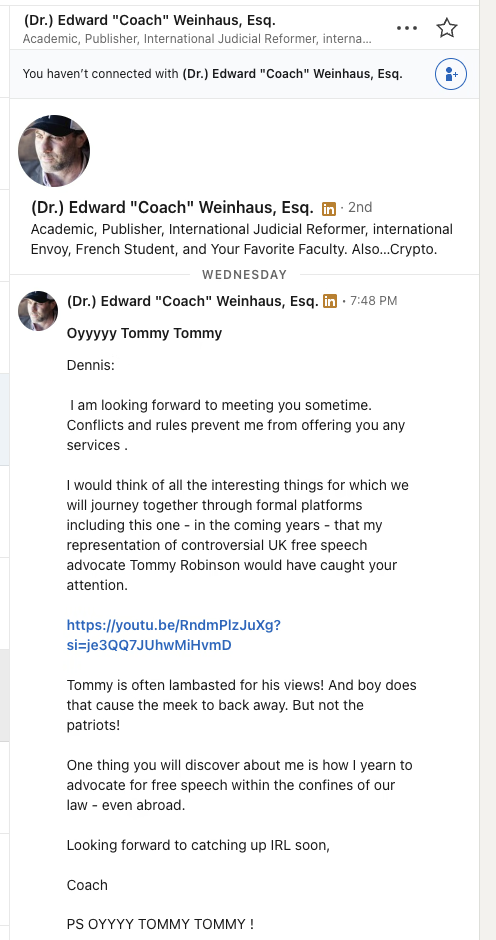
The message was written for an audience of one. It arrived on LinkedIn at 7:48 on a Wednesday evening, under the subject line “Oyyyyy Tommy Tommy,” from a sender who introduces himself as “Academic, Publisher, International Judicial Reformer, international Envoy, French Student, and Your Favorite Faculty. Also...Crypto.” It opens in the language of the bar (“Conflicts and rules prevent me from offering you any services”) and closes in the language of the terrace: “PS OYYYY TOMMY TOMMY !”
Between the two, it advertises “my representation of controversial UK free speech advocate Tommy Robinson,” links to a video of its author at a Robinson rally in London, and proclaims: “Tommy is often lambasted for his views! And boy does that cause the meek to back away. But not the patriots!” Every word of it was written by an American lawyer, Edward “Coach” Weinhaus.
Weinhaus is licensed to practice law in Illinois, Missouri and California, and the fringe network of websites he hatched includes ALAB “news,” billed as “a disciplinary news service that covers attorney misconduct.” It is a beat he knows from both sides of the docket: he faces disciplinary charges of his own.
In May, Weinhaus appeared at Robinson’s Unite the Kingdom rally in London. Andrew Eborn’s Octopus TV interview was titled “EXCLUSIVE BOMBSHELL: Tommy Robinson’s US Lawyer Coach Weinhaus EXPOSES UK Free Speech Hypocrisy.” Asked the hardest part of representing Robinson, he replied: “Tommy likes voice notes. I like things in writing… Write it down!” He did not appear for Robinson at Southwark.
Robinson has been imprisoned for using someone else’s passport, for mortgage fraud and for publishing material in defiance of a court order. At Southwark the jury had his voicemail. He had thoughtfully supplied the recording.
When Weinhaus pressed send, his free speech advocate stood charged with harassing two journalists. On Wednesday, October 28, a jury at Southwark Crown Court convicted him, by majorities of ten to two, on two counts of harassment causing fear of violence, against the freelance reporter Andrew Young and the Mail editor Jacob Dirnhuber. Tommy Robinson’s real name is Stephen Christopher Yaxley-Lennon. The English Defence League founder gave his name at trial as Stephen Lennon; earlier court records call him Stephen Yaxley-Lennon. Each count carries a maximum of ten years. The postscript was a terrace chant. Its subject now has a sentencing date.
He has been sentenced before. In 2014 a judge at St Albans Crown Court, sending him to prison for eighteen months for mortgage fraud, called him the “instigator, if not the architect” of it and told him: “I am satisfied you took part in a thoroughly dishonest course of conduct.” The list has grown since.
Part One“Free Speech Advocate”
“…my representation of controversial UK free speech advocate Tommy Robinson would have caught your attention.” — Edward “Coach” Weinhaus, on LinkedIn
The Story He Did Not Like
Robinson left Britain for Cyprus the day before three girls were murdered in Southport in July 2024. As the riots spread from town to town, he kept posting. The Daily Mail sent Young and a photographer to Cyprus. In early August the Mail and MailOnline published their story: Robinson, “stoking riots from his sunbed.” He later told police that his hotel had been “overrun with news crews.” His reply took three days and required private investigators.
“I’ll Be Knocking at Your Door”
The trial opened on Monday, October 19. Jurors were told to “put aside” whatever they thought of the defendant. For a defendant of his notoriety, that is a great deal to put aside. The prosecutor, Ben Holt, told them: “The prosecution say this defendant — using bully-boy, intimidatory tactics — threatened the journalists.” Robinson, he said, “chose to frighten them, arrange for individuals to go to their addresses.”
The charges covered three days, August 5 to 7, 2024. Between four in the morning and four in the afternoon on the fifth, Robinson sent Dirnhuber a series of direct messages. “You have endangered my children,” one read. Another read: “I’ll be knocking at your door.” The Mail had published no identifiable image of any of his children.
That same day he telephoned Young, recited Young’s home address to him, and asked whether it was fair that Young had “doxxed” his children. “He said that he would be coming round to my house to see me and that I would have to move house,” Young said. The call grew “increasingly menacing”: Robinson shouted and swore, said he had researched Young’s family and would publish their photographs and addresses, and told him, “I’m coming to get you.” “I told him several times that I regarded what he was saying as threatening behaviour and that I would be reporting it,” Young said.
He also hired private investigators to find where Young, Dirnhuber and the Mail’s editor-in-chief, Ted Verity, lived. Doorbell footage caught a gray Audi parked outside Young’s home shortly before Young returned from Cyprus. On Verity’s phone Robinson left a voicemail. “If it’s legitimate journalism then expect me to come knocking,” it said. “I’ve already located every f****** one of you.” It went on: “Now I know you wasn’t in your house yesterday…” “I’m not threatening you with violence or anything like that,” he added. “What I’m promising you is I’ll make you famous and your families because that’s what you’ve done to me.”
On X, where he then had about 800,000 followers, Robinson posted photographs of Dirnhuber outside his own front door, and cropped images of Young’s wife and children with their faces obscured. Holt cited a post sharing a picture of Young’s Suffolk address. Posts like these, the prosecutor argued, would inevitably lead supporters to “pick up the baton and attack those who he was talking about.” The baton did not have to be handed to anyone in particular. It only had to be left where 800,000 people could see it.
What It Cost Them
Robinson’s posts led his followers to “target and intimidate those journalists,” just as he knew they “almost certainly” would, the Metropolitan Police said.
“I was worried and concerned, I felt that my family was under threat and I was fearful of what might happen next,” Young said. After his wife and children appeared on Robinson’s feed, the Mail assigned him a close protection officer: a bodyguard, for a reporter, in Suffolk.
“Even now every time I step out of my front door I am aware that there is a risk of a vigilante attack.”
Jacob Dirnhuber
Dirnhuber said the campaign left him “scared to go to my own house.” He and his partner stayed away until security was in place, a doorbell camera among it, and asked whether they needed a panic alarm. In the end he moved. George Odling, a Mail correspondent who was not named in the charges, said he, his wife and their young child had left home through a neighbor’s house for fear of being followed by Robinson’s supporters. Weinhaus had written of “the meek” backing away.
In the Witness Box
Robinson gave evidence on Thursday, October 22. He had hired investigators to find the journalists, he said, because he wanted to “put pressure on them”; but, he insisted, “I didn’t publish their addresses or their images.” Posting the photograph of Dirnhuber outside his home had been “totally reasonable… under the circumstances.” Had he wanted to expose Dirnhuber to threats? “Not at all.”
“They could have run the story without giving my location,” he told the jury. “I would not endanger any innocent family.” He had been “panicked and terrified,” he said, and he wept when asked how his children had been affected. On the trial’s first day Holt had warned the jury to expect a proverb from the defense: “what is good for the goose is good for the gander.” Robinson argued that the Mail had put his family at risk, making his response reasonable.
By that reckoning, to print where a public figure was on holiday was an outrage, and to post a picture of a journalist at his own front door was “totally reasonable.” Weinhaus’s London interview had promised to expose “UK Free Speech Hypocrisy.” Southwark found some. It was in the witness box.
Eleven Hours and Twenty-Five Minutes
Under section 17 of the Juries Act 1974, the Crown Court may accept the verdict of ten jurors out of twelve, but only after at least two hours of deliberation, and only if the foreman states in open court how many agreed and how many did not. This jury took more than five times the minimum.
Minimum before a majority verdict: 2 hrs
Before the verdicts were read, Justice Cavanagh told the courtroom: “Whatever the verdicts may be, they must be received in complete and respectful silence.” Robinson, in a blue suit, sat down, shook his head and stared at the jury. “But not the patriots!” Weinhaus had written. In the public gallery his supporters “let out sighs of disappointment.” The judge thanked the jurors and told them they would be welcome at the sentencing.
The silence lasted as long as the hearing. Afterward Robinson went online and called the verdicts “insane.” Sharing the Mail’s report of his conviction, he wrote: “F***ing wankers.” The Mail said his behavior “was reprehensible and had grave consequences for our reporters and their families.” Frank Ferguson, head of the Crown Prosecution Service’s Special Crime and Counter Terrorism Division, said Robinson had “weaponised social media and subjected two journalists to a campaign of harassment.” He added: “Nobody should be made to fear violence because of the work they do.”
Part Two“Lambasted for His Views”
“Tommy is often lambasted for his views! And boy does that cause the meek to back away. But not the patriots!” — Weinhaus
The Speech in Question
Robinson’s vocabulary divides people into white “natives” and non-white “invaders.” He has asked what a viral incident “tells you about the mindset of some black people.” In October 2025 he wrote: “Hate speech laws are only used against natives to silence them whilst our country is flooded & raped.” At the London rally, Weinhaus offered a more flattering description: far right “is probably better replaced with very right as opposed to very wrong.”
Natalie Ayeni, from Redcar, had posted a TikTok video of her husband, Olajuwon, a Black musician, with their white granddaughters at a local park. The clip was lifted from her account, and on August 13, 2025, Robinson shared it with his 1.4 million followers on X, asking: “Wtf is even going on here? Where are the parents?!” What Robinson saw was a Black man with white children, and that was enough. Within days, two of Robinson’s followers had threatened to slash the couple, and they feared for their safety whenever they left their house.
In 2018 a Syrian refugee schoolboy, Jamal Hijazi, was filmed being attacked on a playing field in Huddersfield. Robinson posted videos, watched nearly a million times, telling viewers the boy was “not innocent and he violently attacks young English girls in his school.” The boy’s lawyers told the court he was “facing death threats and extremist agitation.” In Hijazi v. Yaxley-Lennon [2021] EWHC 2008 (QB), the High Court found that Robinson had “failed to prove the substantial truth” of the assault claim, called Hijazi “a credible and truthful witness throughout his evidence,” and awarded him £100,000. Robinson repeated the allegations in a film called Silenced and went back to prison for breaching the injunction against repeating them.
The Southwark jury had investigators, photographs and a voicemail to consider.
No Direct Threat Required
Section 4 of the Protection from Harassment Act 1997 makes it a crime to pursue a course of conduct that “causes another to fear, on at least two occasions, that violence will be used against him,” where the defendant “knows or ought to know” that it will. The “ought to know” test is objective: would a reasonable person, holding the same information, think the conduct would cause that fear? At a hearing in 2025, prosecutors said that none of the alleged harassment contained “direct threats of violence.” A direct threat is not an element of the offense.
The Act allows a defense if the accused can show that his course of conduct “was reasonable for the protection of himself or another or for the protection of his or another’s property.” Robinson asked the jury to accept that the Mail had endangered his family and that dispatching investigators to find where journalists lived was a reasonable way to protect it. Ten jurors declined.
Would America Call It Free Speech?
Weinhaus’s London interview was billed as an exposé of British hypocrisy about free speech, as though Britain punished what America would protect. In Counterman v. Colorado, 600 U.S. 66 (2023), the Supreme Court said that “[t]rue threats of violence are outside the bounds of First Amendment protection and punishable as crimes,” provided the prosecution shows that the speaker “consciously disregarded a substantial risk that his communications would be viewed as threatening violence.” Congress has made it a federal crime to use “any interactive computer service or electronic communication service” for a course of conduct, intended to harass or intimidate, that places a person in reasonable fear of death or serious bodily injury to the person or a family member, or that causes or would reasonably be expected to cause “substantial emotional distress” (18 U.S.C. § 2261A(2)).
Robinson’s conduct included a direct message saying “I’ll be knocking at your door,” a phone call reciting a reporter’s home address back to him, investigators sent to learn where journalists sleep, cropped photographs of a reporter’s wife and children posted to an audience of about 800,000, and a voicemail telling an editor to “expect me to come knocking.” The prosecution went beyond foreseeability and argued intent: Robinson, Holt told the jury, “chose to frighten them.” American law has provisions for this sort of correspondence.
Part Three“Within the Confines of Our Law”
“One thing you will discover about me is how I yearn to advocate for free speech within the confines of our law - even abroad.” — Weinhaus
The Record
The confines of the law are indeed where Robinson keeps ending up.
| Year | Matter | Conduct | Outcome |
|---|---|---|---|
| 2005 | Criminal conviction | Assaulting an off-duty police officer | Twelve months’ imprisonment |
| 2011 | Criminal conviction | Headbutting a man at an English Defence League rally in Blackburn | Suspended sentence |
| 2013 | Criminal conviction | Traveling to the United States on someone else’s passport | Imprisonment |
| 2014 | St Albans Crown Court | Conspiracy to obtain mortgages by misrepresentation, put at £160,000 | Eighteen months’ imprisonment |
| 2017 | Canterbury, contempt of court | Filming outside a trial | Three months’ committal, suspended |
| 2019 | High Court, contempt of court | Filming outside another trial, at Leeds, in 2018 | Six months, and the Canterbury term activated |
| 2021 | High Court, libel (Hijazi v. Yaxley-Lennon) | Videos accusing a Syrian refugee schoolboy of violence; truth not proved | £100,000 in damages and an injunction |
| 2021 | Magistrates’ court, on a police application | Going to a journalist’s home after 10 p.m. with a private investigator | Five-year stalking protection order |
| 2022 | Contempt of court | Further contempt | Fine |
| 2024 | High Court, contempt of court | Ten breaches of the Hijazi injunction, the film Silenced among them | Eighteen months less three days; four months remitted in May 2025 |
| 2025 | District judge, terrorism-law offense | Refusing police access to his phone at the Channel Tunnel | Acquitted: “I cannot convict you” |
| 2026 | Southwark Crown Court | Harassment of two journalists, causing fear of violence; two counts | Guilty, 10–2; sentencing December 16 |
Sentencing will decide whether he goes back inside those confines, and for how long. The Sentencing Council’s guideline asks first how much harm the offending caused and how much blame the offender bears. Harm is the easier argument: the highest category asks for a considerable change in the victim’s way of life, and Dirnhuber moved house while Young was given a bodyguard. Robinson’s claim to have feared for his children must be weighed against the investigators, the addresses, the family photographs, and his own admission that he meant to put pressure on the journalists. Those point to high culpability, with a starting point of two and a half years.
“Complete and Respectful Silence”
On December 16 Justice Cavanagh will sit alone.

In December 2024, at the Old Bailey, Cavanagh sentenced Sara Sharif’s father and stepmother to life imprisonment, with minimum terms of forty and thirty-three years. When the Court of Appeal declined to substitute a whole-life order for the father, it gave substantial weight to the trial judge’s assessment.
In R. v. David Gower, in October 2024, Cavanagh suspended a twenty-month term for manslaughter by diminished responsibility. Gower was eighty-four when he was sentenced, and had killed his wife nearly three years before. Cavanagh found strong personal mitigation and no danger of further offending, and attached no community requirements. “A suspended sentence,” he said, “is still a punishment.”
“We Are Coming for You”
Cavanagh has also sat on a case much like this one: Solicitor General v. Millinder [2022] EWHC 2832 (Admin), a contempt case he heard with Lady Justice Andrews. Paul Millinder had breached an order restricting his litigation by emailing judges and a judge’s clerk. His messages followed the same sequence as Robinson’s two years later: find the address, announce that you are coming, promise exposure.
| Move | MillinderEmails to a High Court judge | RobinsonTo the Mail’s editor-in-chief and a reporter |
|---|---|---|
| The address | “You are under surveillance and we have traced your home address.” | “I’ve already located every f****** one of you.”Voicemail to Ted Verity |
| The approach | “We are coming for you…” | “I’m coming to get you.”Phone call to Andrew Young, in Young’s account |
| The exposure | “…and you will be prosecuted and fully exposed.” | “What I’m promising you is I’ll make you famous and your families…”Voicemail to Ted Verity |
The court found Millinder’s language “not just intemperate and contumelious, but threatening and sinister,” and counted against him an earlier conviction for harassing solicitors. It imposed fifteen months, to be served at once, and refused to suspend the term: “suspending the order would make no difference whatsoever to Mr Millinder’s behaviour.” Lady Justice Andrews wrote the judgment, and Justice Cavanagh agreed with it.
“Reckless Disobedience”
Robinson’s record with court orders weighs against suspension. The suspension guideline requires the judge to consider past compliance and the likelihood of compliance in future.
In 2017 a court at Canterbury gave him a suspended committal for filming outside a trial, and the term was activated after he filmed outside another trial, at Leeds. He was fined for contempt in 2022. In October 2024, for ten breaches of the Hijazi injunction, he was sent to prison for eighteen months less three days, for what the court called a “planned, deliberate, direct, flagrant breach” of its orders.
In January 2021, Lizzie Dearden, the Independent’s home affairs correspondent, asked Robinson through his solicitors to comment on a story about his use of supporters’ donations. He hired a private investigator and went to her home after ten at night. A video he filmed on her doorstep caught him saying: “Lizzie, I will be back every day if I have to.” Later that year, on an application by the Metropolitan Police, the deputy chief magistrate, Tan Ikram, imposed a five-year stalking protection order covering Dearden and her partner. “I find that the intention of the defendant turning up a journalist’s house at past 10pm was clear: to intimidate her,” he said. Robinson, he found, “clearly poses and continues to pose a risk to the complainant’s physical and psychological wellbeing.”
Dearden had asked about money. In June 2022, Robinson told the High Court that he had lost about £100,000 gambling, in casinos and online, while receiving thousands of pounds a month from supporters.
The order survived an appeal in 2023 and was still in force in August 2024. Robinson began the 2024 campaign against the Mail’s journalists while still subject to that order.
In 2021 and again in 2024, Robinson responded to unwanted reporting by hiring a private investigator to find a journalist’s home.
A “Change in Attitude”
In May 2025, Robinson took down the banned material under his control, sought its removal elsewhere and promised to comply with the injunction. Justice Johnson found that the imprisonment had achieved its coercive purpose and remitted four months. He recorded a “change in attitude” and an “absence of contrition or remorse.” The compliance helps Robinson’s case for suspension; the absence of remorse does not.
The free speech advocate secured an earlier release by deleting his own material and promising not to repeat it.
Part Four“Conflicts and Rules”
“Conflicts and rules prevent me from offering you any services.” — Weinhaus
Thirty Months
The Journal’s forecast is thirty months’ imprisonment, served immediately, with concurrent terms for the two counts. That reflects high culpability and the most serious category of harm for the principal offending. Justice Cavanagh has left both immediate and suspended custody open.
Weighing against Robinson are the planning, the effect on two journalists and their families, and his record with court orders. In his favor are the brevity of the campaign, the medical evidence of adult ADHD and complex PTSD that the Court of Appeal recorded during his last imprisonment, and the compliance that secured his early release.
Less weight on mitigation points to thirty-six months. The strongest alternative is a suspended sentence. A strong current pre-sentence report, the medical evidence and proof of compliance with court orders since May 2025 could justify one. Living in Spain would not prevent a suspended sentence. The 2024 campaign was conducted from Cyprus.
| Immediate custody, 75% | |
|---|---|
| More than 36 months | 8% |
| 24 to 36 months, inclusiveCentral forecast: 30 months | 52% |
| More than 12 and less than 24 months | 12% |
| 12 months or lessOnly through a statutory exclusion or exceptional circumstances | 3% |
| No immediate custody, 25% | |
| Suspended sentenceThe strongest competing outcome | 24% |
| Community order or other non-custodial sentence | 1% |
On a thirty-month sentence he would normally be released after about ten months and serve the rest on licence, subject to recall. Whatever the term, he can expect restraining orders that bar contact with the journalists, keep him away from their homes and workplaces, and forbid the kind of publication that enables harassment. The front doors would get a court order of their own.
The law behind the forecastCulpability and harm, the prior record, prison and health, the suspension rules, the Chris Brown comparison, release and restraining orders.
The Fight Over Culpability
On harm, Young has described a fear that has not left him, and Justice Cavanagh must consider each journalist separately, asking how long and how badly each man suffered and taking account of what they tell the court now.
A finding of high culpability requires an intention to maximize fear or distress, a high degree of planning or sophistication, or another feature on the guideline’s list. The prosecution will point to investigators hired to locate three homes and to messages designed to intimidate; the defense will describe three days in which a father, afraid for his children, lost his judgment. The guideline places some planning and some intended fear in the middle category; the choice between the two is the judge’s.
The brevity of the campaign and the prosecution’s acknowledgment that it contained no direct threats of violence are the defense’s best points. An organized effort to intimidate a journalist through his wife and children is grave without a single express promise to hurt him.
The way he used the investigators, the addresses and the photographs points to high culpability. Very high culpability would require an extreme feature, or a combination of them, that the trial did not reveal.
The fear spread beyond the two counts. Odling left home through a neighbor’s house. Unidentified men were seen outside journalists’ homes, and an anonymous account published Young’s address.
Under section 63 of the Sentencing Act 2020, the judge may consider the harm the campaign caused, the harm Robinson intended, and the harm his conduct could reasonably have been expected to cause. He need not find that Robinson personally directed anyone before weighing the danger that Robinson created.
Medium culpabilityC1 · starting point 36 wks · range 12 wks–18 mos
High culpabilityB1 · starting point 2 yrs 6 mos · range 1–4 yrs
Very high culpabilityA1 · starting point 5 yrs · range 3 yrs 6 mos–8 yrs
The dashed line marks the twelve-month suspension presumption; the solid line marks the three-year limit for ordinary suspended sentences. All three rows show the highest harm category. At harm category 2, high culpability (B2) has the same range as C1; medium culpability (C2) starts at twelve weeks, with a range from a high-level community order to thirty-six weeks.
The Prior Record, Weighed
Section 65 requires the judge to weigh each previous conviction by how relevant and how recent it is. His earlier convictions are old, but his record with court orders is recent, and the contempt committals and the stalking protection order speak directly to whether he complies, which the suspension guideline makes central. The stalking order was modified on appeal in 2023 to allow public comment on Dearden’s journalism about Robinson, and it was still in force in August 2024.
Prison and Health
During Robinson’s last imprisonment, at Woodhill, specific threats to his safety led to protective segregation. The High Court rejected his challenge to that regime, and he failed to obtain a further reduction of his contempt sentence on appeal.
The Court of Appeal recorded medical evidence of adult ADHD and of complex PTSD symptoms reawakened by segregation. It refused a further reduction because the sentence already allowed for his mental health and the conditions of his confinement. Justice Chamberlain had considered the same evidence in the segregation challenge.
The December hearing will have to consider whether any disorder reduced his responsibility in August 2024, what his health is now, and what a new criminal sentence would mean for him in practice.
Two Victims, One Sentence
The totality guideline requires a sentence proportionate to the whole course of offending. The two counts overlap, so concurrent terms are likely, but they must reflect both victims, and distinct harm to each can justify consecutive sentences.
The riots raise the danger: targeting people’s homes during unrest exposes them to greater harm, whatever Robinson says about having called for calm.
Targeting journalists for their work also brings in the guideline’s public-service aggravating factor.
Because Robinson contested the charges, he gets no discount for a guilty plea, and a ten-to-two verdict earns him no reduction. Nor does he get any credit for remorse, since he has shown none.
Twelve Months and Three Years
The rules on suspended sentences changed on March 22, 2026, and they apply here because Robinson was convicted after that date. Under section 277, an ordinary term of more than three years cannot be suspended, and consecutive terms must fit within the same three-year limit in total. Between twelve months and three years, suspension is at the judge’s discretion, and at twelve months or less, section 277A ordinarily requires it.
For a qualifying term of twelve months or less, the judge can impose immediate custody only if a statutory exclusion applies or the circumstances are exceptional. The relevant exclusions include another term of more than twelve months imposed at the same hearing, consecutive terms totaling more than twelve months, an offense that is, or is closely connected with, an actual breach of a court order, and a significant risk of physical or psychological harm to a particular person if the sentence is suspended.
In R. v. Morgan [2026] EWCA Crim 886, the Court of Appeal replaced an eight-month immediate term with a suspended one: once a judge has chosen a short term, the statute governs, whatever longer term might have been justified. In R. v. Hodge [2026] EWCA Crim 1181, Hodge and Carter had their sentences suspended, while Potgieter’s short immediate term stood because the circumstances were exceptional, a judgment that takes in the whole case, including culpability, harm and the need for deterrence.
The Attorney General can refer a sentence to the Court of Appeal as unduly lenient, and section 4 harassment is covered by that power; in Hodge, a reference produced a longer immediate term for McClements.
Chris Brown, Two Days Earlier
Two days before Robinson’s verdict, in the same building, Chris Brown received an eight-month suspended sentence for affray. The judge, Tony Baumgartner, gave his reasons in published remarks on October 26.
| Issue | BrownFindings and sentence, October 26 | RobinsonForecast |
|---|---|---|
| Offense | One count of affray; maximum 3 years | Two counts of harassment causing fear of violence; maximum 10 years each |
| Conduct | An unplanned attack lasting about 20 seconds; a bottle used repeatedly | Planning across a three-day course of conduct; two victims |
| Guideline | Affray, category A2; starting point 12 months | Harassment, category B1 (forecast); starting point 30 months |
| Before plea credit | 12 months, after aggravation and mitigation | About 30 months overall, after a trial and allowing for both counts |
| Plea credit | One-third, reducing 12 months to 8 | None, and no penalty for contesting the case |
| Suspension | 8 months, suspended for 12 months; no exclusion and no exceptional circumstances found | Discretionary at 30 months; the 12-month presumption could apply only if the final terms qualify |
| Risk and compliance | Low risk in the pre-sentence report; compliance with bail accepted | No current pre-sentence report available; a poor record with court orders, qualified by the 2025 purge |
Before credit for his plea, Brown’s sentence was twelve months, already within the suspension threshold, and the plea reduced it to eight. His two violence convictions, from 2009 and 2013, carried less weight because of their age. Baumgartner found no exclusion and no exceptional circumstances requiring immediate custody. He took account of how brief and unplanned the attack was, Brown’s compliance with his bail, his personal mitigation and the low risk he was assessed to pose.
Robinson would get the same statutory protection only with a final sentence of twelve months or less. A C1 or B2 assessment would make such a short term more likely. At thirty months, suspension is a matter for the judge’s discretion.
The Release Calculation
For an adult serving an ordinary standard determinate sentence, release at the one-third point follows from section 23 of the Sentencing Act 2026 and section 244 of the Criminal Justice Act 2003. The commencement regulations took effect on October 1, 2026, and they cover basic section 4 harassment, including for someone sentenced in December.
Concurrent terms run together, so the custody period is served once.
Ordinary release: about 10 months
After release, the sentence continues on licence.
Qualifying time on remand counts toward custody, but the time he served for contempt is not automatically deducted.
Under the home detention curfew policy, section 4 harassment is presumed unsuitable for early release on an electronic tag except in exceptional circumstances.
Restraining Orders, Whatever the Term
Section 360 of the Sentencing Act 2020 allows the court to make orders protecting victims and other named people from harassment or fear of violence. Orders here would restrict contact, attendance at homes or workplaces, and the publication of private identifying information or other material that enables harassment.
The earlier stalking order gives the court a model, and the prosecution’s draft order and evidence of continuing risk will set the scope and length of the new one.
Evidence That Could Change the Forecast
| New information or finding | Likely significance |
|---|---|
| The more serious count, or both counts, placed in C1 or B2 | A substantially shorter term becomes more plausible, and with it the question whether the 12-month presumption applies |
| A strong current pre-sentence report, backed by demonstrated compliance since May 2025 | Material support for suspension, even for a term above 12 months |
| Updated medical evidence, or credible evidence of unusually harsh custody ahead | Support for a shorter term or suspension |
| Clear evidence of continuing serious harm to the journalists | Stronger support for the top harm category, protective restrictions and possibly immediate custody |
| Reliable evidence connecting Robinson to the unidentified men seen outside Young’s home and another journalist’s, or to the anonymous account | Stronger evidence of aggravation and risk |
| A finding of very high culpability | A materially longer term |
| A proven new breach or threat | Possible remand in custody and stronger evidence about future compliance |
Robinson’s claim that commenting would automatically put him in prison is wrong on the law: under section 7 of the Bail Act 1976, whether he stays on bail or is held in custody is for a judge to decide.
PostscriptWrite It Down
“Tommy likes voice notes. I like things in writing… Write it down!” — Weinhaus, at the Unite the Kingdom rally
Coach has a free speech case of his own.
At Highland Park High School’s October 2025 homecoming football game, a female student went to the dean of students for help. She described Weinhaus as “creepy.” According to United States District Judge Jorge L. Alonso, the dean asked Weinhaus to leave. He refused. Ordered out of the stands, he moved but stayed at the game. The student continued seeking help from security.
In the third quarter, the dean returned with the head of security and three police officers. The student was uncomfortable, the dean told Weinhaus, because he was “following her.” He was given a choice: leave or face arrest for trespassing. The dean escorted him out.
Weinhaus sued the school district, its superintendent, the dean, the head of security, the city and its police chief, claiming that his removal was retaliation for his speech. Two organizations he founded, Children of the Court and Judiciocracy LLC, joined him as plaintiffs. It was his second suit against a school that year. In January he had sued the University of California after UCLA declined to reappoint him as a lecturer. On June 25, 2026, Alonso dismissed the homecoming case with prejudice. The injury he claimed from being escorted out was “truly minimal.” Three plaintiffs, six defendants, one exit.
He also faces the Illinois Attorney Registration and Disciplinary Commission’s April 2025 charges of knowingly or recklessly false statements about judges, and conduct involving dishonesty. In Maryland there is an active warrant for his arrest on harassment charges, and a District Court commissioner has separately found probable cause to charge him with stalking. To the Illinois disciplinary authorities he wrote: “Frankly, I think I could do three years in Maryland state prison in my sleep.”
Robinson had obtained early release from his last eighteen-month term by removing the banned material and promising to obey the court. Coach was advertising twice as long.
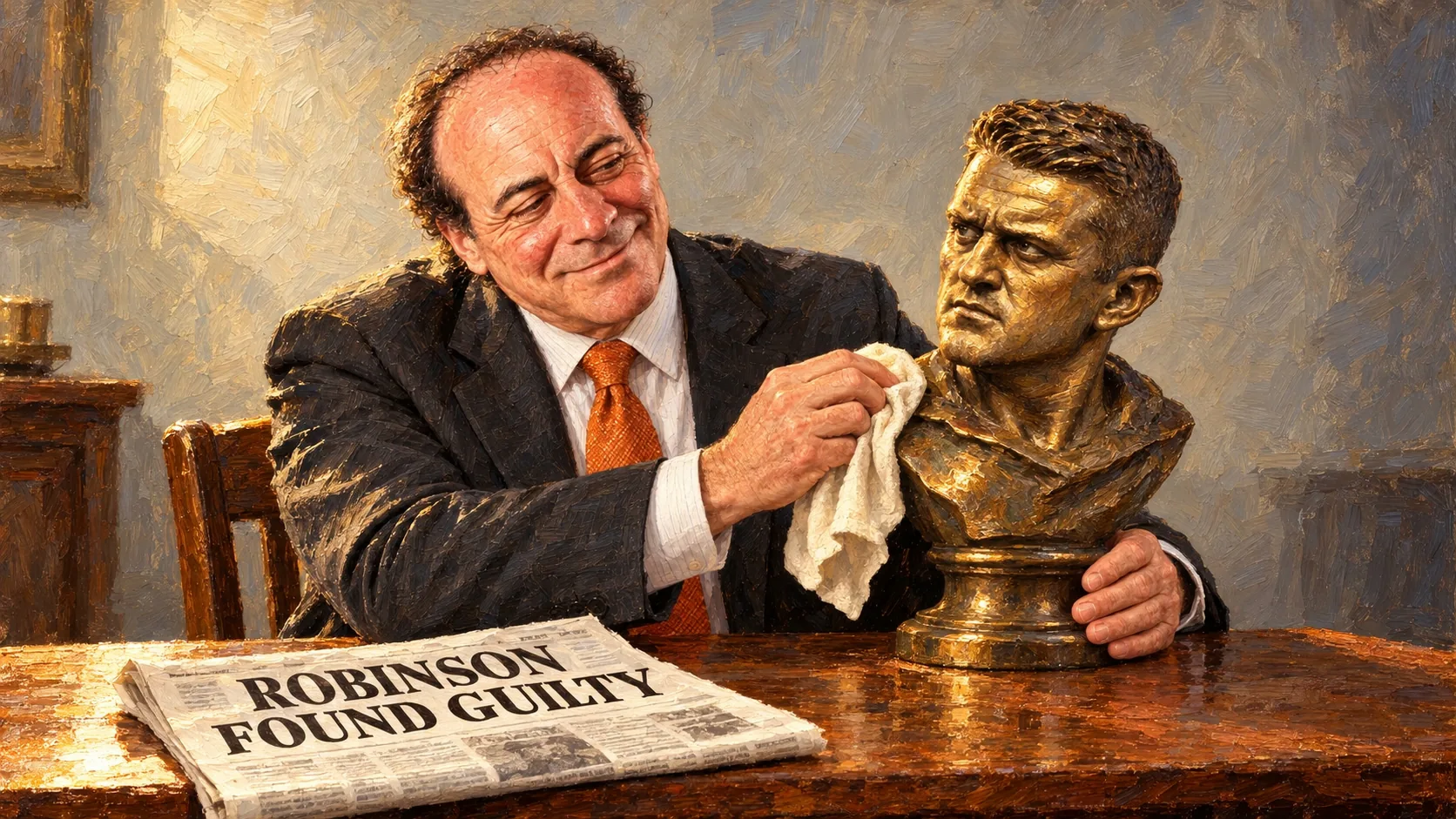
By the time Weinhaus offered his advice, Robinson had left a voice message on the phone of Ted Verity, the Mail’s editor-in-chief, and Verity had given it to the police. On October 20 the jury at Southwark listened to it. “I’m not threatening you with violence or anything like that,” it said. “What I’m promising you is I’ll make you famous and your families.”
Tommy likes voice notes. This one has been written down.
So, as it happens, was the chant.
On December 16 he learns whether he goes back.