The Half Hour
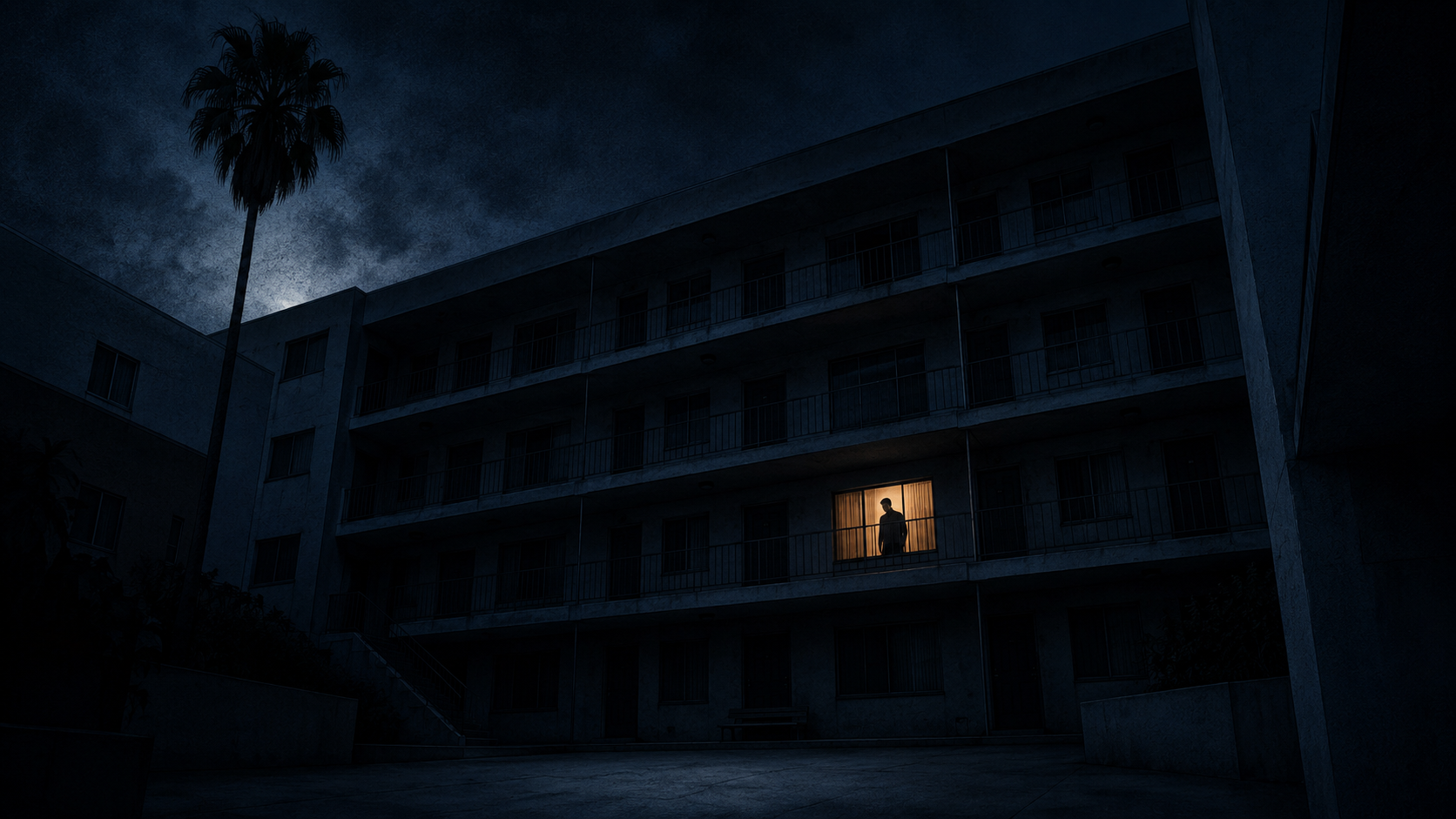
Late on the night of July 22, 2021, several people telephoned the Azusa police to report that a man was behaving strangely in the courtyard of their apartment complex. He was talking to himself, they said. He had threatened a shooting. The callers contradicted one another on whether he was carrying anything. A dispatcher, working from information the building manager supplied, put a name to him: Adrian Rios. A domestic-violence restraining order came up beneath it.
Officers arrived. And then, for approximately half an hour, they watched.
What they saw they later described with little variation. Rios walked back and forth. He repeated a phrase — bang, bang, shots fired — and shaped his hands into the form of a gun. Some of the officers had a clear line of sight; others did not. None of them saw a weapon.
They ordered him to the ground. He did not comply. Several of them moved in to take him into custody.
The nature of the interaction that followed is disputed. Two facts are not.
In the course of handcuffing Adrian Rios, the officers deployed a Taser twice and — the phrase is the Ninth Circuit’s, and the arithmetic is the defendants’ — “by their own description,” punched, kicked, or otherwise struck him at least twenty-four times.
Twenty-four is the defendants’ own count. The Ninth Circuit treats that number, and the two Taser deployments, as undisputed.
Rios suffered serious brain damage. He is now in a persistent vegetative state and has never given an account of that night. Brenda Yvette Ceja, his guardian ad litem, prosecutes the case on his behalf alongside his two children — Adrian Rios Jr. and a minor identified in the caption only as M.P.R.
Every case has a hole in it somewhere. This one has a hole where the plaintiff’s memory should be, and it is the exact shape of the injury he is suing over.
A Rumor with an Excellent Vantage Point
There was one civilian who said he had seen it happen. For a long time that was all anyone knew about him.
He lived in the complex. He came to Rios’s lawyers in the weeks after the encounter and told them he had watched the beating. Then he closed. He would not provide a detailed statement. He would not give his name.
The opinion does not record his reasons. It records the consequence, which inside a lawsuit runs close to total.
Without Brown’s identity, Rios’s lawyers could not disclose him by name under Rule 26 or put his sworn account into the summary-judgment record. He could not function as an ordinary disclosed witness until counsel knew who he was. For the case, he remained a rumor with an excellent vantage point.
And so the case proceeded the way such cases proceed when the people best positioned to describe the disputed encounter include a man who will not speak and a man who cannot. Rios, through Ceja, and his children sued the City of Azusa, Los Angeles County, seven named officers — Benjamin Cypher, V. Garcia, Richard Martinez, Steven D. Sears, Michael Deanda, Michael Wise, and Zachary Chadwick — and a paramedic, asserting excessive force and other constitutional violations under 42 U.S.C. § 1983, an array of California tort claims, and claims under the Americans with Disabilities Act. The courtyard would have to be reassembled out of dispatch logs, medical records, the officers’ own narratives, and whatever the callers could still recall.
Brown’s Own Lawsuit
He returned through a door marked with his own grievance.
During discovery, plaintiffs’ counsel became aware that a man named Michael Brown, a resident of the same apartment complex, had filed a pro se complaint against the Azusa Police Department over an unrelated use of force. They interviewed him promptly.
During that interview, counsel realized Brown was the anonymous witness they had spoken to years earlier, after Rios was injured.
This time he was willing.
The Ninth Circuit does not say how Rios’s counsel first learned of Brown’s complaint. It says that, during discovery, they became aware of his pro se excessive-force case, promptly interviewed him, and recognized him as the man who had described Rios’s beating years earlier.
A few days before the close of discovery, plaintiffs supplemented their Rule 26(a) initial disclosures — which had not identified Brown — to name him as a person likely to have discoverable information. His declaration followed and was attached to their opposition to summary judgment.
A Testimony Made of Negatives
Brown’s declaration is built almost entirely out of things that did not happen.
Rios moved his hands and arms like a gun and said words about a gun, Brown swore, but it was easy to see that he did not have a gun. As the officers approached, Rios “did not move in any manner I would describe as a fighting stance or threat.” Rather than threatening them in any way, Brown said, Rios “lay down on his stomach in front of them,” and it appeared to Brown that “he was obeying their command to get down.”
Then, in Brown’s account, the officers “proceeded to kick Mr. Rios repeatedly while he lay on the ground defenseless.” He “was not fighting back.” He “did not reach for a taser or swing at the officers.” He “did not appear to be resisting in any way.” Afterward, “[o]ne of the officers knelt on top of Mr. Rios near his head or neck.”
The verbs divide along a clean line. Rios’s are negations — did not move, was not fighting, did not reach, did not swing, did not resist — broken once by the single affirmative act of lying down. The officers approach. The officers kick. One of them kneels.
Active resistance is one of the facts courts consider when judging force under the Fourth Amendment, and Brown’s declaration addresses it again and again in a single paragraph.
That is why the declaration became the object of everything that followed.
The Remedy on the Table
The defendants moved to strike it under Federal Rule of Civil Procedure 37(c)(1), the provision that bars a party from using a witness it failed to disclose as Rule 26 requires, unless the failure was substantially justified or harmless. Brown had been identified days before discovery closed. That was not justified, they argued, and it had cost them something concrete: the opportunity to take his deposition.
Judge Wesley L. Hsu denied the motion, and he denied it twice over.
He denied it on the merits first, finding that the plaintiffs had “timely disclosed Brown as a potential witness soon after learning that he saw the incident with Rios.” On that record, the court found no untimely withholding of Brown’s identity.
He also addressed the prejudice the defendants claimed. “Regardless,” the court said, it would “extend the discovery deadline” so that the defendants could depose Brown “if they so wish.”
The injury the defendants had described was a lost deposition. The district court put the deposition back on the table.
The court went on to deny summary judgment in relevant part, holding that “viewing the facts and evidence in the light most favorable to Rios, a rational jury could find that the Officer Defendants used excessive force against Rios in violation of clearly established law.” Portions of the state-law and ADA claims survived as well.
The ruling made no finding that Michael Brown was telling the truth. The court did not weigh his credibility; it asked whether, viewing the evidence in Rios’s favor, a rational jury could credit his account.
The defendants appealed.
The Limit on an Immediate Immunity Appeal
Section 1291 generally gives federal courts of appeals jurisdiction over final decisions. An order denying summary judgment is ordinarily not final: it leaves the case headed toward trial.
Qualified immunity creates a limited exception. Because immunity is, in Mitchell v. Forsyth‘s formulation, “an immunity from suit rather than a mere defense to liability,” an official may immediately appeal a legal ruling denying qualified immunity. Waiting until after trial would defeat the protection from trial that the doctrine provides.
Johnson v. Jones supplies the corresponding limit.
Under Johnson, appellate judges may determine the legal consequences of an assumed set of facts. They may not review the part of a summary-judgment order that resolves “only a question of evidence sufficiency, i.e., which facts a party may, or may not, be able to prove at trial.” The Ninth Circuit’s own recent restatement, in Peck v. Montoya, is plainer: an official may not immediately appeal a fact-related dispute about the pretrial record.
The district court and, if necessary, a jury determine which version the evidence supports. An officer may seek immediate review of whether assumed facts violate clearly established law; he may not use that appeal to relitigate which facts the plaintiff can prove.
Menocal and Final Decisions
Earlier in 2026, while this appeal was under submission, the Supreme Court decided GEO Group, Inc. v. Menocal.
The question was whether a government contractor could immediately appeal the denial of Yearsley protection. The Court held that it could not: Yearsley supplies a potential defense to liability rather than an immunity from suit, so a pretrial denial of that protection is not immediately appealable. Justice Kagan wrote the Court’s opinion; Justices Thomas and Alito wrote separately. The collateral-order doctrine, the Court reiterated, is narrow and stringent.
Judge Miller cites Menocal for the baseline rule that appellate jurisdiction generally runs to final decisions. Rios then turns on the separate, established limit from Johnson: an interlocutory qualified-immunity appeal does not carry a dispute about which facts the evidence can prove.
“In this case, however, it is not difficult at all.”
Judge Eric D. Miller
The Sentence
The Ninth Circuit has acknowledged more than once that the boundary it was asked to police here is a hard one to see — that “the distinction between making sure that only ‘reasonable inferences’ are drawn (which we may do) and answering questions of ‘evidence sufficiency’ (which we may not) is often difficult to discern.”
“In this case, however,” Judge Miller wrote, “it is not difficult at all.”
Everything in the opinion turns on a single absence in the briefs.
The defendants made no argument about what inferences should be drawn from the record that did not begin by assuming Brown’s declaration had already been excluded. And — this is the opinion’s own emphasis — “[c]rucially, they do not argue that, if Brown’s declaration is included as part of the summary-judgment record, they are nevertheless entitled to qualified immunity on the excessive-force claim.”
They never argued in the alternative. If Brown’s declaration remained in the record, their appellate theory ended.
The panel then cited two precedents addressing force against nonresisting or compliant people.
See Blankenhorn v. City of Orange, recognizing that clearly established law prohibits gang-tackling a relatively calm suspect who was not at that moment actively resisting, without first attempting some less violent means of arrest.
See Drummond v. City of Anaheim, recognizing that clearly established law prohibits the application of bodyweight pressure to the back of a compliant individual.
Those two propositions align with Brown’s declaration almost clause for clause. A man on his stomach, apparently obeying. Not resisting in any way. Kicked. An officer’s weight coming down near his head or neck.
The panel did not decide whether Blankenhorn or Drummond controlled the merits. The citations showed why the omitted alternative argument mattered: Brown’s account implicated clearly established limits on force against nonresisting or compliant people.
Their argument went instead to which facts were properly before the district court at all. That is a question of evidentiary sufficiency. Johnson forecloses it. The panel therefore had no jurisdiction to review the denial of qualified immunity.
Because the officers’ theory depended on excluding Brown’s declaration, the dispute concerned evidentiary sufficiency. Johnson placed that question outside the Ninth Circuit’s interlocutory jurisdiction.
The Rule 37 Route
The defendants also presented the issue under a second heading: abuse of discretion in the denial of a Rule 37 motion.
That framing produced the same jurisdictional result. Discovery rulings are not final decisions and are not immediately appealable — Mohawk Industries v. Carpenter, Admiral Insurance.
So the defendants reached for pendent appellate jurisdiction, the narrow allowance recognized in Swint v. Chambers County Commission for reviewing an otherwise nonappealable ruling that is inextricably intertwined with, or necessary to meaningful review of, an order properly on appeal. The theory has an intuitive pull: an appellate court, they said, can conduct meaningful review only if it knows what evidence was properly within the district court’s purview.
Pendent appellate jurisdiction requires an appealable ruling to which the otherwise nonappealable issue can attach. Because the panel lacked jurisdiction over the qualified-immunity denial, there was, in the Seventh Circuit phrase Judge Miller quoted from McKinney v. Duplain, “no appealable claim on which a pendent claim could attach.”
The panel added that even a reviewable qualified-immunity ruling would have reached only the individual officers and the § 1983 claims. Qualified immunity supplied no basis to review the claims against the City of Azusa, the California tort claims, or the ADA claims.
The appeal therefore came back to the same evidentiary point: Brown’s sworn declaration remained in the summary-judgment record.
Dismissed in its entirety
The Record That Remains
Nothing in this opinion determines what happened in that courtyard.
The Ninth Circuit made no finding that the officers used excessive force. The panel made no finding about whether Michael Brown is credible or accurate. If the case reaches a jury, Brown’s perception, consistency, vantage point, and prior statements may be tested through the ordinary trial process.
The court decided a question about its own jurisdiction, and it decided it narrowly. The case continues in the Central District of California with Brown’s declaration still part of the summary-judgment record; Judge Hsu had already offered the defendants additional discovery to depose him.
Rios is the person best positioned to describe what happened to him, and the brain injury at issue prevents him from doing so. If a jury eventually decides the case, it will do so without his account. The injury underlying the suit is also what prevents him from describing the encounter himself.
Years later, Brown reentered the case after counsel learned of his own pro se excessive-force suit. He was now willing to give his name and a declaration.
The officers’ appeal would have removed Brown’s declaration from the summary-judgment record. Cross-examination, contradiction, impeachment, and the additional deposition time Judge Hsu offered remained available. The question on appeal was whether the Ninth Circuit could review Brown’s inclusion before final judgment.
The Ninth Circuit held that it could not review that evidentiary ruling through this interlocutory qualified-immunity appeal. The district court retains the ordinary authority to manage discovery and the trial record, subject to appellate review at the proper time. Five years after the courtyard, the published holding is narrow: Brown’s inclusion could not be relitigated through this immediate appeal.
Adrian Rios remains in a persistent vegetative state.
Michael Brown’s declaration remains in the record.