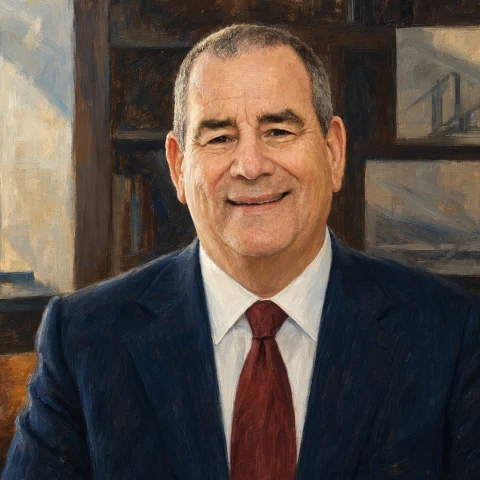
Kevin R. Dean
Wrongful Death · Catastrophic Fire Litigation · Vehicle Defects
Meanwhile, we are continuing to investigate and test the airbags that are being put into vehicles now, to determine potential future risks, working closely with forensic expert Bill Williams of WISAT.
Charleston Fire Litigation v. Sofa Super Store: Nine Firefighters’ Families, Unpermitted Additions and $18 Million in Settlements
Kevin R. Dean’s firm represented Firefighter Melvin Champaign’s estate in the first suit over the 2007 Sofa Super Store fire, which killed nine Charleston firefighters, and Dean served as co-lead counsel in the consolidated case, where settlements passed $18 million by 2011. In the Takata airbag cases he pressed for the recalled inflators to be preserved for independent testing and represented injured drivers on the committee in Takata’s bankruptcy.
In 1998 or 1999 Mike Benke and Richard Koger walked through the Sofa Super Store on Savannah Highway in Charleston to pre-plan it for a fire. Koger, a retired captain, remembered what Benke said during that visit: “Someone’s gonna die if we ever have a fire in this building.” When Koger heard the store’s name on June 18, 2007, he said, he froze. Captain Mike Benke was one of nine Charleston firefighters who died inside the store that night.
Firefighter Melvin Champaign was another. Champaign, forty-six, was an Army veteran who had been a Charleston firefighter for two years, working out of Station 16 in West Ashley, and an aspiring pastor who studied the Bible with his uncle, the Rev. Hercules Champaign. His sister, Pamela Wiggins, was at home when she learned of the fire, and the last time she saw her brother was in the television coverage. “I saw my brother help somebody come out,” she said. “Then he went back in.” The last four words Champaign spoke over his radio were “In Jesus Name… Amen.”
Carl Champaign Sr., his cousin and the representative of his estate, filed the first lawsuit over the fire on October 1, 2007, for the benefit of Champaign’s three minor children and his other beneficiaries. Motley Rice, Kevin R. Dean’s firm, and Gergel, Nickles and Solomon represented him. The complaint accused the store and twelve other defendants of gross negligence and sought damages for grief, sorrow, mental shock and suffering. It said that thick, toxic smoke, locked doors and the store’s confusing layout had left Champaign knowing that he could not escape and was going to die. An OSHA report released on September 20 had already found that the store failed to adequately protect its own employees on the night of the fire.
The suit went after the present and former owners of the site, the companies that built the store’s fire doors, and the manufacturers of the furniture on its floor. It alleged that the owners had built without proper permits, including an unauthorized loading dock where employees were allowed to smoke; that the electrical shut-off had been placed inside the building, so that someone had to go into the store during a fire to reach it; that malfunctioning fire doors failed to stop the fire once it reached the showroom; that exit doors were locked; and that furniture made with highly flammable polyurethane foam created what the suit called a “toxic, ultra-hazardous” environment. The family suggested that smoking materials had ignited varnish or other flammable materials around the covered loading dock. Dean said the case sought the truth about “the condition and content” of the building in which nine men died, and accountability from those whose actions contributed to the “needless death” of Champaign and the others.
A Dock Roof, Heather Baity’s Suit and the City’s Code Findings
Within ten days of the fire, Laura Cabiness, Charleston’s public services director, said the roof over the store’s loading dock had been built without a required permit. City officials had not known about the work until The Post and Courier published aerial photographs of the burned store. “Anytime you modify anything, particularly with a commercial building, you are required to get a permit,” Cabiness said. Colleen Troy, a spokeswoman for the store, said Herb Goldstein had not thought a permit was needed. Employees who loaded and worked on the dock had complained about the heat, she said, so it was covered sometime after 2001; the dock itself had been there since the 1990s.
Engineer Brad Baity had come to firefighting through a Marine Corps crash crew that fought aircraft fires. He joined the James Island Fire Department in 1997 and the Charleston Fire Department in September 1998, usually worked out of Station 19 beside his close friend Earl Drayton, who also died in the store, and served as treasurer of the local chapter of the firefighters union. He had married Heather Baity in 1993. On April 11, 2008, she sued the store’s owners, several furniture manufacturers, a building contractor and the companies that built the fire doors. Dean represented her, along with Thomas Woodley, who also represented the International Association of Fire Fighters.
“Brad Baity’s family is looking for more answers as to the factors that contributed to his death in June 2007,” Dean said. “As they continue to grieve over the loss of their loved one, they seek accountability as well as a hope for change in industry standards to prevent others from having to face a similar tragedy.” Jim Baity, the engineer’s father, backed his daughter-in-law’s decision to sue. “It’s still a shock to us,” he said. Larry Richter, another of the families’ lawyers, was preparing suits for the families of Captain Louis Mulkey and Captain Mike Benke, and he said those suits would not name the city or its fire department.
In May 2008 the City of Charleston released a fire review team report it had paid for. The main showroom had been built as a grocery store, probably in the 1950s or 1960s. After the property became a furniture store, metal showrooms were added on the west side in 1994 and the east side in 1995, and a metal warehouse went up at the rear in 1996. The team found that four additions had been built between 1996 and 2005 without permits, filling the spaces between the warehouse and the showrooms and eliminating the separation between the buildings, and that on the night of the fire no effective fire walls or physical separations stood between the loading dock area, where the fire started, and the three spaces adjoining it. The unpermitted construction had also invalidated the code provision that allowed the main buildings to be built without automatic sprinklers.
The loading dock had been enclosed with a wood frame covered in sheet metal, without permits and not to code, and was used to store furniture. Combustible materials were stored where employees were allowed to smoke, and some pathways were obstructed. The showrooms were crowded, with narrow aisles between the displays. The fire had begun in discarded furniture and materials outside the loading dock, and the team named careless disposal of smoking materials as the suspected cause. “The fire could have been prevented,” the report said. “If the property had been constructed and maintained in accordance with state and local codes, the fire would have been quickly controlled.”
After reading the analysis, Dean said, “It looks to me like the city copied my lawsuit.” By then Motley Rice represented three of the families that had sued. Richard Rosen, a lawyer for the store, noted that the city had commissioned the analysis and said the defense was reviewing it. “We have already noted several inaccuracies, including the characterization of the deck, which was not a smoking area,” he said.
A Loading Dock Missing From the 1994 Aerial Photographs
The National Institute of Standards and Technology published its technical study of the fire in March 2011. Aerial images showed no loading dock at the store in 1994 and a loading dock in 1998. On June 18, 2007, fire was observed at the rear of the store at 6:56 p.m.; it began in trash outside the loading dock and spread into the enclosed dock. The store’s buildings included a distribution warehouse of about 15,800 square feet, a main showroom of about 17,100 square feet and a west showroom of about 7,020 square feet. No fire sprinklers had been installed in the showrooms or the warehouse.
The Charleston Fire Department arrived at 7:11 p.m., less than four minutes after dispatch. Only three of the store’s seven roll-down fire doors activated and closed fully. In the warehouse behind the showrooms, Jonathan Tyrrell III, a twenty-eight-year-old employee from Johns Island, was trapped in a small workshop as smoke filled it. His call to 911 went through, and a dispatcher transferred him to a firefighter outside. He gripped a hammer and started banging so that rescuers could find him. On the other side of the wall, firefighters used their axes to rip through the metal siding until the hole was large enough to pull him out. “Another two minutes and he would have been dead,” Assistant Chief Larry Garvin said.
Sixteen to nineteen minutes after the department arrived, radio traffic showed that firefighters inside might be disoriented or lost, and a Mayday went out. As windows broke, additional air flowed into the showroom and fed the fire burning at its rear, and the fire spread extremely rapidly from the back of the showroom to the front. It trapped six firefighters in the main showroom and three in the west showroom, where Champaign, Michael French and Benke were not far from an exit door that was padlocked shut. About forty minutes after the department arrived, the roof over the west side of the main showroom collapsed. The coroner found that the nine died of thermal burns, smoke inhalation or both, not of compression injuries. The dead were Engineer Brad Baity, Captain Mike Benke, Firefighter Melvin Champaign, Firefighter Earl Drayton, Assistant Engineer Michael French, Captain Billy Hutchinson, Engineer Mark Kelsey, Captain Louis Mulkey and Firefighter Brandon Thompson. No single incident had taken more firefighters’ lives since the attacks of September 11, 2001.
Ten years later Dean described what the firefighters had walked into. “It moved from the outside to the inside of the building very rapidly,” he said. “It just caused mass confusion when those nine guys went in.” He said the store’s owner had not been spending money to update the building or on “servicing these fire doors that should have slammed shut to block off the spread of the fire.” “The firefighters were serving their community, protecting property, and protecting life,” he said of the nine. “So none of them did anything wrong. They just didn’t know what they were getting into.”
NIST also modeled the fire with sprinklers in the loading dock. “Computer model simulations demonstrated that fire sprinklers in the loading dock would have controlled the fire and prevented the fire from extending beyond the loading dock,” the study concluded. NIST recommended that the model codes require sprinklers in every new retail furniture store regardless of size and in every existing furniture store with a single display area larger than 2,000 square feet, and that state and local authorities adopt and aggressively enforce those provisions. Sofas, recliners, mattresses and upholstered chairs, NIST noted, typically contain significant amounts of polyurethane foam.
Nineteen Suits and More Than Two Dozen Defendants
Nineteen suits were eventually filed, by the estates of all nine firefighters and by ten firefighters who survived the fire with injuries. The families’ wrongful-death claims were consolidated in the Court of Common Pleas for the Ninth Judicial Circuit as Charleston Fire Litigation v. Sofa Super Store, Inc., et al., No. 07-CP-10-3186. Dean served as co-lead counsel, working with Dennis O’Neill of O’Neill & Phipps, Lawrence Richter of The Richter Firm, Carl Solomon of The Solomon Law Group, David Whittington of Knight Law Firm and Thomas Woodley of Woodley & McGillivary. By the end he represented four of the nine families.
Champaign’s complaint named thirteen defendants, from Sofa Super Store, Inc. and the Goldstein Family Limited Partnership to furniture makers including Ashley Furniture Industries and Klaussner Furniture Industries. The field grew past two dozen. Furniture makers, contractors and installers of building components settled before the store did, and one group of defendants resolved all claims and potential claims in a settlement on December 5, 2008. That left Sofa Super Store, Herb Goldstein, its primary owner, and the companies connected to them.
The settlements came in rounds. In February 2010 Albany Industries agreed to pay $500,000, David Miller Concrete $125,000, Robinson & Robinson Furniture $100,000 and Best Chairs Inc. $88,888, and Overnight Sofa Corp., Pembrook Chair Corp., Hughes Furniture Industries and Motion-Eaze Recliners agreed to pay $400,000 together. The suits alleged that the furniture makers had failed to warn that their products contained flammable polyurethane foam. By March 2010 the settling companies had agreed to pay a cumulative $8.4 million to the families of eight of the nine firefighters.
Engineer Mark Kelsey’s family had not yet sued. His funeral, the last of the nine, was held in his family’s hometown of Washington, Indiana, and Kevin McClain, an assistant chief of the Vineyards Fire District, escorted his body there on two commercial flights. Kelsey’s only child, Paul, was fourteen when his father died. In March 2010 the family filed a wrongful-death suit for Kelsey’s estate against the store, Herb Goldstein and his family companies, Feltmann & Associates Inc., Conklin Company Inc. and DuPont Performance Elastomers LLC. Dean represented the estate. The family had waited, he said, until Paul, then seventeen, was old enough to understand the issues involved and take part in the process. By then the family had reached settlements of about $800,000 with the companies that had paid the other families, which Dean said brought them in line with the shares the others had received. In 2017 Paul Kelsey still kept one of his father’s firefighting helmets. “I love my dad to death, but I don’t want to remember him in death,” he said.
The Store Points to the Fire Commanders
The store’s lawyers answered that “negligence and incompetence” on the part of the city and its fire commanders contributed to the deaths. Fire experts hired by the city had concluded in 2008 that inadequate training, outdated tactics and aging equipment contributed to the deaths of the nine. The store pushed to add the City of Charleston as a defendant, a step that could have reduced any award the store and Goldstein might have had to pay.
In court filings in the summer of 2009, the store’s lawyers said the city had been “grossly negligent” and “reckless” about the safety of its firefighters. The city’s lawyers answered that it could not be made a defendant, in part because the death claims had already been settled under workers’ compensation. That summer a judge barred the city from the case, on the ground that South Carolina law made it immune from liability. The store’s owners appealed, and the ruling was still under appeal when the last defendants settled.
In 2010 the store went after the city’s files. A six-member team of fire experts hired by the city had produced some 47,000 pages of material, culled from a computer hard drive, and the store’s lawyers accused the city of ignoring a court-ordered July 15 deadline to hand them over and moved for sanctions. “The city’s own documents demonstrate gross negligence on behalf of the city, its fire department and leadership,” said Richard Rosen, the store’s lawyer. In September Dean accused the store’s legal team of staging a witch hunt. In October, having received the documents, the store dropped its sanctions motion.
The case stalled for years because of what Dean called “delay tactics” by Sofa Super Store and Goldstein, and he pointed specifically to the attempt to bring the city in as a co-defendant. Suits against the store by nine former firefighters, who sought damages for physical and emotional harm, lengthened the process further.
$1.9 Million From the Goldstein Defendants
The last defendants settled in June 2011. Sofa Super Store; Herb Goldstein; Herbert A. Goldstein, LLC; the Goldstein Family Limited Partnership; and Furniture Retailers of Charleston, Inc. agreed to pay $1,882,400, about $1.9 million. The settlement was finalized on June 24, approved by all parties and by the court, and released the remaining defendants that the December 2008 settlement had not covered. The money was divided among the nine families, between $184,000 and $228,000 each. The store and its owners also settled with nine former firefighters who had sued over physical and emotional ailments from the fire. Dean put the total at more than $18 million in settlements paid out over four years of litigation against more than two dozen defendants. Each family had separately received between $640,000 and $775,000 from workers’ compensation and a public fund for the firefighters’ families.
Dean said the families had decided that settling at that point was in their best interest. “It just came to the point where it was not worth the continuing aggravation,” he said. Part of the reason, he said, was “the emotional trauma that they’ve had to go through for four years and not being able to close this chapter.” He called the result a fair resolution of the suit.
“For the families, it’s been a tremendous emotional undertaking that they can now bring closure to and feel like that they’ve brought public awareness to the issue of avoiding these fires and deaths in the future as well as adequately taking care of the families and the over 13 children who lost their fathers,” Dean said. “It’s been a long four years.”
Heather Baity, Brad Baity’s widow and Dean’s client, issued a statement when the settlement was announced. “My children and I, as well as the other Charleston 9 families, have suffered such an immense loss that no other family should ever have to endure,” she said. She hoped the families would keep honoring the memory of the nine and call attention to the negligence and failures that led to their deaths.
Early County, Cumberland and the First Door-Latch Trial
Dean served on the Early County Board of Commissioners in Georgia and remains the youngest commissioner the county has ever elected. He earned his B.A. at Valdosta State University in 1989 and his J.D. at Cumberland School of Law in 1991, and in 1989 he published “The Right to Jury Trial in ERISA Civil Enforcement Actions” in The American Journal of Trial Advocacy. He is licensed in Georgia, Mississippi and South Carolina.
Much of his litigation has involved vehicle defects. Before joining Motley Rice he was on the plaintiffs’ litigation team in Malone v. General Motors Corporation (1998), a defective seat-belt case. He was trial co-counsel in Guzman v. Ford (2001), the first case brought to trial over a defective outside door latch handle, and in Hayward v. Ford (2005), a rollover case. In 2004 he co-wrote “Dangerous Doors and Loose Latches” for Trial magazine.
Fires and workplace deaths recur in the practice. Dean has worked on several investigations of catastrophic fires, and in one reached a multimillion-dollar settlement for the surviving children of a couple killed in a house fire allegedly caused by defective electrical wiring in a golf cart. In another wrongful-death case, for the family of a worker who fell at a Boeing facility and left a widow and two small children, a jury returned an $8.8 million verdict against SAR Automation, L.P.
Ten Percent of the Returned Inflators
By January 2015 Dean represented two South Carolina plaintiffs suing Takata. Angelina Sujata was eighteen on March 2, 2012, when her Honda Civic rear-ended a driver who had stopped abruptly on the highway; her suit alleged that the Takata inflator in her airbag exploded and sprayed shrapnel into her chest and face. The complaint in Lyon v. Takata alleged that a car’s frontal airbags had delayed and then burst forward with enough force to cause serious head, neck and chest injuries. When Dean tried to buy inflators from LKQ, which sold recycled original-equipment auto parts, the company could not sell him any. Takata had agreed to purchase LKQ’s entire inventory.
Dean feared that Takata would destroy the returned inflators in its own testing, leaving few or none for injured people to test independently. On January 9, 2015, he filed an emergency motion for a preservation order. Honda, Takata and the National Highway Traffic Safety Administration objected at once. The companies argued that no evidence was in danger and that an order would interfere with the multidistrict litigation, then in its first stages. NHTSA said a preservation order would abruptly halt Takata’s testing, which it called essential to its own safety investigation. In reply Dean pointed out that NHTSA itself had expressed doubts about Takata’s honesty and organizational skills.
On February 25, 2015, NHTSA changed its position. Transportation Secretary Anthony Foxx announced an order requiring Takata to keep every inflator removed in the recalls as evidence, both for the agency’s investigation and for private lawsuits, and to set aside 10 percent of them for private plaintiffs to test. Anyone who wanted access had to accept the order’s terms, which gave NHTSA all the test data. “I’m very pleased by NHTSA’s preservation order,” Dean said. “It has accomplished the underlying basic request that we were making,” he said: chiefly, keeping 10 percent of the returned inflators in each state for testing and analysis by the plaintiffs’ experts.
Motley Rice had hired Bill Williams, a forensic automotive expert, to test Takata airbags independently, and by May 2015 Dean and Williams were the only people known, besides Takata, to be testing recalled airbags. Williams documented three ruptures, one of them showing shrapnel flying toward the driver. His team opened randomly selected Takata airbags and found cracks, rust and other evidence of moisture on internal components, including the propellant tablets. “This is the absolute worst automotive products liability defect we’ve ever seen, ever,” Dean told CBS News. That July he said, “Takata knows more than we do about every bit of this, but they’re not coming forward and telling the public.”
Shrapnel in Savannah, North Salt Lake and Sabah
Cedric Walton of Savannah, a Motley Rice client, was driving with his two young children in March 2015 when, his complaint alleged, metal shrapnel shot out of his airbag and cut his throat. “I reached up to try to see where the blood was coming from, and my finger went inside of my throat,” he said.
Randi Johnston, twenty-five, of Centerville, Utah, was driving to work on Interstate 15 in North Salt Lake in September 2015 in a used 2003 Honda Civic EX. Her suit alleged that the driver’s inflator sent shrapnel into her head and neck, severing her trachea and severely damaging her vocal cords; she spent several days in intensive care on a respirator. A Honda dealer that inspected the car before she bought it had not carried out the inflator directive, and the airbag was never replaced. Dean represented her in Salt Lake County against Takata, Honda and the dealer. “Takata and Honda are not working hard enough to track down the recalled cars, fix them or take them off the streets,” he said. Of people who had bought recalled cars used, he said, “the new owners are unknowingly driving ticking time bombs.”
In May 2017 the husband of Dr. Nida Fatin Binti Mat Asis, a twenty-nine-year-old Malaysian government doctor, sued Takata and Honda for wrongful death in the U.S. District Court for the Eastern District of Michigan. On April 16, 2016, her used 2006 Honda City had hit an uneven stretch of road in Sabah, struck a telephone pole and slid into a ditch. The autopsy found metal shrapnel lodged in the base of her skull. Her husband had minor injuries, and their one-year-old son was unhurt. “Sadly, Nida would likely be alive today had the airbag meant to shield her from harm functioned properly,” Dean said. “We seek to prove in court that this tragedy could have been prevented had Takata and Honda placed the safety and well-being of their consumers above deadly, cost-cutting shortcuts by choosing to use the unstable and highly combustible ammonium nitrate in the airbags.”
Takata’s Bankruptcy and the Tort Creditors’ Committee
When TK Holdings announced its Chapter 11 bankruptcy in 2017, the U.S. Trustee in Delaware created a seven-member Tort Creditors’ Committee of personal-injury and economic-loss claimants at the outset of the case. Three personal-injury claimants represented by Motley Rice and co-counsel were selected to serve on it. The committee gave injured drivers standing in the case, and Takata had to pay for its investigation of the automakers. Dean, who represented injured drivers on the committee, said the automakers were using the bankruptcy to reduce their liability for the airbags they had installed.
Dean wrote that July that nearly two-thirds of the recalled inflators had not been replaced and were still on the road. He described a death Honda had just linked to a Takata inflator: a man repairing a 2001 Honda Accord in June 2016, with the car in park, was killed when the airbag somehow activated and its inflator ruptured, “sending shards of metal flying and killing the man.” He also wrote that “we are continuing to investigate and test the airbags that are being put into vehicles now, to determine potential future risks, working closely with forensic expert Bill Williams of WISAT.”
In January 2018, when Judge Brendan Shannon of the U.S. Bankruptcy Court for the District of Delaware cleared the plan for a creditor vote, it proposed a fund for people hurt by airbags in Honda vehicles, paying from $10,000 for bruising to $5 million for death or loss of eyesight, and it barred car owners from suing Honda. Sander Esserman, a lawyer for car owners seeking recall costs, said the trust limited consumers’ rights by barring punitive damages and paying compensation in installments, and Shannon raised the possibility that he might not approve the Honda fund. In February the committee of injured drivers dropped its objection to the plan in return for a contribution from thirteen automakers to Takata’s estate, which Joe Rice of Motley Rice, who represented dozens of injured plaintiffs in the bankruptcy, put at about $80 million to $130 million. Honda agreed to compensate injuries linked to its vehicles in full and not to contest fault, and the twelve other automakers had eighteen months to join the trust if they agreed to compensate drivers in full.
Shannon approved the plan on February 16, 2018. A personal-injury and wrongful-death trust funded by TK Holdings was estimated at $90 million to $137 million, and Eric D. Green, the special master already administering the $125 million restitution fund in Takata’s criminal case, was to oversee claims as its trustee. Under a channeling injunction with Honda North America and its affiliates, Honda agreed to waive defenses such as the statutes of limitations and repose and contributory negligence, and to pay “100 percent of compensatory damages without any credit for fault placed on Takata, third parties or the victims.” A claimant unhappy with Honda’s offer could opt out and sue. Dean expected the trust to begin taking claims within months, on a standard form with photographs, damages information, possible vehicle inspections and an appeal for claimants who did not like their awards. By then Dean counted 23 people killed worldwide and roughly 270 others with life-altering injuries.
Dean credited the committee. Its creation, he wrote, gave personal-injury and economic-loss victims “a voice equal to that of the Original Equipment Manufacturers” and let them negotiate the two resolutions the court approved; he judged them “a much more favorable outcome” than the victims would have received had they not intervened and stopped the first plan Takata and the automakers put forward. He serves on the Trust Advisory Committee for victims of the airbags.
The SCAJ Presidency and the ARC Inflator Claims
At the South Carolina Association for Justice’s 2026 annual convention in Hilton Head, Dean was sworn in as the association’s president. He had served on its Executive Committee and on its Board of Governors for the Ninth Judicial Circuit.
His airbag work now extends to a second inflator maker. In 2023 NHTSA tentatively concluded that inflators made by ARC Automotive were defective and asked the company to recall 67 million of them, used in driver and passenger front airbags; at least 33 million vehicles in the United States could be affected. ARC inflator explosions had killed two people in the United States and Canada and injured at least seven others. ARC refused, saying no safety defect existed and that NHTSA lacked authority to order a parts maker to conduct a recall. Dean represents consumers who own vehicles with ARC inflators or were harmed by them, as well as people harmed by airbags that did not deploy.