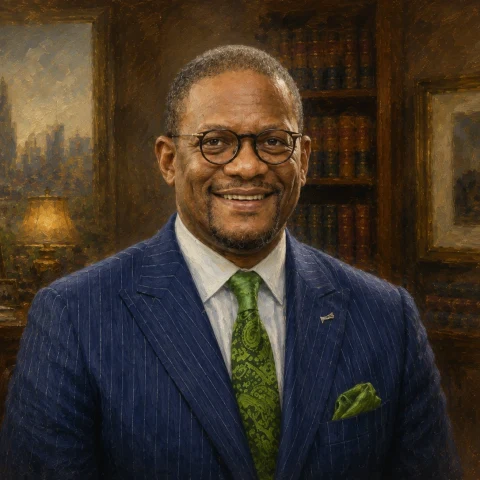
L. Chris Stewart
Civil Rights · Wrongful Death · Negligent Security
This is a direct violation of their own rules. You cannot use a Taser to escort or prod a subject.
From East Point’s Taser Logs to North Charleston’s $6.5 Million Walter Scott Settlement
In 2014 L. Chris Stewart sued East Point, Georgia, over the death of Gregory Towns, a handcuffed man on whom, Stewart said, two officers had triggered their Tasers 13 times. A year later North Charleston’s council voted 10–0 to pay Walter Scott’s family, whom Stewart represented with Justin Bamberg, $6.5 million.
On the afternoon of April 11, 2014, in a stretch of woods near a townhouse complex in East Point, Georgia, Gregory Towns kept telling the police he was tired. He was 24. He had run into the woods when an officer tried to detain him, and when Officer Irving Johnson caught him he said, “okay, you got me,” and put his hands behind his back. Over about 20 minutes Sgt. Marcus Eberhart and Cpl. Howard Weems used their Tasers on the handcuffed man in drive-stun mode to force him to walk out of the woods. Eberhart told Weems to “tase his ass” if Towns did not get up. When another shock was threatened, Towns said, “Give me a second, I’m tired.” He said he had already been tased ten times and could not get up, and he asked to be carried out. Eberhart tased him at least twice while he sat in a creek. Towns eventually stopped talking, and at 4:33 p.m. he was pronounced dead.
L. Chris Stewart, his family’s lawyer, built the wrongful-death claim against the city on East Point’s own records and on eyewitness accounts: Taser logs that, he said, showed far more trigger pulls than the officers had reported, and the department’s Taser procedures, which he said the officers had broken. “The police officer writes the report, not the victim,” Stewart said in 2020.
Within a year Stewart was representing Walter Scott’s family, whom North Charleston’s mayor approached about a settlement within days of Scott’s death in April 2015. East Point settled after Stewart sued it; North Charleston settled before anyone sued. Stewart has carried the police cases alongside a trial practice in negligent-security and sexual-assault claims.
Five in the Incident Reports, Thirteen in the Taser Logs
East Point officers had come to the complex on a domestic-disturbance call and encountered Towns as he walked out through a gate. After Johnson handcuffed him, Eberhart and Weems were the officers who used the Tasers. Their incident reports said they had used their Tasers five times to keep him moving because he refused to walk toward their patrol car.
The Tasers kept logs. Stewart said those logs, combined with other information from the city, showed that the two officers had triggered their weapons 13 times around the time in question—ten times for Eberhart, three for Weems—though he acknowledged that the records did not show the Taser making contact on every pull. The officers used the Tasers to try to make Towns get up. A witness photographed them trying to get him to stand after they had chased him almost a mile, and Stewart later released the photograph. Stewart described the man on the ground: “He wasn’t cursing. He wasn’t being abusive. He was saying, ‘I’m tired.’”
East Point’s internal affairs investigation summarized what the other officers at the scene had said. Johnson had requested an ambulance for Towns after he complained of just being tired. Officer Nicole Allen said Towns got up with help, walked several feet and stopped, a sequence that “repeated itself at least twice,” and the report recorded that she “did not understand, and became frustrated, as to why they would Taser the suspect while only getting the same results.” Eberhart resigned in lieu of termination. Stewart said he could prove that Towns had not been resisting when he was shocked in handcuffs.
Stewart measured the officers against East Point’s own policy. “This is a direct violation of their own rules. You cannot use a Taser to escort or prod a subject,” he said. The officers’ own reports described shocks used to move a handcuffed man toward a car, the use Stewart said the rules forbade. In August 2014 he filed a wrongful-death suit against the city of East Point on behalf of the Towns family. “This situation is indefensible,” he said.
East Point’s strongest defense lay in the medical findings. The Fulton County medical examiner’s office gave the cause of death as “electrical stimulation” and “hypertensive cardiovascular disease exacerbated by physical exertion,” which left room to argue that a heart condition and exertion, rather than the shocks, killed Towns. The city did not take that argument to a jury. By early November 2014 East Point had agreed to pay the family $1 million, the maximum its insurance policy covered. During the negotiations, Stewart said, the city confirmed that every East Point officer who had been issued a Taser had been retrained on the device since Towns’s death. By then one of the two officers had been fired and the other had resigned.
The Taser Data Before a Fulton County Jury
The criminal case came later. A Fulton County grand jury indicted the two officers, and in December 2016 they were tried together. Jason Greensteen testified that he had seen the officers walking Towns through the woods with his hands behind his back and had heard a Taser, and jurors watched the cellphone video he took of paramedics treating Towns. “They were doing CPR and then putting him on a stretcher,” Greensteen said. A neighbor who went to the creek said Towns had looked “asleep with his eyes open.”
The officers’ lawyers said Eberhart and Weems had followed department rules and had no intent to harm Towns, and the officers said he had been too large to carry. East Point’s policy was in evidence. It described the Taser as a tool for violent or actively resisting subjects, and it did not authorize its use “[a]gainst handcuffed subjects” unless “exigent circumstances” existed. Several officers and both use-of-force experts agreed that Towns had been “passively resistant, not actively resistant.” Johnson said that once Towns was handcuffed he was no longer actively resisting, and Allen and a second officer, Robinson, testified that drive-stunning him had been unnecessary. Data downloaded from the two Tasers showed that Weems had pulled his trigger four times and Eberhart ten. A cardiac electrophysiologist testified that the repeated tasing accelerated Towns’s death.
On December 16, 2016, after deliberating about 30 minutes, the jury convicted Eberhart of felony murder, aggravated assault, reckless conduct and violating his oath of office. Weems was acquitted of felony murder and aggravated assault and convicted of involuntary manslaughter, reckless conduct and violating his oath. “This has to stop,” Stewart said that day. “Police officers need to know that if they abuse someone, they are going to go to jail.” Towns’s sister, Tiara, said, “We’re very proud of the outcome.”
Five days later Fulton Superior Court Judge Henry Newkirk sentenced Eberhart to life in prison, with the possibility of parole after 30 years. Weems received five years, 18 months of it to be served in prison, and was ordered to speak during his probation to at least 10 police agencies about the dangers of shock devices like the Taser. Addressing the court and Towns’s family, Weems said, “I’m sorry for the Towns family.”
Eberhart appealed. On October 31, 2019, the Supreme Court of Georgia held that the evidence supported his felony-murder conviction, and Justice Boggs’s opinion closed with the disposition: “Judgment affirmed.” The facts the court set out—the handcuffs, the policy, the data from the Tasers, a young man saying he was tired—were the facts Stewart had put to East Point in August 2014.
A Brother’s Call and a Barber’s Video
On April 4, 2015, North Charleston police officer Michael Slager fired eight times as Walter Scott ran from him. Slager had stopped Scott over a broken taillight. Scott was 50, an honorably discharged Coast Guard veteran with four children, and he worked at a trucking distribution center. Slager said Scott had grabbed his Taser and that he had fired in self-defense. Slager was not wearing a body camera. A bystander recorded the shooting on a cellphone.
Scott’s family had heard about the Towns case. That April a friend sent Stewart a news article over Facebook: her cousin, Walter Scott, had been killed by a police officer, and she was asking for his help. Then his phone rang during an engagement photo shoot with his fiancée, and Scott’s brother was on the line. Stewart remembered what the brother told him: “If you can get here by tomorrow, you’re hired.”
Stewart arrived at the Scott family home in North Charleston in the middle of the night, the day after the shooting, carrying a duffel bag and two suits because he expected a short stay. He did not go home for two months. “They started having to FedEx me suits and clothes,” he said.
The bystander was Feidin Santana, a barber from the Dominican Republic who was walking to work when he heard a Taser and began recording. He thought about erasing the video and leaving town, and changed his mind when he read police accounts that did not match what he had seen. Santana had sent a screenshot of the footage to a Black Lives Matter activist, who told Scott’s family. Stewart and his co-counsel, Justin Bamberg, spent several hours persuading Santana to let them see the video and then to give it to them. “This can’t be real,” Stewart remembered thinking when he saw it. “A police officer wouldn’t just unload on somebody like that.” Before the night was out the lawyers delivered it to the South Carolina Law Enforcement Division.
The video showed Scott running and Slager firing at his back from about 30 feet, with no audible order to stop, and then Slager going back for the Taser and dropping it near Scott’s body. On Tuesday, April 7, the video became public and Slager was charged with murder. Hours later, at a news conference in North Charleston with Scott’s family around him, Stewart said, “This was a cop who felt like he could just get away with shooting someone that many times in the back.” He also asked, “What if there was no video? What if there was no witness, or ‘hero’ as I call him, to come forward?” Slager was fired after his arrest on a murder charge and was indicted for murder that June.
“This is not going to become a circus as long as I’m involved,” Stewart said the next day. “I’m fighting for the family that I was brought here to fight for, period.” Online trolls forced him to hire private security at his house while the case went on.
A Mayor’s Approach to the Scott Family
Within days of the shooting, Mayor Keith Summey contacted the family about a settlement and met with the Scotts and their lawyers, Stewart and Justin Bamberg, a South Carolina state representative. Summey also ordered 150 more body cameras for the department. City attorney Brady Hair said both sides felt it was in everyone’s best interest to reach a resolution and avoid a lawsuit.
On October 8, 2015, the North Charleston City Council voted 10–0 to approve a $6.5 million settlement. Summey called it “a step in the right direction for the family, the city, the Lowcountry, and our state.” Hair described what he saw as different: “What’s different here is there were no acts of violence. There were no buildings burned.” Stewart agreed with Hair that the handling on both sides had been “almost a blueprint of how these situations should be handled.”
Stewart also sized the figure to the city that would pay it. North Charleston is no New York, he noted: “There is no way this city could pay $50 million.” “Governments are listening now and they are not tolerating this type of behavior,” he said.
The family said it was pleased to have resolved “the civil portion of Walter’s death with the City,” and that part of the money would be donated to flood relief. “While nothing can replace having Walter in our lives, the City of North Charleston historic actions ensure that he did not die in vain,” the family said. By the time of the vote, North Charleston’s police officers had been outfitted with body cameras.
Slager’s Plea and Sentence in Federal Court in Charleston
The settlement closed the civil claim and left the criminal case open. Slager’s state murder trial ended in 2016 with a hung jury. On May 2, 2017, he stood before U.S. District Judge David Norton in Charleston and pleaded guilty to a federal civil-rights charge, deprivation of rights under color of law. He admitted that he had used excessive force against Scott and acted willfully with an intent to break the law. Scott was more than 10 feet away when Slager started shooting. Under the plea deal, state authorities dropped the separate murder charge.
“Today, he told the truth,” Scott’s oldest brother, Anthony, said after the hearing. Stewart had represented the family in the city’s $6.5 million settlement nineteen months earlier. “Justice doesn’t look like a big settlement check; it looks like today,” he said. “Today is a monumental day ... for civil rights.”
Norton sentenced Slager on December 7, 2017. He found that the underlying offense was second-degree murder, that Slager had shot Scott with “malice and recklessness,” and that Slager had obstructed justice by giving false testimony to investigators. The guidelines ran from 19 to 24 years, and federal prosecutors had asked for life. Norton imposed 20 years in prison, followed by two years of supervision. Judy Scott, Walter’s mother, told Slager, “I forgive you.”
“Being a police officer is one of the most powerful jobs in the country, and you should be respected,” Stewart said after the hearing, “but it doesn’t mean you’re above the law.” Scott’s death, he said, “can make the next officer think one second longer before pulling that trigger.”
The Trial Practice Behind the Police Cases
Stewart graduated from Xavier University of Louisiana and earned a master’s degree in public health at Tulane. He was working for the Environmental Protection Agency, monitoring cancer clusters in low-income communities, when he sat in a room in a small Florida town where residents believed they had cancer and a company that owned a chemical plant near a water source was suspected of causing it. From another room he heard the company’s lawyers laughing about golf. “If I see something wrong and I think I can do something about it, then I do something about it,” he said.
He took his law degree at Howard University School of Law. “That is ingrained in your DNA at the law school. Your job isn’t just to make money,” he said of Howard. At Morgan & Morgan he made partner at 29 and represented more than 2,500 clients, and he spent 16 years as a personal-injury trial lawyer before civil-rights cases became a large part of his work. Until the Towns case he had mostly handled sexual-assault cases.
He is now managing partner of Stewart Miller Simmons Trial Attorneys in Atlanta, where Justin Miller and Madeleine Simmons are his name partners, and his civil-rights work since the Scott case has included the cases arising from the deaths of Alton Sterling, Ahmaud Arbery, George Floyd and Rayshard Brooks; in the Floyd matter he represented Floyd’s daughter. In 2019 he said his office was turning down 90 percent of the requests it received. “I’ll tell my law partners we’re done with civil rights no more cases,” he said, “and then I’ll call them at 2 in the morning.” “I don’t want to do these cases,” he said. “So if you see me on one it’s a problem, it’s bad.”
A Damages Trial for Hope Cheston in Clayton County
In October 2012, during a friend’s birthday party at the Pointe South Apartments in Jonesboro, an armed security guard raped Hope Cheston, then 14, near some picnic tables. The guard, Brandon Lamar Zachary, was 22; Stewart said he approached Cheston and her boyfriend and told the boyfriend not to move. Zachary was convicted and sentenced to 20 years in prison.
In 2015 her mother sued the guard’s employer, Crime Prevention Agency. Stewart tried the case. He said the guard had not been licensed as an armed guard and should not have been hired. The judge had already ruled the company liable, so the jurors in the State Court of Clayton County decided the damages, and Stewart asked them to determine the value of the pain the rape had caused.
On Tuesday, May 22, 2018, the Clayton County jury came back with $1 billion. “A Clayton County jury of 12 people said a woman who has been sexually assaulted is worth 1 billion dollars,” Stewart said. The jurors, Stewart said, had left the jury box without waiting for the judge’s permission and hugged Cheston and her mother. They told her, “You’re worth something.” “It was a shocking moment; it was a beautiful moment,” said Cheston, who was 20 by then and chose to be named. “This shows that people do care about the worth of a woman.”
“As I said at trial and as I say today there is no amount that can ever fix the harm that’s done when a woman is raped,” Stewart said.
Ten Officers and a Chief Under Oath
On May 30, 2020, less than an hour after a citywide curfew took effect, Atlanta police confronted Messiah Young and Taniyah Pilgrim, students at historically Black colleges in the city, pulled them from their car and shocked them with Tasers. Young attended Morehouse and Pilgrim attended Spelman, and they had been out getting food. The two were stuck in downtown traffic caused by the protests over George Floyd’s killing and were not taking part in the demonstrations. They filed a federal lawsuit. Stewart was one of their lawyers, with Mawuli Davis and Justin Miller; Harold Spence was the lead litigator.
The concessions came from the police. In depositions, ten officers and the police chief at the time acknowledged that the degree of force used against Pilgrim and Young was not justified. Each of those depositions, including former Chief Erika Shields’s, lasted seven hours. Atlanta had hired three private law firms to defend the case. Spence said lawyers from those firms took part in every deposition and then advised the city that it could lose and should settle. “There was no justifiable legal reason to use any kind of force,” Spence said.
On July 1, 2024, the Atlanta City Council voted 13–1 to settle the students’ suit for $2 million, $1 million for each student. At a news conference the next day Stewart, who represented Pilgrim, described what happened after the arrests: “What most of you don’t know is later that night, an officer just opened the back of the van, took off her handcuffs and pushed her away.” Stewart said both students had been innocent victims, caught in traffic that night. “This is not a gift,” he said. He also told reporters that the city “wouldn’t just pay $2 million for no reason.” Pilgrim said, “I’m happy to close this chapter in my life.”