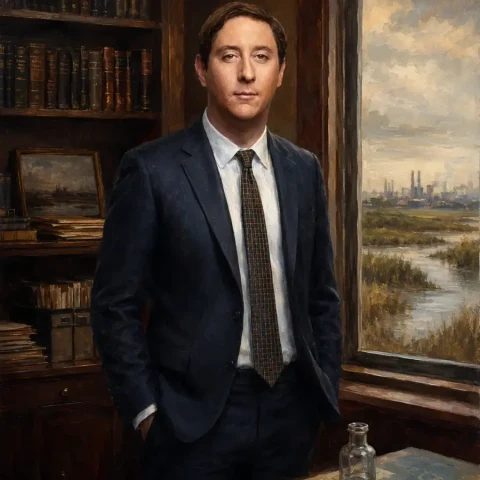
Michael A. London
Mass Torts · PFAS and AFFF Litigation · Class Settlements
These settlements create a substantial funding source that will be essential to addressing the public health crisis created by PFAS in untreated drinking water. But they’re only part of the solution.
Michael A. London, Judge Gergel’s AFFF Docket, and the Public-Water Class Settlements in Charleston
Michael A. London, a co-lead counsel in the federal firefighting-foam litigation, is class counsel for the nation’s public water systems in settlements with eight defendants, four of them awaiting a fairness hearing in January 2027. The personal-injury cases he also leads are still being prepared for their first bellwether trials.
At 10:04 on the morning of Monday, February 25, 2019, Judge Richard M. Gergel of the United States District Court for the District of South Carolina opened the first status conference in the federal firefighting-foam litigation, in Courtroom I of the courthouse at 81 Meeting Street in Charleston. Lawyers for water utilities, states, the Port Authority of New York and New Jersey, the United States, and the foam makers all spoke that day. “Good morning, Your Honor, Michael London,” one of them said. “Douglas and London Law Firm in New York City.” He told Gergel that the plaintiffs had a proposed steering and executive committee: “I believe all members are here.”
Gergel then warned the lawyers that he would push them “at every phase of this,” and told them to “put on your seat belt, we’re going to do real discovery here.” Later that day Joseph G. Petrosinelli of Williams & Connolly, speaking for the foam manufacturers, told him that “the foam manufacturers have a government contractor defense, which is an absolute immunity to claims.” He described one of its elements as whether a contractor had warned the government of hazards it knew about and the government did not, and he said those issues would “cut across the water district cases, the personal injury cases, the putative class cases, every case.” Gergel answered that “fairly early on we’re going to need to address this issue,” and that “we’re not going to have it years down the road.” The foam makers pressed the defense for three and a half years before he ruled on it.
The Judicial Panel on Multidistrict Litigation had created MDL 2873 on December 7, 2018, gathering the federal firefighting-foam cases before Gergel in Charleston, and he had entered his first case management order on January 2, 2019. The plaintiffs allege that aqueous film-forming foam containing PFOA and PFOS contaminated groundwater near military bases, airports, and industrial sites, and they seek damages for personal injury, medical monitoring, property damage, and economic loss. The docket has passed 10,000 cases. Two groups of plaintiffs have moved through it on separate tracks: public water systems that must test and treat their supplies, and people who say the chemicals made them sick.
On March 20, 2019, Gergel appointed London, Paul J. Napoli of Napoli Shkolnik, and Scott Summy of Baron & Budd as the plaintiffs’ co-lead counsel, and Petrosinelli and Michael A. Olsen of Mayer Brown as co-lead counsel for the defendants. In March 2022, in Case Management Order No. 24, he reappointed London, of Douglas & London in New York, along with Napoli and Summy, with Fred Thompson III of Motley Rice as liaison counsel and a Plaintiffs’ Executive Committee. The order made each appointee personally responsible for the functions assigned. London, Summy, and Joseph F. Rice of Motley Rice now serve as co-lead counsel, with Robert A. Bilott of Taft Stettinius & Hollister as the plaintiffs’ advisory counsel; Petrosinelli and Daniel L. Ring of Jenner & Block lead for the defendants. London is co-lead counsel for the whole docket, and he is class counsel for the water systems in all eight class settlements the court has approved or preliminarily approved—with 3M, the DuPont companies, Tyco, BASF, Carrier, Amerex, Archroma, and Nation Ford.
From the C-8 Docket in Columbus to the Foam Docket in Charleston
London came to Charleston from a PFAS docket in Columbus, Ohio. On February 26, 2013, he and William F. Cash III of Levin Papantonio signed the complaint Carla Bartlett filed in the Southern District of Ohio, alleging that she had lived in the Tuppers Plains-Chester water district since about 1980 and that C-8 from DuPont had caused her kidney cancer. London had begun working with Bilott as follow-up cases against DuPont multiplied in 2012 and 2013. On October 7, 2015, a federal jury in Columbus awarded Bartlett, of Guysville, Ohio, $1.6 million; she had said her cancer came from drinking water contaminated with C-8 from DuPont’s plant near Parkersburg, West Virginia.
In Columbus, he was co-lead counsel with Jon C. Conlin and Robert A. Bilott, and liaison counsel, in the DuPont C-8 personal-injury MDL before Chief Judge Edmund A. Sargus Jr.—the PFAS litigation in which his partner Gary Douglas won the first jury verdicts. He held the same post in Charleston. “The general themes are the same,” London said in 2020. “What the defendants knew, and when they knew it, really is a liability issue that cuts across all cases.” Concern about his own exposure led him to buy a carbon filter for the water supply at his house.
London and Gary Douglas are the founding partners of Douglas & London, which opened in 2002; London is the firm’s general counsel and runs its New Jersey practice. He studied at the University of Miami and Brooklyn Law School. In 2000 he was co-trial counsel in the first two tobacco cases tried in New York, and his practice has included hundreds of people injured by diethylstilbestrol, or DES, and people harmed at the World Trade Center disaster site.
Before PFAS, his practice centered on pharmaceutical and medical-device mass torts. He was vice-chair of the plaintiffs’ steering committee in the Zyprexa MDL before Judge Jack B. Weinstein in Brooklyn, and co-lead counsel in the Yaz and Pradaxa MDLs before Judge David R. Herndon in the Southern District of Illinois. Sargus also presides over the Davol and C.R. Bard hernia-mesh MDL, where London chairs the plaintiffs’ executive committee.
What 3M Knew, and When It Told the Government
The defense Petrosinelli described came from Boyle v. United Technologies Corp., in which the Supreme Court held in 1988 that a supplier cannot be held liable under state law for a design defect in military equipment when the United States approved reasonably precise specifications, the equipment conformed to them, and the supplier warned the government about dangers known to the supplier but not to the government. The foam makers pointed to the military specification the Navy first issued for AFFF in 1969. The parties litigated the defense through more than two years of discovery, in which the Justice Department, a third party to the cases, produced millions of pages, and then through briefing, supplemental briefing, and an evidentiary hearing.
At argument on August 19, 2022, defense counsel told Gergel that “the government dictated every material aspect of AFFF’s chemical formulation and testing,” leaving the contractors “no discretion whatsoever.” Gergel observed that “the Navy specifications identify performance criteria rather than a precise chemical formula.” The plaintiffs answered that EPA had been “swimming upstream against a powerful industry current of denial.”
On September 16, 2022, Gergel denied the defendants’ motions for summary judgment on the government contractor defense. London was one of the three lawyers leading the plaintiffs when that ruling came down. Gergel held as a matter of law that the specification was not reasonably precise: it “plainly does not require PFOA, PFOS or any other C-8-based chemistry,” the manufacturers had “treated their formulations as proprietary information,” and the Navy had written what he called a “performance spec” that left each manufacturer to make its own “magic witch’s brew.”
On the warning element, Gergel set out what 3M had known. In 1975 two independent toxicologists found an unidentified organic fluorine compound in human blood, and in 1976 a team headed by 3M scientists confirmed that it was PFOS. 3M told no one outside the company for nearly twenty-five years, and its own lawyers urged that the compound’s identity not be released; in 1981 a 3M scientist, Jon Belisle, published an article in Science attributing the compound to natural sources. Inside the company, 3M’s Manager of Corporate Toxicology called PFOS-based chemistry “insidiously toxic,” while a 3M brochure described its foam as “neither toxic nor corrosive.” In 1988 a 3M environmental specialist warned against “perpetuat[ing] the myth that these fluorochemical surfactants are biodegradable.” When 3M released more than 1,200 studies and reports to EPA between 1998 and 2000, the disclosure, Gergel wrote, “has unleashed significant scientific inquiry and investigations.” He found “numerous instances in which 3M knowingly withheld highly material information about defects and risks associated with its AFFF product,” and evidence that 3M had “actively sought to discredit” adverse information.
The telomer manufacturers—Tyco, Chemguard, National Foam, Buckeye, and Kidde-Fenwal—had told the government that their foam did not contain or produce PFOA or PFOS, and Gergel pointed to evidence that they had known internally it could degrade into PFOA. Whether they had misled the government, chiefly through the Fire Fighting Foam Coalition, was disputed, and so was whether the government’s use of their foam, by then restricted to “mission critical activities,” counted as continued use. A 2008 Defense Department memo filed in the litigation said the coalition had been “economical with the truth” with EPA and the department. The manufacturers, Gergel wrote, “had significantly greater knowledge than the government about the properties and risks associated with their products.” With the motions denied, the defense could not end the cases before trial.
Stuart Was Four Days From Trial
The first water case set for trial came from Stuart, Florida. At 5:05 on a Monday night in the spring of 2016, Dave Peters, then the city’s assistant public works director, took a call from a congressional office: the state had found PFAS in Stuart’s water. “Are you prepared for this?” the caller asked. Some individual wells later tested above 1,000 parts per trillion, against the 70 parts per trillion health advisory EPA set that May, and the city took its three most contaminated wells offline. Peters called what followed a “week in hell.” Stuart installed ion-exchange treatment, spent roughly $20 million keeping PFAS below 30 parts per trillion, a limit it set for itself, and faced about $2 million a year to replace resin that cannot be reused. “We can’t afford to spend that kind of money every year,” Peters said in a 2021 deposition. “We’re a small utility, a small municipality.”
The city believes the chemicals came from its own fire department, less than a fifteen-minute walk from the water treatment plant. Firefighters had trained with foam on a grass field hundreds of times over about twenty years. “We just hosed it with straight water down into the ground,” Fire Chief Vince Felicione said of the cleanup, and what was left of the chemicals sat under a tarp marked “Danger Hazardous Chemicals.” Stuart sued in 2018, alleging that 3M’s foam had polluted its soil and groundwater, and sought more than $100 million for filtration and remediation.
Gergel moved the water-provider cases toward bellwether trials. Case Management Order No. 19, entered August 11, 2021, set the discovery and expert deadlines for the first of them and made it triable on or after January 1, 2023. The first case to reach a trial date, City of Stuart, Florida v. 3M Company, was set for June 5, 2023, with London’s partner Gary Douglas as lead trial counsel. Settlement talks with 3M had started in April 2021. On June 1, 2023, four days before trial, the plaintiffs signed memoranda of understanding with 3M and with the DuPont companies under the oversight of the court-appointed mediator, retired Judge Layn Phillips, and on June 5 Gergel stayed Stuart so that the plaintiffs and 3M, by then its only remaining defendant, could work toward a global resolution of the public-water claims.
The parties, Gergel wrote that day, “have reached a stage in those discussions where they believe a final binding agreement is achievable in the near future.” He called for weekly updates and said he would reschedule the trial if no agreement came within 21 days. 3M signed on June 22, seventeen days later. Stuart’s commissioners approved the settlement; “We are very pleased to reach a settlement and grateful we were part of the solution,” said Mike Mortell, the city attorney, and Felicione said “a little city like Stuart can actually go out and fight and stand up for what’s right and win.” In approving the 3M settlement, Gergel credited the MDL plaintiffs with approximately 431,158.9 hours of work, including bellwether preparation, overcoming the government contractor defense, and service of nine general and twelve case-specific expert reports.
Both agreements took the form of nationwide class settlements for public water systems. 3M agreed to pay between $10.5 billion and $12.5 billion over 13 years: $6.875 billion for Phase One, systems with an impacted water source as of the June 22, 2023 settlement date, and between $3.625 billion and $5.625 billion for Phase Two, systems without one that must test under the federal UCMR 5 monitoring rule or serve more than 3,300 people. DuPont de Nemours, The Chemours Company, and Corteva agreed to pay $1.185 billion, divided 55–45 between their own two phases. “This settlement by DuPont, in our mind’s eye, deals with really just a fraction of this contamination,” London said that June. Gergel granted preliminary approval to the DuPont settlement on August 22, 2023, and to 3M’s on August 29. After fairness hearings on December 14, 2023, and February 2, 2024, he granted final approval to the DuPont agreement on February 8, 2024, and to the 3M agreement on March 29, 2024, in City of Camden v. 3M Company. London was class counsel in both; in the 3M case he served with Summy, Napoli, Elizabeth A. Fegan of Fegan Scott, and Rice. Gergel described class counsel in each as “undoubtedly experienced and highly qualified mass tort litigators.”
Gergel’s Answers to the Objectors
The 3M class was projected to include more than 12,000 public water systems. In the 3M order Gergel recorded 897 valid exclusions, about 7.5 percent, and objections from only seven parties. Objectors challenged both agreements, and Gergel answered each argument. To the claim that the money was small beside what water systems might recover at trial, he answered that the Fourth Circuit had never required a court to estimate trial value before approving a class settlement, and he found that the plaintiffs’ ability to prevail on the merits was uncertain and that the settlement conferred relief continued litigation might not achieve. To the claim that the releases swept in real-property, stormwater, and wastewater claims, he read the agreements to preserve claims for separate facilities unrelated to drinking water. He upheld the split between the phases on an expert analysis by Timothy G. Raab. When objectors complained that the releases covered PFAS compounds not yet identified, he explained that the release of all PFAS followed from the allegation that 3M knew of the environmental and potential human-health risks. To an objection about personal-injury claims, he answered that a public water system cannot assert one.
In the DuPont case the plaintiffs acknowledged that the DuPont companies were responsible for only three to seven percent of the MDL defendants’ total alleged PFAS-related liabilities, and that success at trial was far from secured. At the December hearing, class counsel told Gergel that determining whether a particular manufacturer had used a DuPont product gets very complicated, and that the “beauty of this settlement is you don’t have to prove … causation.” Gergel added that statutes of limitations and repose posed serious challenges for any claimant that chose to litigate alone. In the 3M order he observed that although nothing indicated 3M was insolvent, other defendants in the MDL had filed for bankruptcy because of the litigation, and the 13-year schedule let 3M pay more money over time.
Flow Rates, PFAS Scores, and the Litigation Bump
On August 23, 2023, the day after DuPont’s preliminary approval, Douglas & London and other members of the Plaintiffs’ Executive Committee posted estimates of what individual water systems might receive, worked out from each source’s flow rate and level of contamination. The money could pay for testing and for installing and operating filtration.
A water system is eligible for payment only if it files a claims form. Under the 3M and DuPont agreements, Phase One claims were due July 26, 2024, and Phase Two systems had to complete baseline testing by July 1, 2026, and file their claims by July 31, 2026. Gergel appointed Matthew Garretson as special master and Dustin Mire of Eisner Advisory Group as claims administrator. The allocation procedures attached to the 3M agreement give each impacted water source a Base Score from two cost components, one driven by the source’s flow rate and the other rising with its measured PFAS levels; Gergel called the result an objective formula that scores each source using the factors considered in calculating the real-world cost of installing PFAS treatment.
The procedures then adjust each score. Sources that qualify for the regulatory bump, which turns on federal and state maximum contaminant levels, receive a positive adjustment factor of 4.00. Systems that sued receive a litigation bump scaled to how early they filed: 0.25 for cases on file by December 31, 2020, 0.20 for cases filed in 2021, 0.15 for 2022, and 0.10 for cases filed from January 1, 2023, to the settlement date. Systems that carried water-provider bellwether cases receive 0.15 at Tier One, 0.20 at Tier Two, and 0.25 for the final trial case. The procedures set aside seven percent for a Supplemental Fund, open to claims through December 31, 2030, and five percent for a Special Needs Fund.
When Gergel preliminarily approved the 3M agreement, London said: “These settlements create a substantial funding source that will be essential to addressing the public health crisis created by PFAS in untreated drinking water. But they’re only part of the solution. Federal government funding will also be available to help ensure that our communities have access to safe, clean drinking water.” The DuPont agreement reaches only the public water systems’ drinking-water claims; claims over soil, groundwater, property damage, and natural resources were left outside it.
In February 2026 Stuart announced that its recovery from the DuPont settlement came to more than $2.6 million, money its officials said would go to PFAS monitoring and treatment, regulatory compliance, and protecting the city’s drinking water. “This settlement represents an important step in holding manufacturers accountable,” Stuart’s mayor said.
Telomer Bellwethers, Tyco, and BASF
After the 3M and DuPont settlements, Gergel opened a second bellwether program aimed at the telomer defendants, Tyco among them. Case Management Order No. 27, entered September 13, 2023, limited it to water-provider cases with at least some evidence of foam made by a telomer defendant other than Kidde-Fenwal and National Foam, and named four Tier One cases: Village of Farmingdale, City of Watertown, Southeast Morris County Municipal Utilities Authority, and Bakman Water Company. In December 2023 the court selected Watertown and the Southeast Morris County authority for Tier Two discovery, and their trial date moved from September 23, 2024, to January 27, 2025, and then to March 3, 2025.
Tyco Fire Products and Chemguard settled in the midst of that program. With Phillips again mediating, they executed a $750,000,000 agreement on April 12, 2024, a year and a half after talks began; the class reached every active public water system with an impacted source as of May 15, 2024. BASF executed its agreement on May 20, 2024, and Gergel’s approval order put its total at $316,500,000. London was class counsel for both classes, with Summy, Napoli, and Rice. Gergel held the fairness hearing on November 1, 2024, and granted final approval to both agreements on November 22, 2024. Phase One claims under both were due April 8, 2025.
Five water systems objected to each agreement, with Marten Law representing the principal objectors, and they aimed at the releases: future PFAS claims, compounds not yet identified, wastewater and stormwater. Gergel overruled them. Releasing future claims for contamination reasonably expected to enter the water, he wrote, “protects against double recovery and promotes finality,” and the released claims shared an “identical factual predicate” with the class claims because they depended on the very same set of facts.
Kidde-Fenwal’s Bankruptcy and the Carrier Class
One foam maker left the trial track through bankruptcy. On May 14, 2023, Kidde-Fenwal, Inc., a subsidiary of Carrier Global Corporation, filed for Chapter 11 in Delaware. Named since 2016 in more than 4,400 lawsuits over its foam, it said in its filings that its likely litigation liability “substantially exceeds” its ability to pay. From 2005 to 2013 the National Foam line of AFFF had been owned and operated by Kidde-Fenwal or through subsidiaries of United Technologies Corporation, and the plaintiffs alleged that Carrier had assumed liabilities of foam-making subsidiaries through a series of corporate transactions, including the 2020 spin-off in which Kidde-Fenwal came under Carrier. The plaintiffs engaged with Kidde-Fenwal in the bankruptcy, and negotiations with Carrier took concrete shape only after the bankruptcy filing and the announcement of the 3M and DuPont settlements that summer.
On July 24, 2026, London, Summy, and Rice moved for preliminary approval of a class settlement with Carrier, and London filed a declaration describing how it was reached. Phillips had been appointed mediator in October 2022. The Tier Two water cases had gone through multi-day field sampling events attended by both sides’ experts, site investigations at airports, fire-training centers, and every water-supply well, and several dozen third-party subpoenas. The co-leads told the court that the public-water litigation was in a trial-ready posture when the deal was made. Phillips and his team ran negotiating sessions in person, by video, and by telephone, and the parties also met privately, with increasing frequency in 2025 and 2026. “By all accounts, the negotiations were hard fought,” the co-leads wrote. Carrier settled, they wrote, only after the drinking-water claims against 3M, DuPont, Tyco, and BASF had been resolved and after the court had issued orders teeing up trial for the defendants that had not settled.
Carrier agreed to pay $129,200,000, plus 68 percent of the first $125 million of any net insurance proceeds, with the insurance share capped at $85 million. London and Summy are also class counsel for agreements with Amerex Corporation for $4,000,000, Archroma U.S. for $14,000,000, and Nation Ford Chemical Company for $1,875,000. The class for each reaches every active public water system that had an impacted source as of July 31, 2026, or that was required to test for PFAS under UCMR 5. On September 10, 2026, Gergel found the Carrier agreement fair, reasonable, and adequate at the preliminary stage, with “no obvious deficiencies,” and provisionally appointed London and Douglas & London, with Summy and Baron & Budd, as class counsel. Objections to the Carrier settlement are due November 23, 2026, and requests for exclusion December 22, 2026. The fairness hearing on all four agreements is set for January 15, 2027, in Charleston.
The Personal-Injury Cases, Short of a First Trial
The eight agreements settle claims of public water systems. Individuals’ personal-injury claims run on their own bellwether schedule. Case Management Order No. 26, entered May 5, 2023, confined the first personal-injury pool to four conditions and directed the parties to select 28 plaintiffs: eight each alleging kidney cancer, testicular cancer, and hypothyroidism or thyroid disease, and four alleging ulcerative colitis. A first bellwether trial was set for October 20, 2025.
On August 15, 2025, Gergel vacated that trial date in Case Management Order No. 35. He cited a large number of unfiled cases, many alleging one or more of the six injuries at issue: “The existence of these unfiled claims, many of which may not be vetted, creates challenges for the Court’s continued efficient management of this MDL docket.” He opened a 21-day filing window in which plaintiffs’ counsel could bundle up to 150 unrelated plaintiffs into one short-form complaint, and the defendants agreed not to challenge those pleadings under Rule 12(b)(6). On June 3, 2026, he ordered that each plaintiff keep a single action covering the entire personal-injury claim, with counsel to dismiss duplicate filings identified by the portal administrator.
Experts on thyroid cancer and liver cancer are on a separate schedule. Under Case Management Order No. 33F, entered August 31, 2026, responses to the Rule 702 motions over the general-causation experts on those cancers are due November 20, 2026, and replies January 22, 2027; Gergel will then decide, after consulting both sides’ leadership, whether further process or a hearing is needed.
The second group of bellwether cases is moving. A July 30, 2026 scheduling order directed that three previously approved plaintiffs—James Zajicek, John Slagle, and Karin Frazier—move into expert discovery when it begins, and gave the parties until November 20, 2026, to propose which of three plaintiffs alleging ulcerative colitis—Tracy Gutierrez, Mary Shuman, and Sylvia Smith—will join them.