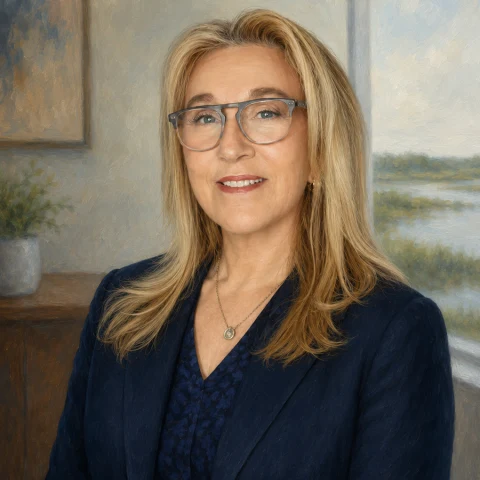
Robert A. Bilott
PFAS Litigation · Environmental Torts · Medical Monitoring
This chemical is not only incredibly persistent. Once it gets out into the environment, it stays there virtually forever.
Leach v. DuPont, the C8 Science Panel, and the Four-Parts-per-Trillion Rule: Making a Chemical Answer to a Number
Under the settlement of Leach v. DuPont, Robert A. Bilott’s class action for the people whose water carried C-8, 69,030 of them gave blood samples, medical histories, and laboratory results to the C8 Health Project. Three jointly selected scientists then spent seven years working out, disease by disease, whether the evidence showed a probable link between the chemical and their illnesses.
In 2002 the working safety level for perfluorooctanoic acid in the drinking water of the Mid-Ohio Valley was 150 parts per billion, which is 150,000 parts per trillion. In April 2024 the Environmental Protection Agency set the first enforceable national limit for the same chemical at four parts per trillion, a figure it reaffirmed in 2025. Few numbers in environmental law trace one lawyer’s work so starkly, because in 1998, when the phone rang in Robert A. Bilott’s office at Taft Stettinius & Hollister in Cincinnati, the compound had no public name, no enforceable limit, and no place in any rule. Bilott had spent eight years at Taft advising chemical companies on environmental regulation. The caller was Wilbur Tennant, a farmer near Parkersburg, West Virginia, whose cattle were dying along a creek beside a DuPont landfill, and who had found Bilott through the lawyer’s grandmother, who lived in the Parkersburg area.
The call from Parkersburg
Bilott took the case his firm did not ordinarily handle, and the documents it produced told a story far larger than one farm: PFOA, called C-8 in the later cases, used at DuPont’s Washington Works plant, had entered groundwater and public water supplies across the valley, and the company’s own record showed it had known for decades that the chemical was toxic to animals and a possible human carcinogen even as discharges increased. The son of an Air Force officer, Bilott attended eight schools before finishing high school in Ohio, studied political science and urban studies at New College of Florida, took his law degree from Ohio State in 1990, joined Taft that year, and made partner in 1998, the year the phone rang. Nothing in that training suggested he would become the chemical industry’s most consequential adversary. Everything in his method, the patience with documents and the fluency in regulatory machinery, turned out to be exactly what the work required. His first move was not a mass tort but a warning: he assembled DuPont’s internal record into a submission to federal and state regulators, and in 2005 the EPA’s disclosure claims against DuPont settled for a $10.25 million civil penalty plus $6.25 million in supplemental environmental projects, then the largest civil administrative penalty in the agency’s history.
A class defined by the tap
Regulation punished nondisclosure; it could not say what years of exposure had done to the people drinking the water. In 2001 Bilott brought Leach v. E. I. du Pont de Nemours & Co. in West Virginia state court for a class of some seventy thousand people whose water was contaminated with C-8. Membership followed pipes, wells, and consumption, not diagnosis: the class gathered a common exposure while its medical consequences remained invisible. The 2004 settlement, approved in 2005, funded treatment systems for the affected water supplies and then did something no toxic-tort settlement had done at that scale. It tied part of the cash benefit to full medical examinations, and 69,030 people enrolled in the resulting C8 Health Project, contributing blood samples, medical histories, and laboratory results for independent study. Three jointly selected scientists then spent seven years determining, disease by disease, whether the evidence showed a probable link between exposure and illness among class members. By 2012 the panel had linked C-8 to six conditions, kidney cancer, testicular cancer, thyroid disease, ulcerative colitis, diagnosed high cholesterol, and pregnancy-induced hypertension, and for those diseases DuPont agreed not to contest the chemical’s capacity to cause them, retaining only the right to dispute causation in a particular claimant’s case. The settlement was designed to learn, and what it learned became binding.
Verdicts on the long bargain
That allocation of proof transformed the roughly 3,500 personal-injury cases consolidated in federal multidistrict litigation in Columbus, where Bilott served as co-lead counsel. Bellwether juries returned verdicts for Carla Bartlett in 2015 and for David Freeman and Larry Vigneron in 2016, and in February 2017 DuPont and Chemours agreed to pay $670.7 million to resolve the qualifying inventory. The bargain held. When Travis Abbott, exposed from childhood, later won a jury verdict after recurrent testicular cancer, the Sixth Circuit affirmed in 2022, treating the C8 Science Panel process not as background but as the source of the parties’ legal obligations nearly two decades after the settlement was signed. Further rounds of resolutions followed for later-filed cases. A plaintiff in the valley still had to prove her own injury; she no longer had to reconstruct the chemical’s entire history from the beginning. That division of labor is Bilott’s signature contribution to American tort law.
From the valley to the world
What began at one creek now reaches everywhere PFAS does. Bilott filed a nationwide class action on behalf of Americans carrying the chemicals in their blood, serves in an advisory leadership role in the aqueous film-forming foam multidistrict litigation in South Carolina and co-chairs its science committee, where settlements with 3M and other manufacturers for the benefit of public water systems have reached multibillion-dollar scale, and has testified before Congress, European parliaments, and United Nations committees as PFAS legislation took shape. The story reached the wider public through his 2019 memoir, Exposure, and the film Dark Waters, in which Mark Ruffalo played him; the documentaries The Devil We Know and Revealed: How to Poison a Planet drew on the same history. In 2017 he received the Right Livelihood Award, and New College of Florida, Ohio State, and Thomas More University have awarded him honorary doctorates. He lectures at the Yale School of Public Health, carrying the case’s scientific legacy into the training of the people who will manage its consequences. “This chemical is not only incredibly persistent,” he said in 2023. “Once it gets out into the environment, it stays there virtually forever.”
Bilott remains a Taft partner, practicing from Cincinnati and Covington, still litigating the contamination he first traced a quarter century ago. His most durable invention is not a verdict but a design: filters for the contaminated tap, examinations for the exposed population, independent science for the uncertain risk, and legal rules sturdy enough to carry that science into individual courtrooms, resolving the claims of the present while leaving the science to govern the cases of the future. Wilbur Tennant wanted someone to look at his creek. Bilott looked, and kept looking until the whole country had to.