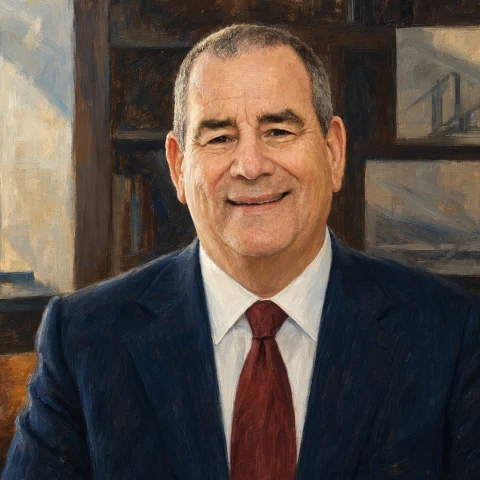
Tab Turner
Automotive Product Liability · Rollover and Tire Failure · Wrongful Death
I can tell you it’s much easier to convince people the tire is defective than it is to convince people the vehicle is defective.
Cooper Tire v. Tuckier and the $131 Million Cole Verdict: Tab Turner’s Tire and Rollover Cases in Mississippi
In 2002 the Mississippi Supreme Court affirmed a $3 million punitive verdict against Cooper Tire that Tab Turner defended on appeal for the family of Laura Dawn Tuckier, built on two former Cooper workers’ testimony about bad stock. In 2010 a Jasper County jury awarded $131 million in actual damages against Ford for the death of Mets prospect Brian Cole in an Explorer rollover, and Ford settled before punitive damages were considered.
Brian Cole, a twenty-two-year-old New York Mets prospect, was driving home from spring training in Port St. Lucie, Florida, to Meridian, Mississippi, on March 31, 2001, when his Ford Explorer rolled over on Interstate 10 in the Florida Panhandle. He was thrown from it and died. His cousin Ryan Cole, seventeen, who was riding with him, was treated and released. At first, people assumed Brian had died because he had not buckled up. Then his family looked inside the Explorer and saw that his seat belt was still latched.
Ford said he had been speeding and had not been wearing the belt. In November 2010 it was still saying he had not worn it, two months after a jury in Jasper County, Mississippi, put none of the fault for his death on Brian Cole and all of it on Ford. Tab Turner, the North Little Rock lawyer who retried the case for the family, had by then been suing automakers over the stability of their sport utility vehicles for more than twenty years.
Turner described the choice facing a rollover lawyer when Frontline interviewed him in the spring of 2001. “With regard to which is easier to prove, whether you aim your gun at the tire or whether you aim your gun at the vehicle, clearly the tire case is easier,” he said. Most people, he explained, “don’t expect driving down the roadway that your tire is going to peel apart.” A vehicle case was different: “we’re attacking the entire design of somebody’s vehicle.”
He has represented families in both kinds of case. In November 1999 a Panola County, Mississippi, jury put 68 percent of the fault for Laura Dawn Tuckier’s death on Cooper Tire & Rubber Company, whose tire had lost its tread on her Bronco II, and awarded $3 million in punitive damages against Cooper; the Mississippi Supreme Court affirmed in January 2002, with Turner among the lawyers defending the verdict on appeal. Donna Bailey’s case, against Ford and Firestone together, settled in January 2001 on the eve of what would have been the first trial over Explorers and Firestone tires since the previous August’s recall; Turner and Mikal Watts obtained an undisclosed sum, a videotaped apology from Ford, and the companies’ agreement to inspect the wrecks and tires Turner had stored. Brian Cole’s was a vehicle case. The verdict came nine years after the crash, and Ford settled with the family before the jury could consider punitive damages.
Six Months From Job 1
Turner was one of the first lawyers to sue Ford over the Bronco II’s stability. He described the vehicle as a derivative of Ford’s small pickup: “It was basically the Ranger pickup truck with a roof on the back.” He said sport utility vehicles were classed as multipurpose passenger vehicles, built to be driven off the road as well as on it, and that “believe it or not, the federal motor vehicle safety standards did not apply to those vehicles at that time.”
The Bronco II first came out in 1983 as a 1984 model. “By 1985,” Turner told Frontline, “this vehicle was having lawsuits, litigation-related problems.”
His account of the Bronco II starts with Ford’s own testing. When Ford put the vehicle through handling maneuvers, he said, “The wheels were lifting off the ground at speeds as low as 25 miles per hour.” In June 1982, he said, Ford was talking about widening and lowering the vehicle, but it was six months from Job 1, the start of production, and widening it, lowering it, and changing its suspension would have pushed Job 1 back by 12 to 18 months. “Nobody working at Ford Motor Company had the courage to go knock on the chairman and chief executive officer’s door,” he said, to ask for another 18 months while Ford was racing General Motors to get its vehicle out against the Chevrolet Blazer. “Nobody was going to do that, because that meant truck market share.”
Turner said the federal regulator would open an investigation, close it soon after, and write a report, as it had on the Bronco II, saying it had no reason to believe it would find anything wrong. “And the next day, the bad guys are showing up in the courtroom, holding up this report from the National Highway Traffic Safety Administration and literally shoving it down my client’s throat.”
A Cooper Tire Built After a Holiday Shutdown
Laura Dawn Tuckier was driving a Bronco II on October 13, 1995, when the tread separated from its rear tire. Eyewitnesses testified that the Bronco moved into the left lane, came immediately back to the right, and began to flip, and that it kept flipping until it was off the interstate. There was no swerving from side to side, they said; the Bronco made a sharp turn to the right and flipped off the highway. She died. Her father, Lawrence Tuckier, had bought the tires from Dillard Lowery, who did business as Auto Specialists.
On May 27, 1997, her wrongful-death beneficiaries, with Trudys Tuckier suing as administratrix of her estate, sued Ford, which made the Bronco; Johnny Ray Works, who sold it; Lowery; and Cooper, which made the tire. Every defendant except Cooper settled before trial. Cooper went to trial alone in November 1999 in the Circuit Court of Panola County, before Judge George C. Carlson Jr., in Batesville.
The family’s case was that Cooper had built the tire with bad stock, rubber that had sat too long before it went into a tire. Their expert, Max Nonnamaker, had analyzed more than 3,000 tires over a twenty-six-year career in tire manufacturing. From the tire’s Department of Transportation number he identified where and when it was made: Cooper’s Texarkana plant, in the fourth week of January 1992, a period following a holiday shutdown of the plant during which stock was allowed to sit. He found a breakdown in the rubber between the two steel belts and a similar area on the opposite side of the tire, which he said showed the failure was built into the tire rather than caused by the way it was driven. “The stock that was used to build the tire in the steel belts was probably dry or set up,” he testified; the tire was “bonded together mechanically but not chemically,” without the chemical bond he said a tire needs if it is not to fail.
The rest of the proof came from two former Cooper employees, Jimmy Oats and Richard Angell, who testified that Cooper knowingly and intentionally used bad stock in building tires. Cooper presented the two men to the jury as witnesses testifying out of animosity toward the company and cross-examined both about their employment status at the plant in 1992 and the grievances each had filed. Counsel for the Tuckiers asked Oats point-blank what had brought him all the way to Batesville, Mississippi, to testify in a case involving people he did not know. “I understand that I can’t live with myself if I don’t tell the truth and don’t try to do what I think the Lord would have me do,” Oats answered, over Cooper’s objection. On redirect, counsel asked Angell, “And why are you here testifying?” He answered: “it’s just too few a people that are brave enough to do it, I guess. I just felt like it was a Christian responsibility.” Cooper did not object to that answer.
The Tuckiers also put Cooper’s own quality-assurance manual in front of the jury. Nearly 90 percent of its pages were blank, the Tuckiers said, the information on them deleted or whited out; Cooper said the pages held confidential product information. The manual came into evidence without objection from Cooper during the Tuckiers’ cross-examination of Larry Dowd, a product assurance manager at the Texarkana plant. Dowd said it had “lots of blank pages in here so it’s different. I mean it’s difficult to tell if this is the manual I use or not.” He added: “from the pieces that are here, yes, it looks like pieces of mine.”
The jury apportioned fault 68 percent to Cooper and 30 percent to Ford, which had already settled and was not at trial; it assigned 2 percent to Laura and none to her father, to Works, or to Lowery. It awarded $485,000 in compensatory damages, $329,000 of it to be paid by Cooper, and $3 million in punitive damages against Cooper. The parties had stipulated that Cooper’s net worth was $947,000,505. Judge Carlson entered judgment on November 17, 1999.
One Tire in 66,000 and the Missing Specifications
Cooper’s central argument on appeal was that the Tuckiers had never made a prima facie case under the Mississippi Products Liability Act. A manufacturing defect, Cooper contended, has to be measured against the manufacturer’s own specifications, and the Tuckiers had never put Cooper’s specifications in evidence. Cooper also relied heavily on its assertion that this tire was the only one found defective out of the 66,000 Cooper produced that year. It attacked the trial rulings as well: the former employees’ references to the Lord, testimony about other Cooper tire cases, the Tuckiers’ questions about blank pages in Cooper’s quality-assurance manual, and a reference on Nonnamaker’s redirect to x-rays of the Bronco’s other three tires after the x-ray report had been excluded.
Turner, Virginia McBryde Todd, and D. Briggs Smith represented the Tuckiers on appeal. Their answer to the specifications argument was that if the ingredients are bad, it does not matter whether the recipe was followed. On January 10, 2002, the Mississippi Supreme Court affirmed. Writing for the court, Presiding Justice McRae held: “The Tuckiers did meet their burden of proof when they put on expert testimony that the subject tire did in fact fail due to the use of bad stock, which in turn failed to create a chemical bond in the tire.”
On the evidentiary points, the court held that Cooper had opened the door. Because Cooper had cast Oats and Angell as men testifying out of animosity, the questions about why they came to testify went to bias and interest, and the court rejected the argument that they improperly used religion to bolster credibility. Cooper had likewise opened the door to the other tire cases when it attacked Nonnamaker’s credibility on cross-examination, and the trial judge had instructed the jury that “you cannot and must not consider this evidence of other alleged claims as substantive evidence on the issue of whether Cooper is responsible for the accident involved in the case before you today.” The quality-assurance manual had come in without objection from Cooper, during the cross-examination of its own employee, and the court said: “The Tuckiers had every right to question witnesses about this item of evidence.” The x-ray reference was proper rehabilitation of an expert whose credibility Cooper had attacked.
Mississippi allows punitive damages only on clear and convincing proof of actual malice, gross negligence, or actual fraud. The court held that the Tuckiers met that burden through Oats and Angell, who said that over their many years at Cooper they had personal knowledge that bad stock had been used. The $3 million award was less than one percent of Cooper’s net worth, and the court added: “Punitive damages have been upheld by this Court in cases where the conduct by the defendant was far less egregious than in this matter.” It upheld the compensatory award as well, pointing to General Motors Corp. v. Jackson, in which it had sustained an award of $7.15 million.
Three justices dissented. Presiding Justice Smith, joined by Chief Justice Pittman and Justice Cobb, would have directed a verdict for Cooper. In his words: “‘Good stock/bad stock’ and ‘fresh stock/old stock’ are not sufficient standards under the MPLA.” He pointed to Larry Dowd, who testified that Cooper limited to 30 days the time materials could sit before they were used, and he wrote that there was no proof the tire had been built from materials older than that. The majority rested instead on the expert’s testimony about the failed bond and on the two former employees. The court denied rehearing on April 4, 2002.
Two Inches Wider, Two Inches Lower
When Turner sat for Frontline’s interviews in April and May 2001, he estimated that he was involved in 170 lawsuits against Ford and Firestone. What separated the Explorer and Firestone litigation from the Bronco II years, he said, was who was now behind the wheel: “we evolved from the late 1980s to the late 1990s to a situation where doctors, lawyers, accountants, congressmen and women and people who in the 1980s weren’t driving sport utility vehicles were now driving them.”
His account of the Explorer, like his account of the Bronco II, began with Ford’s testing. Turner said that when Ford’s engineers came back from Arizona in June 1989, the Explorer’s wheels had lifted off the ground at very low speeds there, and the engineers’ two main aims were “widening this vehicle two inches and lowering the center of gravity two inches.” He put management’s answer this way: “We’re going to take air out of the tires in order to try and fix the problem.” He cited a company document: “There is an internal e-mail that says, ‘I have advised management of the risk and they have accepted the risk.’ That is conscious disregard for the safety of the public.” On why Ford ignored the engineers, he said, “Money. Money, and specifically Job 1.” When Ford weighed four alternatives for fixing the vehicle, he said, “one of the columns was timing,” and “What they realized was that we can’t do this and meet our deadline.”
The Explorer was the most profitable vehicle Ford had, Turner said: “the specific number I think is 39 percent or 40 percent profit on every Explorer they sold,” against 10 or 11 percent on a station wagon. In Frontline’s February 2002 broadcast he described Ford’s choice on the Explorer as “a fork in the road”: take the time to fix the vehicle properly, or fix it cosmetically, knowing the risk it posed to the people who bought it. “And they chose to cosmetically fix the vehicle instead of really fixing the vehicle.”
Asked what happens to a human body inside an Explorer that rolls at highway speed, he described the belt and the roof together. The belt, he said, does not hold the occupant down in a rollover, so a belted driver moves up toward the roof: “So in a normal mid-sized sport utility vehicle like the Explorer, you’re going to be interacting with the roof.” And the roof gives way: “The roof is so flimsy that it’ll crush 10-12 inches.”
Asked whether lawyers, safety advocates, and the press could stand in for federal regulation, Turner said: “Would it be nicer to have regulations in place that had bite and had meaning and had technical common sense attached to them? Sure, it would be.” He said he would take “12 ordinary citizens over 12 politicians any day of the week in making these decisions.” Asked whether that left the job to him, he answered: “Yes. It falls to me, the people that do this for a living, and the Joan Claybrooks of the world who will continue to fight for what they believe in, in terms of trying to get regulations passed.” Claybrook ran the National Highway Traffic Safety Administration from 1977 to 1981 and in 2001 was president of Public Citizen.
Donna Bailey and the Wrecks in Turner’s Warehouse
When Firestone recalled 6.5 million tires in August 2000, the Explorer litigation became national news, and Turner had been in it for a decade. “I spent a lot of time litigating this vehicle over the last 10 years, and so I had documents, I had information,” he said. At a press conference he described the cases as being about “the bad tires and the bad vehicle,” and said: “There has never, ever been a problem as severe as this, from the standpoint of fatalities and injuries.”
Donna Bailey, a single mother of two teenagers from Portland, Texas, was riding in a friend’s Explorer on March 10, 2000, when, police said, the tread on the right rear tire separated. The Explorer rolled over. “Ms. Bailey is a ventilator-dependent quadriplegic as a result of a rollover crash in a Ford Explorer,” Turner said. The tire was a Wilderness AT made at Firestone’s plant in Wilson, North Carolina. It had not been recalled: so far the recall covered only Wilderness AT tires from the Decatur, Illinois, plant, and Ford had called the Wilson-made tires “world class performers.”
With her two children, she sued Ford and Bridgestone/Firestone and asked for $100 million. Her trial, in Corpus Christi, would have been the first over Explorers and Firestone tires since the recall; jury selection was set for January 9, 2001. She intended to testify. The cost of her past and future medical care was expected to reach at least $30 million.
The settlement was reached at about 2 a.m. on Monday, January 8, after four nights of negotiation. Ford officials flew to see her over the weekend to apologize in person, and three Ford representatives accepted responsibility and apologized on videotape. Firestone had apologized earlier, and its chief executive, John Lampe, wrote to her. “There is nothing that any of us at Firestone can say or do,” he wrote, “to return to you what you and your family have lost.” The amount was not disclosed. Turner said it “is far in excess of anything I’ve ever heard of in any automotive liability settlement,” and Watts said: “It’s enough to take care of her for the rest of her life.”
Ford and Bridgestone/Firestone also agreed to make public any further information they gave the National Highway Traffic Safety Administration and Congress in the recall investigation, and once the judge approved the settlement, Ford had fifteen days to release documents to the public and the agency. The companies were to inspect, within ninety days, the tires and crashed vehicles Turner had stored, along with Explorers and tires from other crashes that lawyers working with Safetyforum.com were investigating, and to report their findings to Congress. Frontline’s February 2002 broadcast showed dozens of SUVs that had rolled over sitting in Turner’s Little Rock warehouse as evidence in suits against the automakers. A Chevy S10 Blazer, a Nissan Pathfinder, a Mitsubishi Montero, a Kia Sportage: every one of those models, Turner said, had a rollover problem.
Bailey, on camera, said that business “needs to put their customers first before their money,” and that a company should make sure its products are well tested and not “try to cover up the problem, but try to, you know, really fix it.”
Ford ended its nearly century-old relationship with Firestone in 2001, blaming the tiremaker for the blowouts and rollovers, and in the early 2000s set aside $2.6 billion to replace 19.5 million Firestone tires. Turner settled between 100 and 120 cases with the two companies in 2001, for confidential amounts, while helping coordinate discovery for the plaintiffs in the federal multidistrict litigation involving Ford and Firestone in Indianapolis.
An Arkadelphia Lawyer’s Son
Clyde Talbot Turner, known as Tab, is the son of Otis Hawes Turner, an Arkadelphia, Arkansas, lawyer who was the city’s attorney from 1959 to 1973. In 1990 Governor Bill Clinton appointed the elder Turner to the Arkansas Supreme Court to fill a seat for a year, until a new justice was elected. The son was admitted to the Arkansas bar on March 25, 1985.
Turner has said he takes his approach to the lawyers on the other side from his father. “Some people think of this as being all-out war,” he said. “He taught me that you can have a difference of opinion without hating each other.” Otis Turner died of a heart attack on September 14, 2000, while helping a friend prepare a deer stand near the Ouachita River.
Brian Cole’s Explorer in Jasper County
Brian Cole went to Meridian High School, was the youngest of five children, and turned down a football scholarship to Florida State. At Navarro College in Texas, in the spring of 1998, he hit .524 with 27 home runs, 82 runs batted in and 49 stolen bases in 60 games, and Baseball America named him its junior college player of the year. The Mets drafted him in the 18th round that year. In 2000, split between Class A and Double-A, he hit .301 with 19 home runs and 69 stolen bases and was the Mets’ minor league player of the year. His brother Greg said Brian was on the Mets’ 40-man roster when spring training began in 2001.
He was going home before reporting to Double-A Binghamton when the Explorer went over near Sneads, Florida. The family’s account was that another driver forced him off the road and that he swerved to avoid the car. The Explorer flipped three times, and he was pronounced dead at the scene.
How the Explorer came to roll, and why Cole died, were the contested questions. Turner said the family made two claims: that the Explorer was unstable, and that its safety belts did not work in rollovers. “That permitted Brian Cole to be thrown out of the car during the rollover despite being belted,” he said. Ford blamed speeding and reckless driving. Its spokeswoman, Marcey Evans, said Cole had been driving over 80 miles an hour when he drifted off the road, turned the steering wheel 295 degrees, and lost control, and that he was not wearing his safety belt; his cousin, who was belted, walked away.
The family’s case was tried three times in nine years. The first trial, built on a claim that a suspension part was defective, ended in a mistrial; Turner did not try it. Brought in to retry the case in 2004, he moved the theory to the Explorer itself: too tall and too narrow, it rolled over too easily when Cole swerved to avoid another car. The family also argued that Ford had installed belts it knew were unsafe in a rollover. The second trial ended in a mistrial as well. Mississippi requires nine jurors to agree, and Turner said that jury had leaned 8 to 4 toward awarding the family $104 million. He tried to settle, and he said he told Ford not to “bet the company on this case.”
In April 2004, the year he took over the retrial, Turner was one of five writers of Rolling Over on Safety: The Hidden Failures of Belts in Rollover Crashes, a Public Citizen report. The report counted 22,000 people who died in rollover crashes in the United States from 1992 through 2002 while wearing a safety belt, and it described belts that go slack, spool out, or come unlatched in a roll. Turner put the cost of the changes Public Citizen wanted at about $100 a vehicle. “It’s not simple, but the fixes are both technologically and economically there, and they have been there for 10 years,” he said.
Ford’s Own Expert and the Mark on Brian Cole’s Shoulder
Turner tried the third case as lead counsel, with Ted Leopold; Walker W. Jones defended Ford, as he had in all three trials. “I’ve been trying these cases for 25 years. This was a fairly routine maneuver the Explorer just can’t handle,” Turner said. With a steering machine Turner had bought a decade earlier for $1 million, the family’s lawyers demonstrated that an Explorer built 3 inches wider and 1.5 inches shorter would not have rolled over. A memo from TRW, the belt maker, had told Ford that the belts would not work in a rollover.
Ford pointed to the passenger seat. Ryan Cole had stayed belted and suffered minor injuries. Brian’s belt had been found buckled after he was thrown from the Explorer, and the jury had to decide whether he had been wearing it. The family’s expert testified that a mark on Brian’s left shoulder showed he had been strapped in, and their accident experts testified that the way this Explorer rolled made only the driver’s belt spool out.
On speed, Ford called a state trooper, who estimated that Brian had been going 89 miles an hour. On cross-examination Turner showed that Ford’s own accident reconstruction expert had put the speed at 65 to 75 miles an hour. The trooper had used a formula the Society of Automotive Engineers had discredited. “Why rely on a police officer whose calculation is false when in the back room you have an expert you’ve hired and paid thousands and thousands of dollars?” Turner said. Ford did not call that expert to support its speeding claim, and Turner said Ford lost credibility with the jury for it.
On damages, Jim Duquette, a former Mets general manager, testified that the club had planned to build around Brian Cole. By Leopold’s account, Duquette expected Cole to become an all-star, with an earning capacity of $120 million. Turner said the damages were higher than in other rollover cases because of Cole’s profession.
On September 2, 2010, the Jasper County jury awarded Cole’s family $131 million in actual damages and awarded Ryan Cole $1.5 million. “They put zero percent of the fault on Brian Cole and 100 percent of the fault on Ford Motor Co. for a defective and unreasonably dangerous vehicle,” Turner said. Evans said in a statement that the Mississippi court had “denied Ford a fair trial by excluding evidence that the jury should have heard and considered about Brian’s driving and the speculative nature of plaintiffs’ claims.”
Ford settled with the family shortly after the verdict, before the jury was to consider punitive damages. Turner said the amount and terms of the settlement were confidential. “The family is glad this is finally over,” he said. His family said later that the assumption he had not buckled up had tarnished Brian’s reputation. They could not bring him back, they said, but they believed they had cleared his name.