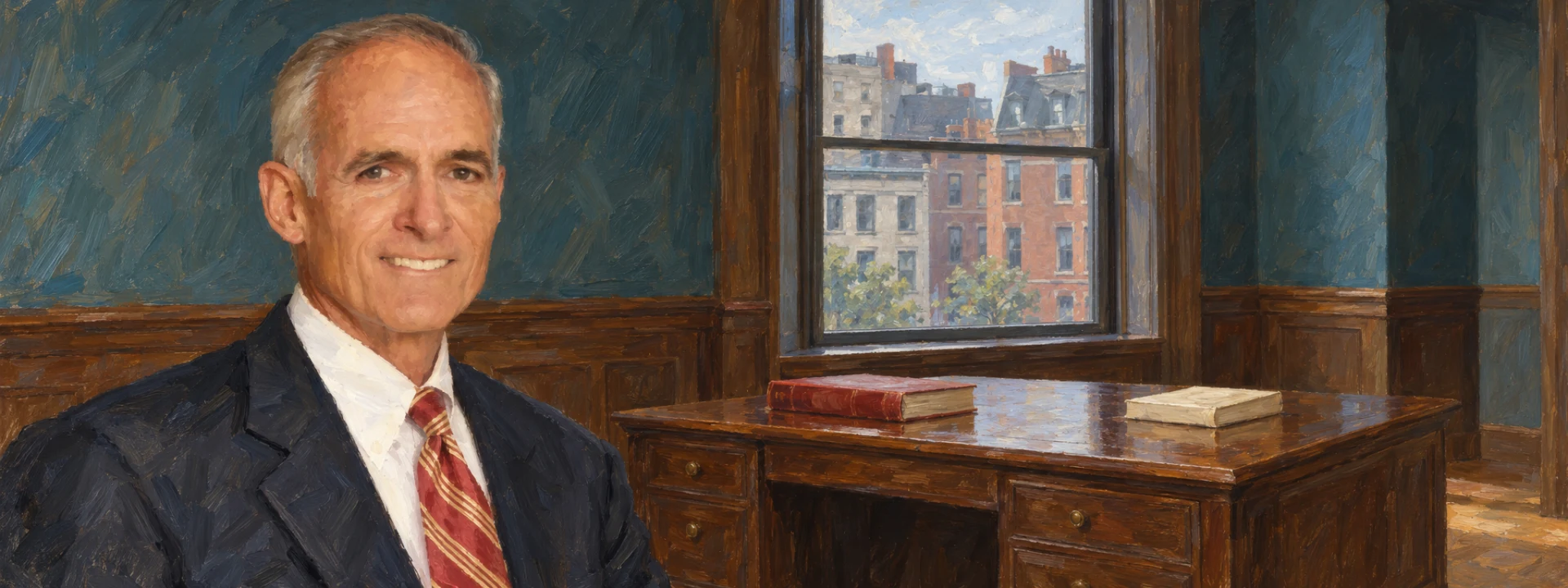
Thomas M. Greene
False Claims Act · Pharmaceutical Fraud
This is a triumph for evidence-based medicine over marketing-based medicine.
Tracing the Claim Back to the Promotion
False Claims Act and pharmaceutical-fraud whistleblower litigation — Founding partner, Greene LLP, Boston.
Parke-Davis argued that it had not submitted the Medicaid prescriptions at issue in David Franklin's whistleblower case. The prescriptions came from doctors and the reimbursement claims from pharmacies. Franklin alleged that the company had promoted Neurontin for uses outside its FDA approval, using false statements and financial incentives to increase those prescriptions. Thomas M. Greene's task was to connect that upstream marketing to the claims eventually presented to government health programs.
Greene filed the case for Franklin in 1996. Franklin, a scientist who had worked for several months as a Parke-Davis medical liaison, alleged that the company instructed liaisons to promote unapproved uses and dosages, misstate their scientific role and encourage physicians to prescribe the drug. In 2001, the district court rejected the argument that the False Claims Act stopped with the doctors and pharmacists. Taking Franklin's allegations as true at the motion-to-dismiss stage, Judge Patti Saris concluded that their participation in submitting claims was an intended consequence of the alleged promotional scheme.
The federal government had declined to intervene, and Greene and his colleagues continued the litigation. In 2004, Pfizer, which had acquired Parke-Davis's parent, resolved the Neurontin matter for $430 million in combined civil and criminal payments. The case provided a route for treating a manufacturer's promotion as conduct that could cause false reimbursement claims even when the manufacturer did not submit those claims itself.
Putting the Marketing Evidence Before a Jury
Greene later chaired the Neurontin multidistrict litigation and represented Kaiser Foundation Health Plan at a five-week jury trial in 2010. Kaiser alleged that Pfizer's promotion had caused it to pay for Neurontin prescriptions for uses that were ineffective. The trial record included company documents, marketing plans and evidence connecting promotional activity to prescribing.
The jury found RICO violations for several promoted uses and awarded Kaiser $47.36 million in damages, which the court trebled to about $142.1 million. The district court separately found for Kaiser under California's Unfair Competition Law and calculated about $95.3 million in restitution, but did not add that amount to the RICO award because it reflected the same underlying injury. The First Circuit later affirmed the judgment.
His pharmaceutical docket also included a Detrol off-label matter that resolved for $14.5 million. Outside pharmaceutical litigation, he served on the plaintiffs' steering committee in the multidistrict litigation arising from the crash of American Eagle Flight 3379.
Payments to Prescribers at Biogen
Michael Bawduniak, a former Biogen employee, alleged a different route from a drug manufacturer's conduct to reimbursed prescriptions. His complaint said that Biogen paid physicians through speaker honoraria, speaker-training fees, consulting fees and meals to induce prescriptions of the multiple-sclerosis drugs Avonex, Tysabri and Tecfidera. Greene served as lead counsel for Bawduniak after the government declined to intervene.
The private litigation continued for years as the team developed evidence about the physician programs and prescribing. In September 2022, days before trial, Biogen agreed to pay $900 million to resolve the allegations: about $843.8 million to the United States and $56.2 million to fifteen states. The federal government assigned Bawduniak approximately 29.6 percent of the federal proceeds. The settlement expressly resolved allegations without a determination of liability.
A Boston False Claims Act Practice
Greene graduated cum laude from Boston College in 1974 and earned his law degree from Suffolk University Law School in 1977. He has practiced complex civil litigation for decades and has represented False Claims Act whistleblowers since 1992. He founded Greene LLP in Boston, where the firm takes on cases that may require private financing and years of discovery when the government does not intervene.
He has lectured on off-label promotion and False Claims Act practice at Harvard Law School, Johns Hopkins, Boston College and Northwestern, and has spoken to congressional and professional audiences. His writing has addressed the use of civil RICO in pharmaceutical cases. Melody Petersen's Our Daily Meds discusses his work, and his cases have been covered by NPR and Dateline.
Across the pharmaceutical matters, the proof differs with the alleged scheme. In Franklin, it included promotional instructions and the path from physicians' prescriptions to Medicaid claims. In Kaiser, marketing records were paired with evidence about prescribing and payment. In Biogen, the allegations centered on speaker and consulting arrangements with physicians. Greene's work has required connecting those records to the claims paid by public or private health plans.