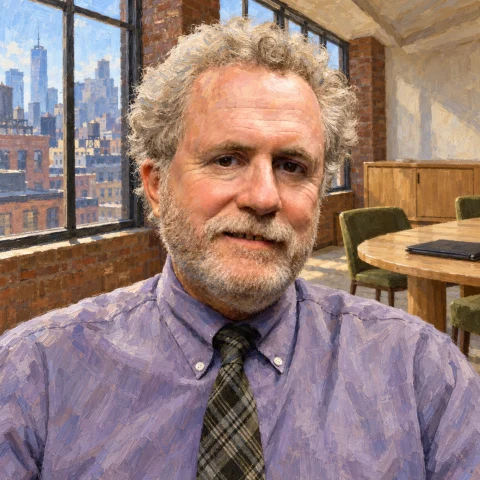
Barry C. Scheck
DNA Exonerations · Forensic Science · Wrongful-Conviction Civil Rights
What bothered us, from our law-science backgrounds, was that they really hadn’t published their procedures in peer-reviewed journals or done adequate experimentation.
Rodriguez v. City of Houston: A Fabricated Serology Report and a Federal Jury’s Deliberate-Indifference Finding
In the Bronx, Barry Scheck used blood typing to undo Marion Coakley’s rape conviction in 1987 and defeated a DNA laboratory’s claimed match in People v. Castro in 1989. In 2009 he opened George Rodriguez’s civil-rights trial against Houston, where a federal jury found the city deliberately indifferent to failures in its police crime lab.
In June 2009, during a civil-rights trial in federal court in Houston, the City of Houston conceded that the serology report in George Rodriguez’s 1987 kidnapping and rape prosecution had been knowingly fabricated. Its author, James Bolding, had been the chief serologist of the Houston Police Department crime lab. The city denied that the fabrication had caused Rodriguez’s conviction, and it denied that Houston was legally responsible for what Bolding had done. Barry Scheck, a co-founder of the Innocence Project, had worked to free Rodriguez five years earlier. At trial he represented Rodriguez as a lawyer with the New York firm Neufeld, Scheck & Brustin, alongside Mark Wawro, Alex Kaplan, and Rob Safi of the Houston firm Susman Godfrey.
Rodriguez had gone to prison at twenty-six and walked out at forty-three to find his three daughters grown and his father dead, Scheck said. “What was taken away from him was his youth.” In his opening statement before Judge Vanessa Gilmore and a jury of five women and three men, Scheck told the jurors about the loneliness, fear, and depression Rodriguez had suffered in prison, and told them why it had happened: the city’s policymakers, he said, had been deliberately indifferent to rampant underfunding, understaffing, and a lack of supervision at the crime lab, conditions that created a high risk that an innocent person could be convicted or the guilty one could go free. “We will prove that a false and misleading serology report violated (Rodriguez’s) constitutional right to a fair trial,” he told them. The evidence would show, he said, that the lab specialist had a pattern of changing his findings to match what police and prosecutors wanted.
Robert Cambrice, a lawyer for the city, told the jurors that bad lawyering by the prosecutor and by Rodriguez’s late defense attorney had caused the wrongful conviction, that no city policy had led to the error, and that underfunding had not made a city employee lie. “No city policy makers approved of unconstitutional fabrication of evidence,” he said. He asked the jurors not to be overcome by the emotion surrounding Rodriguez’s ordeal. The city invoked Monell v. Department of Social Services, in which the Supreme Court held in 1978 that a local government cannot be sued under 42 U.S.C. § 1983 for an injury inflicted solely by its employees or agents; the government is responsible as an entity when the execution of its own policy or custom inflicts the injury.
In City of Canton v. Harris, in 1989, the Court held that inadequate police training can support that liability “only where the failure to train amounts to deliberate indifference to the rights of persons with whom the police come into contact,” and that the deficiency must be closely related to the injury. To hold Houston liable, Scheck and his co-counsel had to prove that a city policy or custom of inadequate training or supervision at the crime lab, maintained with deliberate indifference by the city’s policymakers, caused the violation of Rodriguez’s constitutional rights. Bolding had given his testimony twenty-two years earlier, at Rodriguez’s criminal trial in Harris County.
Bolding’s Testimony About Isidro Yanez
On February 24, 1987, two men in a green and white 1978 Chrysler Cordoba forced a fourteen-year-old girl into the car in Houston, took her to a house, and raped her there. Then they put her back in the car and left her on a roadside. She described them to police as the skinny one and the fat one. One had called the other George, but she thought the name was fake, because the two men had talked about not using their names.
Police went to a house belonging to two brothers, Manuel and Uvaldo Beltran. Rodriguez became a suspect because the name George had been used and because one of the investigating officers knew that he was an associate of Manuel Beltran. Rodriguez told police that he had been at work at the time of the crime, and his work records confirmed it. He worked the 3-to-11:30 p.m. shift at a home-furnishings manufacturer in Houston, and his supervisor, Clarence Green, told the police that he had been on the job when the girl was taken. Before officers spoke to Uvaldo Beltran, they had already shown the girl a photo array that included Rodriguez’s picture, and she picked him. Rodriguez called the police and offered to come in for a lineup whenever they wanted him. At a show-up she identified him as the fat man, partly by the way he stood; she later testified that she had been able to see his face for only three or four seconds during the attack.
The Beltran brothers implicated Isidro Yanez. Uvaldo Beltran told police that he had been watching television when his brother and Yanez walked through the house with the girl and went into a bedroom. Manuel Beltran confessed to being the skinny man and named Yanez as the fat one. Police confirmed that Yanez’s car had been used in the abduction. Rodriguez looked a great deal like Yanez. Police did not show the girl a picture of Yanez until two months after the attack, in a photo book that also held Rodriguez’s picture. She picked out both, noted how alike they were, and identified Rodriguez again.
The physical evidence came from the crime lab. At trial, Bolding and another crime-lab analyst testified that a pubic hair recovered from the girl’s underwear was microscopically consistent with Rodriguez’s hair. Bolding testified that Rodriguez could not be excluded as a contributor of the semen found on her clothing and in the rape-kit samples, and that Yanez definitely could not have contributed. Rodriguez’s supervisor testified that he had been at work. Rodriguez had numerous tattoos, and the girl had never described any. In October 1987 Rodriguez was convicted of kidnapping and aggravated sexual assault of a child and sentenced to sixty years in prison.
Marion Coakley’s Type A Blood
Less than two months after Rodriguez was convicted, on December 15, 1987, Justice Burton B. Roberts of the State Supreme Court in the Bronx told Marion Coakley that “the serological evidence establishes that you could not have been the individual who was the donor of the semen” and “therefore could not have committed this crime.” A serologist’s blood-typing report had excluded Coakley before he was tried. Scheck had worked for two and a half years as a Legal Aid Society public defender in the South Bronx, where he met Peter Neufeld, and in 1978 he joined the new Benjamin N. Cardozo School of Law to run its clinical programs. Their old public defender’s office sent Coakley’s case to them after he was convicted and before his direct appeal. “Everybody in the office was just so shocked that he was convicted, based on the testimony of the three eyewitnesses,” Scheck said. “So the clinic and I took the case, and I brought Peter in to work with us,” he said.
On the night of October 13, 1983, a man broke into a room at the Bronx Park Motel, robbed a woman and her companion at gunpoint, locked the man in the bathroom, and raped the woman. Then, as Scheck later described it, the attacker put the woman in a car, drove to her home to get more money from her relatives, and abandoned the car. Three witnesses, the woman among them, identified Coakley. Each had described a Black man with a dark complexion and a short afro; Coakley, a twenty-eight-year-old part-time contract worker, was Black but not dark-complexioned, and he did not have an afro on the day of his arrest. From the start he said that he had been at a Bible study meeting, and he demanded, took, and passed a polygraph test. He had seventeen alibi witnesses who placed him at a prayer meeting on the other side of the Bronx. “The reverend, all the members of the congregation, and anybody that knew Marion knew that he really couldn’t drive and he was probably incapable of making it from the prayer meeting to the motel and back,” Scheck said. A jury convicted Coakley of first-degree rape and robbery, and in August 1985 he was sentenced to five to fifteen years in prison.
Dr. Robert Shaler, the director of serology at the Office of the Chief Medical Examiner for the City of New York, had tested the semen stain on the woman’s underwear and found blood-group substances B and H, meaning that the donors, the rapist and the woman, could have type B or type O blood. Coakley had type A. In a report dated April 18, 1984, Shaler concluded that Coakley could not have been the source of the sperm. At a Frye hearing, Shaler qualified that finding: because Coakley was a low-level secretor, his blood-group substances might on a given day have been too faint for the tests to detect. The trial court, unwilling to delay the trial any longer, refused to adjourn the case so that confirming tests could be run. With Shaler unable to give an unqualified opinion, all of the serological evidence was suppressed at trial. The jury heard the identifications and none of the blood typing.
By the time Scheck took the case, Shaler had left the medical examiner’s office for Lifecodes, a new DNA-testing company. Lifecodes tried DNA testing on the evidence and could not get results. Scheck and Neufeld then set out, as Scheck put it, to prove Coakley innocent “the old-fashioned way.” They had Coakley give semen samples at different times at Attica prison to show that he was not a low-level secretor. A palm print on the rearview mirror of the car the attacker had used, never analyzed before, also excluded Coakley, Scheck said. “We found exculpatory evidence that hadn’t been turned over,” he said. In September 1986 Coakley was released from state prison while his case was pending.
Roberts heard the motion to vacate the conviction on November 23 and December 1, 1987, taking the serological evidence first. Shaler testified that the further tests he had run after the conviction showed that Coakley’s secretion levels never fell so low as to be undetectable, and that he could again say with a reasonable degree of scientific certainty that Coakley was excluded. The district attorney’s office then joined the defense, telling Roberts that “the serological evidence should have been presented to the jury, and upon any or all grounds, the judgment of conviction must be vacated.” Roberts set aside the conviction principally on newly discovered serological evidence and then, on the joint motion of the defense and the district attorney, dismissed the indictment in the interest of justice. Scheck and Neufeld then represented Coakley in the New York Court of Claims, where he sought damages from the State for unjust conviction and imprisonment. In 1996 Coakley received $450,000 in compensation through the Court of Claims.
“So we proved him innocent anyhow, but we saw immediately that this DNA testing would be transformative for the criminal justice system,” Scheck said. After Coakley’s release, Scheck and Neufeld organized a presentation on DNA testing at Cardozo, bringing in Shaler and the serologist Neville Coleman. DNA analysis, Scheck said, “was a technology that was developed for medical and research purposes, but transferring it to the forensic arena was going to be not so simple.” Soon afterward, he said, Governor Mario Cuomo asked John Poklemba, a criminal justice coordinator, to form a New York State commission to investigate DNA and whether it could be carried over into forensic work, and Scheck and Neufeld were appointed to it.
Lifecodes’ Autoradiographs in People v. Castro
After the Cardozo program, Scheck recalled, someone from the public defender’s office asked him and Neufeld: “You guys are very interested in this. Could you do the admissibility hearing?” In People v. Castro, in State Supreme Court in the Bronx, Scheck and Neufeld represented Joseph Castro, who was accused of stabbing to death Vilma Ponce, twenty years old and seven months pregnant, and her two-year-old daughter on February 5, 1987. Detectives had seized the wristwatch Castro was wearing when he was arrested and noted what appeared to be bloodstains on it. The Bronx District Attorney’s office set out to prove, through DNA tests performed by Lifecodes, that the blood was Ponce’s. Lifecodes, a company in Valhalla, New York, had concluded that DNA from the blood on the watch matched Ponce’s, and its scientists testified that the chance of a coincidental match was 100 million to one. Risa S. Sugarman and Peter D. Coddington represented the People.
Before the admissibility hearing, Scheck and Neufeld took the autoradiographs from Lifecodes’ tests to a Banbury conference at Cold Spring Harbor and showed them to Eric Lander, whom the court would later accept as an expert in genetics and population genetics. “Eric immediately recognized that there were some extraordinarily serious problems,” Scheck said. The human control lane, which used DNA from one of the laboratory’s scientists, showed five or six bands for each probe where there should have been two, Scheck recalled, and Lifecodes attributed the extra bands to bacterial contamination. The lab was also declaring matches between bands that were six standard deviations apart; it had not yet developed what Scheck called a “matching rule.” Lander later told a Senate committee that he had agreed reluctantly to review the evidence and testify, and that he insisted on doing it pro bono. “To make a long story short, the evidence turned out to be appalling,” he said.
Lander testified for the defense at the hearing before Justice Gerald Sheindlin, which ran twelve weeks and produced a transcript of about 5,000 pages. The People called Richard Roberts of Cold Spring Harbor Laboratory, Pablo Rubinstein of the New York Blood Center, Michael Baird of Lifecodes, and Alan Giusti of the FBI, among others; the defense also called Howard Cooke of the University of Edinburgh, Conrad Gilliam of Columbia University, Lorraine Flaherty of the Wadsworth Center, and Phillip Green of Washington University. In March, with the hearing under way, the defense objected to seventeen autoradiographs the People offered because various ones carried no precise dates. Sheindlin wrote that “voir dire and cross-examination has demonstrated that the precise dates of the development of certain autorads are unclear,” and that Lifecodes’ notes conflicted over whether some had been developed overnight or over three, four, or seven days.
One Lifecodes witness, Scheck recalled, accounted for the contamination by testifying that the laboratory’s scientist had been very sick; Lander told Scheck that a man that sick would have been septic, or dead. Within perhaps forty-five minutes the witness changed his testimony and said that the probes had probably been contaminated because they were in bacterial vectors. The defense did not contest the exclusion: Lifecodes’ tests showed that the blood on the watch was not Castro’s, and where the bands clearly did not line up, Scheck said later, there was no dispute. The contest was over Lifecodes’ claim that the blood matched Ponce.
Near the end of the hearing, Lander and Roberts proposed that the expert witnesses for both sides meet to go over the evidence. “We decided to have a one-day joint scientific meeting to review the evidence together, without the lawyers or judges,” Lander told the Senate committee. By the end of that day, he said, the prosecution’s experts agreed with the defense experts that the DNA evidence was unacceptable. Scheck recalled that the defense and prosecution scientists wrote a joint statement concluding that the matching, the molecular biology, and the statistics and population genetics were unsound. “They wrote a joint statement at the end of the hearing that you couldn’t match the fragments, you couldn’t make an adequate statement about their significance, and called on the National Academy of Sciences to convene a panel immediately,” Scheck said.
Sheindlin found that DNA identification rested on a generally accepted theory and that generally accepted techniques could produce reliable results. The prosecution’s claimed match depended on his third question: “Did the testing laboratory perform the accepted scientific techniques in analyzing the forensic samples in this particular case?” In a decision dated August 14, 1989, he wrote: “In a piercing attack upon each molecule of evidence presented, the defense was successful in demonstrating to this court that the testing laboratory failed in its responsibility to perform the accepted scientific techniques and experiments in several major respects.” Lifecodes had declared matches by visual observation without applying the rule it used to compare measurements with its population data, had used a contaminated probe, and had run a sex-typing test without the positive and negative controls that Sheindlin said any reputable laboratory would use, and the population frequencies it reported were not generally accepted by the scientific community.
By then the prosecution agreed that the DNA evidence could not be used to declare a match. “Both sides concede this point,” Sheindlin wrote. He held the evidence of a match inadmissible as a matter of law and admitted the evidence of exclusion for the jury. He also set out the discovery that a party offering DNA evidence must give its adversary, beginning with copies of the autoradiographs and an opportunity to examine the originals. “We won a split decision here,” said Ed McCarthy of the Bronx District Attorney’s office.
Validation Studies and New York’s Forensic Science Commission
The National Academy of Sciences was then asked to form a commission on DNA technology and forensic science, and its report, DNA Technology in Forensic Science, Scheck said, “laid out a lot of bases for how you did experiments and validation studies for all the different technologies.” Looking back on the Innocence Project’s first years, from 1992 to 2000, Scheck said that too many crime laboratories had been “run by police in lab coats” who realized that DNA exonerations were showing traditional forensic science disciplines to be unreliable. A 2009 National Academy of Sciences report, he said, found that only DNA testing had adequate scientific validation. “We can’t afford any more to have lawyers and judges that are scientifically illiterate,” Scheck said in 2014. A lawyer bringing evidence into a courtroom, he said, has to understand what it means to validate it.
Scheck served on New York’s Commission on Forensic Science, which regulates the state’s crime laboratories and forensic DNA laboratories, from 1994 to 2016, and Neufeld served on it from 1995 until he resigned in 2016. By statute the commission develops minimum standards and an accreditation program for every forensic laboratory in New York, including routine internal and external proficiency testing of laboratory personnel, and it may revoke, suspend, or otherwise limit a laboratory’s accreditation for a pattern of excessive errors; for a DNA laboratory, it acts on the binding recommendation of its DNA subcommittee. Its members include a representative of the public criminal defense bar and one of the private criminal defense bar. At the Innocence Network’s 2025 conference, Scheck was a speaker on a panel titled “Two Steps Forward, One Step Back: SBS/AHT Scientific Advancement and Pushback,” on the science of shaken baby syndrome and abusive head trauma.
DNA Testing Excludes Rodriguez
The Innocence Project, which Scheck and Neufeld founded at Cardozo in 1992, began working on Rodriguez’s case in 2002, and Scheck worked on it with the Susman Godfrey lawyers Wawro, Kaplan, and Safi. In 2003 Rodriguez won his petition for post-conviction DNA testing of the hair. Mitochondrial DNA testing in 2004 showed that he could not have left the pubic hair found in the girl’s underwear, and that Yanez could not be excluded as its source.
In August 2004 Harris County District Attorney Chuck Rosenthal said that the hair could have come from anyone. “The crime scene in this case was not a pristine crime scene,” he said. “To be kind, it was squalid. Any number of hairs could have been on the bed that was used.” That month six independent forensic scientists concluded that the crime-lab official whose testimony led to Rodriguez’s conviction had either lacked basic knowledge of blood typing or knowingly given false testimony, and that he might have offered “similarly false and scientifically unsound” reports and testimony in other cases. Their conclusion raised the estimated number of Houston crime-lab cases needing re-examination from 360 to between 5,000 and 10,000. “We know already that they couldn’t do DNA testing properly,” Scheck said. “Now we have a scandal that calls into question many thousands more cases.” The Innocence Project’s lawyers asked Harris County to agree to an independent review of every case Bolding had handled. “We’ve had more than 20 years of bad lab work,” Scheck said.
Further serological testing by the prosecution showed that Yanez had been mistyped at the time of trial and should never have been excluded as a possible contributor of the semen. By early October the district attorney’s office acknowledged that Rodriguez had been wrongly convicted on inaccurate crime-lab tests. “I’m upset that the testing was not accurate and that he didn’t receive a fair trial… We need to do what’s right here,” said Bill Hawkins, the prosecutor who had sent him to prison. Mary Rodriguez, his mother, said, “I’m happy. Now he can come home.” Scheck pressed for an audit of the lab. “When somebody makes a mistake that is either egregiously incompetent or an act of fraud, you have no choice but to conduct an audit of all their prior cases,” he said, and he asked for an examination of twenty-five years of the lab’s work. On October 8, 2004, Rodriguez was released from prison on a personal recognizance bond.
On August 31, 2005, the Texas Court of Criminal Appeals vacated the conviction. In September, Rosenthal moved to dismiss the charges, saying that with little or no physical evidence he preferred not to make the victim testify. Rodriguez was remodeling his mother’s kitchen while he looked for a job. “I had been released, but I was not free,” he said, standing in it. “This is a big relief. Now I can try to get myself together.” Scheck said: “This is the face of the crime-lab debacle. This is the human damage.”
Scheck said that he and Rodney Ellis, a state senator from Houston, used Rodriguez’s case to expose other deficiencies in the lab, and that Mayor Bill White and the police chief then agreed to appoint Michael Bromwich, a former inspector general of the Justice Department, to audit it. Bromwich became the independent investigator for the Houston Police Department’s crime lab and property room in 2005 and published his final report in 2007. Scheck described the audit as the largest of any crime lab in the world up to that time, and said it found “quite a number of other cases where certainly the serology was not adequately tested.”
Deliberate Indifference Before Judge Vanessa Gilmore
In 2006 Rodriguez sued the city under § 1983 in the United States District Court for the Southern District of Texas. He first sued Harris County and others as well, then dismissed every defendant except the City of Houston, which his lawyers said was the most clearly culpable. His complaint alleged that during 1987 the city “systemically failed to adequately train or supervise its employees in the crime lab,” that the lab “routinely failed to follow generally accepted forensic science practices prevailing in 1987,” and that those failures resulted in his wrongful conviction.
In May 2006 Bromwich reported serious problems in virtually every serology case his team had reviewed and wrote that they were “the product of defective procedures employed in the Serology Section” from 1980 through the early 1990s and of “the Crime Lab’s systematic failure to adequately train and supervise its serologists.” Bolding had begun issuing serology reports in October 1980 and did not attend a formal outside training program in bloodstain analysis until the summer of 1982. Bromwich’s final report, released on June 13, 2007, set out the serology section’s defective procedures and its failure to train and supervise its serologists. Before trial, the court refused the city’s request to declare that report inadmissible hearsay and rejected the city’s effort to use the ineffective-assistance claim in Rodriguez’s habeas petition to deflect blame, along with its other summary-judgment defenses. The report went into evidence, together with communications from crime-lab administrators who had complained of severe understaffing.
His daughter Marlene Thomas came to support him at trial. “He lost being with us in our childhood, and all of us growing up,” she said. Late on the day of opening statements, an assistant police chief told the jurors that the city had not closely investigated the crime lab’s problems until a local television report in 2002, which finally led to the $5 million independent investigation that highlighted Rodriguez’s case and others.
Scheck later said that the serologist “had literally testified to serology results that he had to know were false, but gave an interpretation that was consistent to help convict poor George Rodriguez in this rape case, whereas on other occasions, he literally testified to the opposite.” The man doing the department’s serology testing, Scheck said, “was literally overwhelmed. They had taken too many cases, they didn’t have adequate resources, they didn’t have adequately trained personnel.”
The police chief in 1987 was Lee P. Brown, who later became New York City’s police commissioner, director of the White House Office of National Drug Control Policy, and mayor of Houston. He ran the department from 1982 to 1990, and he had approved Bolding for a promotion on the strength of a glowing report from a subordinate. Rodriguez’s lawyers contended that city policymakers, Brown among them, knew about training, supervisory, and quality problems in the crime lab and did nothing. Brown testified that the lab’s mistakes during his tenure were not his fault and that he had worked hard to get the lab the resources it needed. “There was a consistent desire of people in the lab to get more people and consistently I tried to get more people for them,” he said. In the mid-1980s, he testified, the city had a hiring freeze and had closed the police academy, and he could not get all the positions he needed or even overtime approved. He said he had not learned of shoddy lab work and falsified evidence until the media reported it in 2002.
A lawyer for Rodriguez showed Brown police department memos about the lab and questioned him about being told that the lab was understaffed and that its people lacked training and supervision. One memo, from 1986, said the lab was “cutting additional corners,” had “diluted quality assurance,” and could be “embarrassed” by its deficiencies. Brown testified that he considered understaffing the root cause of every such warning. “It was tough for the city,” Brown said. “I fought hard to get them what they needed.” Wawro answered: “It turned out it was tough for some criminal defendants who were not guilty, too.” When Rick Morris, a lawyer for the city, asked whether anything about the staffing problems would have led to Bolding’s lie and Rodriguez’s conviction, Brown said, “I don’t see the correlation between the two.”
After deliberating for about six hours, the jury sent Gilmore a note saying that it could not decide whether Brown had been deliberately indifferent to the lack of training and supervision at the lab. On June 25, 2009, the jury found that the city had an official policy or custom of inadequate supervision or training of its crime-lab personnel, that its policymakers had been deliberately indifferent to those deficiencies, and that the deficiencies were the moving force behind Rodriguez’s wrongful conviction. It found that Brown had been deliberately indifferent to the substantial risk that the city’s policy of inadequate supervision or training in the crime lab would lead to constitutional violations similar to the one Rodriguez suffered. The jury awarded Rodriguez $5 million: $3 million for past pain and suffering, $1.5 million for future pain and suffering, $350,000 for past lost earnings, and $150,000 for future lost earnings. “Ain’t no amount of money is going to even my scale,” Rodriguez said. “I am grateful, but no money could replace what I lost.”
Houston’s Crime Lab Leaves Police Control
Houston appealed the verdict. In the years that followed, Rodriguez said, he picked up cans and paid his rent by doing handyman work for his landlord. His requests for exoneration or a pardon were turned away until Harris County District Attorney Pat Lykos declared him actually innocent. The parties settled while the appeal was still pending: in November 2012 Mayor Annise Parker announced that the city had agreed to pay Rodriguez $3.1 million, and she apologized to him. “You were an innocent victim of a faulty system and I am sincerely sorry for the injustice you suffered,” she said. “I accept the apology for what happened to me,” Rodriguez said. “It could happen to anybody.”
“The Rodriguez case was the case that led to the Bromwich report and the cleaning up of the HPD crime lab,” Scheck said. “It’s very important to George and his attorneys that nothing like this happen to anyone ever again.” When Bromwich released his final report in June 2007, Police Chief Harold Hurtt said that the lab’s budget had risen from about $3.2 million to $7.6 million in fiscal 2006, that staff training had doubled since 2002, that the lab’s upper management and DNA staff had been completely replaced, and that the lab had earned accreditation. Of the civil-rights suits his firm brings after exonerations, Scheck said in 2014: “Then we sue, not just trying to get them compensation, but in each of these cases we try to get non-economic relief.” Parker said her goal was “a crime lab independent of police, prosecutors and political influence.”
With the City Council’s support, Parker created the Houston Forensic Science Center in 2012, and on April 3, 2014, the center took over management of the city’s forensic services. It is an independent local government corporation that provides forensic services to the Houston Police Department, governed by a nine-member board that the mayor appoints and the City Council confirms.
In September 2016 the President’s Council of Advisors on Science and Technology, co-chaired by John P. Holdren and Eric Lander, reported on the scientific validity of forensic feature-comparison methods. It noted that the 2009 National Academy of Sciences report had recommended that forensic laboratories be independent of law enforcement and prosecutors, and it found that Houston had “succeeded in transitioning the laboratory into an independent forensic science center.” By then the center had put blind proficiency testing into its firearms, controlled substances, and toxicology sections. Its directors can be removed only for malfeasance, a design meant, the council wrote, to “insulate the Center from undue influence by police, prosecutors, elected officials or special interest groups.”