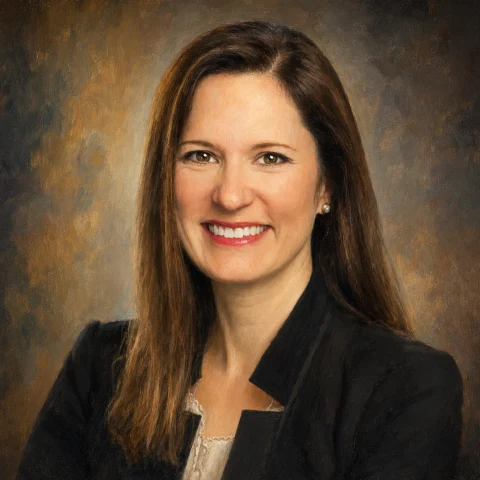
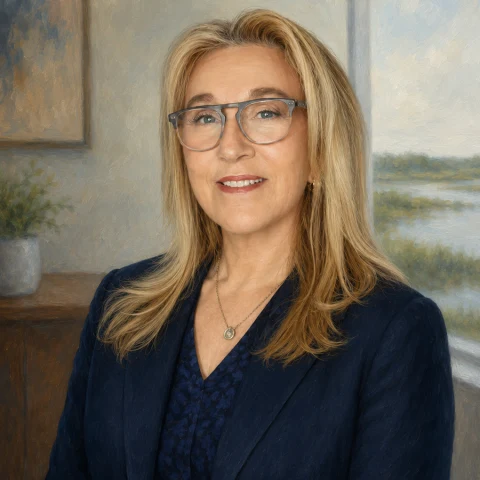
Jayne Conroy
Prescription Opioid Litigation · Mass Tort · Products Liability
They have no incentive to protect those kids until there’s some sort of State or federal law that requires them to do that.
Jayne Conroy Tried Suffolk County’s Opioid Case to a Verdict Against Teva and Helped Settle With CVS, Walgreens and Walmart
About five weeks after her law partner Paul Hanly died in May 2021, Conroy opened Suffolk County’s case against the opioid industry before a Long Island jury, which found Teva and its distributor Anda liable that December. She succeeded Hanly as a co-lead of the national opioid litigation and was on the team that negotiated about $13.8 billion in settlements with CVS, Walgreens and Walmart.
At the end of June 2021, in a two-story law school auditorium in Central Islip, on Long Island, Jayne Conroy began her opening statement with a photograph of an opium flower. The room, at Touro College’s law school, had been turned into a courtroom for the first opioid case in the country to go before a jury: the State of New York and Suffolk and Nassau counties against the companies that had made and shipped the pills, with the parties seated at the six-foot distances COVID precautions required. Conroy represented Suffolk County. “There is a terrible darkness here,” she told the jurors. “The evidence is going to show that more prescription opioids were shipped to Suffolk County than any other county in all of New York.”
She told them what the companies had said and what to listen for. The drugmakers, she said, had told doctors and patients that addiction was rare, had told doctors not to worry about “pseudoaddiction,” and had advised that a higher dose would make withdrawal-like symptoms go away. “Honesty was in short supply,” she said. Then she gave the jurors a warning. “You will not hear these defendants accept any blame for this epidemic. You will hear them blame everyone else,” she said—the FDA, the DEA, the police, county and state officials, doctors. “I want you to listen for that.”
About five weeks before that opening, Paul J. Hanly Jr., her law partner of more than thirty years, died at his home in New York on May 22, 2021, at seventy, after months of illness with anaplastic thyroid cancer. “There are no words to fully capture what the legal community has lost or the impact he had on our lives, especially my own,” Conroy said. Hanly had co-led the Plaintiffs’ Executive Committee coordinating the national opioid litigation in Cleveland, and Conroy took his place. For the rest of 2021 she was trying Suffolk County’s case on Long Island while co-leading the national committee as its first trial against the pharmacy chains went forward in Ohio.
Five Thousand OxyContin Clients
The two had been suing the opioid industry for eighteen years by then. They founded Hanly Conroy together in 2002. Doctors had told Hanly that patients taking OxyContin as prescribed were becoming addicted, and in 2003 the firm sued Purdue Pharma, which made the drug, and Abbott Laboratories. Conroy and Hanly represented more than five thousand people who had been prescribed OxyContin, and the firm filed more than 1,200 separate cases in courts across the country. It would be fourteen more years before the federal courts gathered the country’s opioid cases into a single proceeding.
Their lawyers deposed dozens of witnesses and collected millions of pages of company documents, and Hanly also represented a former legal assistant from the office of Purdue’s general counsel, who gave them an account of how the company worked from the inside. The discovery produced internal Purdue marketing material that had told physicians the drug carried a low risk of addiction. After a fight of more than three years, Purdue settled the claims of all of the more than five thousand clients, paying $75 million in 2007.
The Justice Department subpoenaed what the firm had found and used it in its prosecution of Purdue and its executives. On May 10, 2007, the Purdue Frederick Company pleaded guilty in federal court in the Western District of Virginia to misbranding OxyContin with intent to defraud or mislead. Three executives—Michael Friedman, its president; Howard Udell, its chief legal officer; and Dr. Paul D. Goldenheim, its former head of worldwide medical affairs—pleaded guilty to misdemeanor misbranding, and Purdue agreed to pay $634.5 million. Prosecutors said Purdue’s sales representatives had told some doctors that OxyContin produced less euphoria and carried less potential for abuse than short-acting opioids, that it caused no “buzz,” and that it could be used to “weed out” addicts and drug seekers.
For help with thousands of Purdue cases, Hanly Conroy had turned to John Simmons’s firm, from Alton, Illinois. “Twenty years ago, Hanly Conroy reached out to John Simmons for assistance in thousands of cases brought around the country against Purdue Pharma on behalf of victims,” Conroy has said. The firms kept working together on other mass torts and merged in 2014 as Simmons Hanly Conroy, the firm that carries both partners’ names.
Hanly’s Seat in Cleveland
That single proceeding came in December 2017: In re: National Prescription Opiate Litigation, MDL No. 2804, before U.S. District Judge Dan Aaron Polster in Cleveland. By then the claims reached past the company that made the pills to the companies that shipped them and the pharmacies that filled the prescriptions. About three thousand counties, cities, and other local governments, along with tribes, brought suits against more than thirty companies along the supply chain, and a 22-lawyer Plaintiffs’ Executive Committee coordinated the work. Hanly co-led it from the start with Joe Rice of Motley Rice and Paul Farrell. Conroy held his seat when the committee’s first case against the pharmacy chains, brought by Lake and Trumbull counties in Ohio against CVS, Walgreens, and Walmart, went to trial later in 2021.
Red Flags at the Counter
That trial opened in Cleveland on October 4, 2021. The retail pharmacies stood at the end of the supply line, and the counties reached them through the pharmacist’s own duty. A prescription can carry warning signs of abuse or diversion—the “red flags” pharmacists are trained to catch—and the industry’s own standards require “due diligence” before one is filled. Mark Lanier, the counties’ trial lawyer, told the jury the chains had dispensed opioids so irresponsibly that dealers used their pharmacies to build a black-market supply line running from Florida to Ohio, and he read the companies’ own words aloud. One Walgreens document warned that “Walgreens is not verifying the legitimacy of suspicious orders,” and that an illicit order could be filled as a result. A CVS employee had written: “I may have been naive to believe we were doing everything we could to reduce the growth of this tragic problem.”
Walgreens’ lead lawyer, Casper Stoffelmayr, answered that its pharmacists had tried to be careful with the drugs and that the blame belonged elsewhere: with doctors who overprescribed, drugmakers who misrepresented the drugs’ safety, and regulators who moved too slowly.
The counties built their case on the pharmacies’ own operations: Drug Enforcement Administration and Ohio Board of Pharmacy inspection records, the companies’ internal dispensing policies and emails, and data showing how often prescriptions had been filled without a documented review of the warning signs. The chains’ own people described the rules. Kenneth Cook, a CVS pharmacist and district leader, testified that red flags had to be resolved before a controlled substance could “ultimately reach the hands of the public.” Michelle Travassos, CVS’s manager of pharmacy professional services, agreed that every red flag a pharmacist identified had to be resolved before the prescription was filled. Nicole Harrington, CVS’s senior director of pharmacy, acknowledged that it was “common” for pharmacists not to document how they had resolved one, though CVS policy told them to “document all steps.” Thomas Davis, a CVS vice president, testified that the company’s dispensing software gave its pharmacists “all the information from a data perspective that they would need to exercise corresponding responsibility.”
Natasha Polster, Walgreens’ divisional vice president for pharmacy compliance—no relation to the judge, as the court noted on the record—testified that it had long been “an obligation of the pharmacist to document the resolution of red flags on prescriptions.” Amy Stossel, a Walgreens pharmacist, testified on cross-examination that she regularly did not take the time to document her resolution of red flags; time constraints, she said, kept her from it. At Walmart, Susanne Hiland, the senior director for patient safety, described Archer, the system the company used to track its stores’ compliance, and Brad Nelson, its former senior manager for controlled substances, said his job had been to communicate the policies rather than to enforce them. Scott Ortolani, a Walmart market director, testified about an inspector who had worried that Walmart’s “more liberal policies on dispensing painmeds” were making it a “funnel” for Schedule II drugs.
The proof went prescription by prescription. Carmen Catizone, a pharmacist and former executive director of the National Association of Boards of Pharmacy, drew random samples of the prescriptions each chain had filled that carried at least one red flag. For each, he examined both the notes pharmacists had entered in the companies’ computer systems and the paper prescription itself, looking for a record that someone had resolved the warning before the pills were handed over. Almost half of the CVS sample had no relevant entry in the digital notes, and the paper copies of those prescriptions showed no due diligence either. At Walmart, he testified, most of what pharmacists had written “would not qualify as adequate or even relevant due diligence.” Craig McCann, a data analyst, then testified that the share of inadequately documented prescriptions in Catizone’s samples could be extrapolated across every red-flag prescription the three chains had filled in the two counties.
Two and a Half Hours, Every Year or Two
CVS’s answer was its regulators. Neither the DEA nor the Ohio Board of Pharmacy, it argued, had ever revoked or suspended the license of any of its pharmacies in the two counties or expressed concern about how they dispensed opioids, and that history entitled it to safe-harbor immunity from public-nuisance liability. The counties answered with the inspections themselves. George Pavlich, a retired agent of the pharmacy board, was asked whether he had reviewed the pharmacies’ policies for dispensing controlled substances. “I don’t recall looking at those policies,” he said. Trey Edwards, another board agent, testified that he had neither reviewed dispensing policies nor systematically checked prescriptions for red flags.
On November 23, 2021, after an eight-week trial and six days of deliberation, the jury returned its verdict. CVS, Walgreens, and Walmart, the jury found, had each “engaged in intentional and/or illegal conduct which was a substantial factor in producing” the public nuisance created when opioids the companies dispensed reached the illicit market in Lake and Trumbull counties. It was the first jury verdict returned in the National Prescription Opiate Litigation. “The jury verdict sends a strong message to these giant pharmacy companies that the American public expects them to fulfill their obligations as good corporate citizens,” Conroy said afterward. “When companies put profits over people’s lives, they will be held accountable.”
In March 2022 Judge Polster denied the chains’ post-trial motions for judgment as a matter of law and for a new trial, and he rejected CVS’s safe-harbor argument. The immunity, he wrote, was “available only to those who perform in accordance with their applicable licensing and regulatory obligations,” and passing an inspection did not establish that CVS had met all of them: the jury had heard evidence that the Ohio Board of Pharmacy’s inspections of CVS stores were “brief cursory and infrequent,” lasting two and a half to three hours and occurring every year or two for each store, and that the inspections never reviewed how individual pharmacists had resolved red flags on individual prescriptions.
Three Reasons for a Suffolk County Jury
On Long Island the New York trial went on through the fall. Justice Jerry Garguilo of the State Supreme Court presided over what Conroy later called “a grueling marathon, lasting approximately seven months.” More than seventy witnesses testified and more than eight hundred exhibits went before the jury, and defendants settled one after another while it ran. Johnson & Johnson agreed to pay $230 million and to stop making opioids; the three largest drug distributors settled for a combined $1.18 billion; Endo agreed to $50 million and Allergan to $200 million. By December the case was down to Teva Pharmaceuticals, the last drug manufacturer still in it, and Anda, its distributor.
The claims against Teva turned on two fentanyl drugs, Actiq and Fentora, approved for some cancer patients; the plaintiffs charged that Teva had promoted them again and again for other kinds of pain in a “deceptive and dangerous marketing strategy.” Teva maintained that the plaintiffs had no evidence of medically unnecessary prescriptions, suspicious orders, or oversupply, and could not show that its marketing had harmed anyone in New York.
Conroy gave Suffolk County’s closing argument on Monday, December 13, 2021. “I told you this is a simple case,” she told the jurors. “You don’t need to overcomplicate things.” She counted it out for them: “Three reasons. One: Don’t violate the law.” “Two: Don’t lie about your product.” “Three: And don’t harm our communities for profit.” She reminded them of the warning from her opening, that the defendants would blame everyone else, and handed them a verdict form for dividing responsibility among the remaining defendants and the companies that had settled, asking them to put half on Teva and its subsidiaries and half on Anda.
The jurors began deliberating the next day. With days off for Christmas, they returned their verdict on December 30, 2021, finding Teva and Anda liable for helping to fuel the opioid crisis in New York. Garguilo called the trial “an ultramarathon” that had “touched four seasons.” “Manufacturer Teva and distributor Anda cannot break the law for profit and cause deadly harm to our communities,” Conroy said. She put the cost in emergency services and rehabilitation: “The numbers are staggering, what it has cost our communities and what it will continue to cost our communities.” The money, she said, was needed “to have effective emergency medical services for overdose victims, to have Narcan available to everyone.”
Ten months later Teva agreed to pay. On November 3, 2022, Attorney General Letitia James announced settlements bringing New York $523,892,020.15 from Teva: $210,548,226.20 as the state’s share of Teva’s national settlement and $313,343,793.95 to resolve the remedies phase of the trial, with the payments spread over as long as eighteen years. Teva accepted limits on how it marketed opioids and on its funding of groups that promoted them, and agreed to monitor and report off-label use of its fentanyl products; Anda agreed to unannounced visits to its customers and periodic reviews of its systems for detecting diversion. Under a state law passed in 2021, the money had to go to abatement, treatment, and prevention in the communities the epidemic had hit.
Constant Pressure to Fill
Conroy was also one of the co-lead trial counsel for San Francisco in the city’s opioid case in federal court there, alongside City Attorney David Chiu, Richard Heimann, Aelish Baig, and Peter Mougey. By the end of an eleven-week liability trial before Judge Charles R. Breyer, Walgreens was the only defendant left; Allergan and Teva had settled with the city for $54 million on the eve of closing arguments. In August 2022 Breyer ruled, in a 112-page decision, that Walgreens had substantially contributed to the opioid epidemic in San Francisco. He found that “from 2006 to 2020, Walgreens pharmacies in San Francisco dispensed hundreds of thousands of red flag opioid prescriptions” without adequate due diligence, many of them written by prescribers the company’s own pharmacists had warned it about, and that “Pharmacists experienced constant pressure to fill prescriptions as quickly as possible.” He called the aggregate evidence “devastating.”
Walgreens called the outcome unsupported by the facts or the law and said it had never manufactured or marketed opioids. In May 2023 it agreed to pay San Francisco $229,610,000 over fourteen years, most of it in the first eight, in a settlement that would end the city’s suit. The city’s health director, Dr. Grant Colfax, said the Department of Public Health would use the money for treatment and lifesaving efforts, including its response to fentanyl.
Over Ten Years and Fifteen
The national settlements with the chains came in November 2022. CVS agreed to pay about $5 billion over ten years and Walgreens about $5.7 billion over fifteen; Walmart agreed to $3.1 billion, most of it up front. The agreements, about $13.8 billion in all, were the first nationwide opioid settlements with retail pharmacy companies, and they resolved thousands of suits by states, local governments, and tribes accusing the chains of mishandling opioid painkillers. Conroy was on the court-appointed leadership and negotiating team that reached them, with Paul Farrell, Joe Rice, Elizabeth Cabraser, Christopher Seeger, Hunter Shkolnik, Peter Mougey, and others. CVS and Walgreens also agreed to court-ordered terms requiring them to “monitor, report, and share data about suspicious activity related to opioid prescriptions.” The pharmacy agreements followed more than $33 billion in nationwide settlements with the drugs’ makers and distributors.
Writing about the litigation in the ABA Journal in 2024, Conroy put it plainly: “There is no ‘winning’ this lawsuit in the usual sense.” What she was proudest of, she wrote, was that the money reached communities whether or not they had sued, and that “settlement monies must be spent on abatement of the opioid epidemic”: on local treatment and prevention programs, and on support for first responders handling overdoses. “The opioid litigation allows us to get some relief to these communities faster,” she has said, “which could actually help someone who has not been hurt yet.”
Purdue, Twenty-Two Years Later
The company she had first sued in 2003 reached the end of its own case in November 2025, when U.S. Bankruptcy Judge Sean Lane, in the Southern District of New York, approved Purdue Pharma’s plan. It sends at least $7.4 billion to Purdue’s public and private creditors, up to $7 billion of it from members of the Sackler family over fifteen years, with about $850 million set aside for individual victims. Purdue is to be dissolved and its assets moved to a new company, Knoa Pharma, owned by an independent foundation, which will supply medicines for opioid use disorder and overdose reversal under a strict operating injunction and a monitor. The plan also creates an archive of Purdue’s historical sales and marketing records. The national plaintiffs’ co-leads, Joe Rice, Conroy, and Paul Farrell, called the approval “a significant step toward providing additional funds for the victims.”
From Cap-Haïtien to East Palestine
Her appointments reached past opioids. A federal court in Ohio appointed her to the Plaintiffs’ Steering Committee in the litigation over DePuy’s recalled ASR hip implant, and federal courts named her to steering and executive committees in the litigation over Volkswagen’s diesel-emissions software, the antipsychotic Zyprexa, and the diabetes drug Actos. She represented children abused by Douglas Perlitz, a 1992 Fairfield University graduate who had founded and run Project Pierre Toussaint in Cap-Haïtien, Haiti, and who admitted sexually abusing boys there during trips from 2001 to 2008; he is serving a twenty-year federal sentence. In June 2019 U.S. District Judge Robert Chatigny approved a $60 million settlement for as many as 170 of them, paid by Fairfield University, the Society of Jesus of New England, the American Association of the Order of Malta, Haiti Fund Inc., and two individuals. “It’s life changing for the kids,” Conroy said. “We are so anxious to finalize this settlement and find some justice for these kids.”
On February 3, 2023, a 150-car Norfolk Southern freight train derailed just outside East Palestine, Ohio, a town of just under five thousand people, and spilled vinyl chloride, a chemical used to make PVC. Residents were evacuated while officials carried out a controlled burn that lasted until February 8; the chair of the National Transportation Safety Board, Jennifer Homendy, later testified that the burn had been harmful and unnecessary. Thirty-one class actions were consolidated before U.S. District Judge Benita Pearson in the Northern District of Ohio, and Conroy served as co-lead counsel for the residents’ class with Seth Katz, Elizabeth Graham, and Michael Morgan. In April 2024 Norfolk Southern agreed to a $600 million class settlement covering people within twenty miles of the crash, with personal-injury claims limited to those within ten; Pearson granted final approval that September. “We believe this is a fair, reasonable and adequate result for the community on a number of levels,” class counsel said.
The personal-injury money went out first through a claims administrator, Kroll. In October 2025 class counsel, Conroy among them, charged that Kroll had disregarded the court-approved plan, under which each claimant’s share turned on points. “Kroll inexplicably ignored the concept of points entirely,” they told Pearson, asking her to order the company to show cause why it should not be held in contempt, and they counted at least $17,249,717.45 in overpayments. Pearson had already replaced Kroll with Epiq. After a hearing on December 5, Kroll agreed to pay $17.25 million into the personal-injury fund for class members, and Pearson approved the agreement and ordered the payment.
More Than Seventy Trials
Conroy graduated from Dartmouth College in 1980 and from New England School of Law in 1985, where she was an editor of the New England Journal on Criminal and Civil Confinement. She worked as a paralegal while she was in law school and has credited the job with teaching her how to know a case file thoroughly and how to organize one. She was admitted to the bar in Massachusetts in 1985 and in New York in 1997, has spent her career in private practice on civil litigation, and by 2023 had tried more than seventy cases. She leads the complex litigation department at Simmons Hanly Conroy. “Terrible things have happened to my clients that I can’t change, but what I can do is try to get them the justice they deserve,” she has said.
The First Social Media Jury
In 2022 Conroy and other lawyers sued Meta Platforms in federal court in Northern California, arguing that the algorithms behind Facebook and Instagram were designed to be addictive and harmed young users. In early 2026 she joined the plaintiffs’ trial team in the first social media addiction case to reach a jury, brought in Los Angeles County Superior Court by a young plaintiff identified as K.G.M. against Meta and YouTube and tried before Judge Carolyn Kuhl. K.G.M. testified that she had started using YouTube at six and Instagram at nine and was on social media “all day long” as a child; Meta’s founder, Mark Zuckerberg, and the head of Instagram, Adam Mosseri, took the stand. On March 25, 2026, after more than forty hours of deliberation, the jury found the companies negligent and assigned Meta 70 percent of the responsibility. It awarded $3 million in compensatory damages and $3 million in punitive damages, and ordered Meta to pay $4.2 million and YouTube’s parent, Alphabet, $1.8 million. In June the court denied the companies’ motions for a new trial, and both have appealed.
Asked why the platforms had not adopted the age-verification rules already required in the United Kingdom and France, Conroy put a figure on the answer: adopting them would cost YouTube alone “about $4 billion a year” in advertising to minors. “They have no incentive to protect those kids until there’s some sort of State or federal law that requires them to do that,” she said.