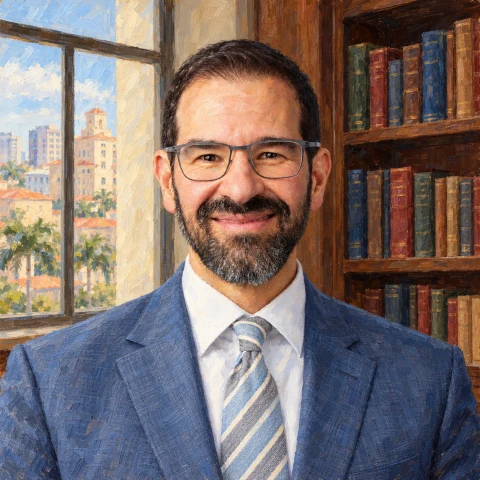
Christopher Paulos
Anti-Terrorism Litigation · Mass Torts · Catastrophic Injury
This jurisdictional and evidentiary threshold is based upon the enormous deference and comity U.S. law and courts afford foreign nations—even those who actively seek to kill Americans.
Fishbeck v. Islamic Republic of Iran in D.C. Federal Court: Twelve Bellwether Attacks on U.S. Troops in Iraq and a $983.6 Million Judgment
Christopher Paulos led the Levin Papantonio counterterrorism department, which spent six years building a case against Iran for U.S. service members killed or wounded in Iraq and their families; Iran never appeared to defend it. Judge Christopher R. Cooper held Iran, its Revolutionary Guard, its intelligence ministry, and two state banks liable for twelve attacks in Iraq, and the final judgment for 111 plaintiffs came to $983,581,364.
Spc. Christopher Fishbeck was 24, on his first deployment with the 1st Infantry Division, when militants fired rockets into Camp Loyalty, on the eastern side of Baghdad, on June 6, 2011. The rockets killed five American soldiers; it was the deadliest attack on U.S. troops in Iraq in more than two years. Before he left for Iraq he had the words “St. Michael Defend Me” tattooed on his chest. Home in Orange County, California, on leave that May, he told his mother, Toni Kay, that there was “a 90-percent chance that he wouldn’t make it out alive.” In March he had married Stephanie Kidder, a girl he had gone out with a few times in high school, on a small island in Denmark; both of them wore jeans. She begged him not to go back. He told her he would “finish what he started.”
His estate leads the list of plaintiffs in the lawsuit that Levin Papantonio brought in federal court in Washington against the Islamic Republic of Iran, which the plaintiffs charged with supporting the groups behind that attack and more than 400 others.
“As in many similar actions against Iran, no defendant has appeared,” Judge Christopher R. Cooper of the U.S. District Court for the District of Columbia wrote on August 18, 2023, in Estate of Christopher Brook Fishbeck v. Islamic Republic of Iran. Iran’s silence did not decide the case for the plaintiffs. Under the terrorism exception to the Foreign Sovereign Immunities Act, a court may enter judgment against a foreign state in default only if it finds that it has jurisdiction and that the plaintiffs have established their right to relief “by evidence satisfactory to the court.” The plaintiffs, more than 1,400 in all—service members injured in Iraq between 2003 and 2011, the estates of those killed, and their families—had to prove that Iran stood behind the particular attacks that had killed and wounded those service members, and they had to do it without a single document or witness from the other side.
Christopher Paulos led the counterterrorism department at Levin Papantonio, the Pensacola, Florida, firm that brought the case, and the department worked for six years building it against Iran and its state entities. In the August 2023 ruling Cooper held Iran, its Islamic Revolutionary Guard Corps, its Ministry of Intelligence and Security, its central bank, Bank Markazi, and the state-owned Bank Melli liable for twelve attacks the plaintiffs had put forward as bellwethers. The final judgment that followed in 2024 awarded $983,581,364 to 111 Fishbeck plaintiffs whose claims arose from those twelve attacks.
Affidavits of Service and a Thousand Exhibits
In May 2017, more than a year before the Fishbeck complaint was filed, Levin Papantonio and other firms announced a suit against Iran on behalf of injured veterans and Gold Star families over sixteen attacks in Iraq. Paulos said then: “Based on all available evidence today, there is no doubt that Iran purposefully waged a campaign of terror against our troops and coalition partners for the sheer purposes of destabilizing the region and disrupting the democratic potential of Iraq.” The attackers, he said, were trained by Iran and carried Iranian weapons, “and were financed and directed by Iran.”
The Fishbeck complaint was filed on September 27, 2018, under 28 U.S.C. § 1605A, the provision that lifts the immunity of a designated state sponsor of terrorism. On March 21, 2019, Cooper granted a motion for Paulos to appear in the case pro hac vice as a Levin Papantonio lawyer. A court acquires personal jurisdiction over a foreign state when service has been properly made under 28 U.S.C. § 1608, and Paulos filed the proofs. On June 12, 2019, he filed the affidavit requesting foreign mailing to Iran, the IRGC, and MOIS, along with returns of service showing Bank Markazi served on May 29 and Bank Melli on May 30. That August he filed the affidavits for default against the banks, and in November the affidavit for default against Iran, the IRGC, and MOIS. On March 27, 2020, he moved for an order finding that service had been properly made, and on March 1, 2021, Cooper granted it. In April 2020 he moved for discovery from third parties, and Cooper granted that motion too.
With Iran absent, the evidence had to come from American sources. In February 2022 Paulos moved for a protective order covering records from the Department of Defense; in March he moved to file the plaintiffs’ proof of standing under seal and filed the motion on subject-matter jurisdiction; and on May 2, 2022, he filed the motion asking Cooper to find that the defendants had given material support to the terrorist organizations, followed four days later by an amended exhibit list that ran from PX1 to PX1001. Getting thousands of documents out of the Defense and State Departments took years, and Paulos has said the agencies were not always cooperative; in 2024 the Defense Department was nearly 1,000 pages behind the schedule for documents it had agreed to produce. “We are, you know, establishing a factual record for things that happened thousands of miles away, sometimes, you know, over two decades ago,” Paulos said. “And either our eyewitnesses are either all deceased or are the bad guys, themselves.”
For each attack the statute required three showings: that the defendants provided “material support or resources” to the group that carried it out, that the support was “a substantial factor” in the attack, and that the injuries were “reasonably foreseeable or anticipated as a natural consequence” of that support. Ordinary litigation would have tested those propositions through discovery. Paulos has explained why that was impossible here: Iran purposefully ignores any case accusing it of supporting terrorism, so plaintiffs are “robbed of the opportunity to confront Iran and obtain discovery from the defendants.” Even so, he said, the narrow exception to Iran’s immunity still required the plaintiffs to prove every element of their case to the complete satisfaction of the court.
Three Days of Testimony in September 2022
By the time the plaintiffs moved for judgment, their Second Amended Complaint described more than 400 separate attacks on American troops. They asked Cooper to decide liability first for fifteen bellwether attacks, chosen, they told him, “based upon their representativeness of all 438 attacks at issue in this case.” The twelve that went to final judgment in 2024 ran from April 2004 to April 2008 and across much of Iraq, including Sadr City, Kadhimiya, Adhamiya, and the Green Zone in Baghdad; Fallujah, Haqlaniyah, and Ramadi in Anbar Province; and Salah ad Din Province to the north.
Cooper heard the bellwether evidence over three days, September 12 to 14, 2022. Survivors of the attacks testified, and so did three experts who linked Iran to the groups suspected of carrying them out: Daveed Gartenstein-Ross took the first five attacks, Col. M. Lee Walters the next five, and Michael Pregent the last five. Gartenstein-Ross testified that in Anbar Province in 2005 no Shia group had claimed responsibility for a single attack, while Al Qaeda in Iraq had credibly claimed 43. Walters testified that the explosively formed penetrator “was very unique and only given to Shia militia groups from Iran.”
The rest of the proof came from military reporting on the attacks, from the Treasury Department’s findings about Iran’s banks, and from the experts’ reports and declarations. Cooper acknowledged that in a default case “the quantum and quality of evidence that might satisfy a court can be less than that normally required,” and that expert testimony can carry a claim where “firsthand evidence of terrorist activities is difficult, if not impossible to obtain.” He then went attack by attack.
Shia Militias and Sunni Insurgents
The groups behind the bellwether attacks did not belong to one camp. Jaysh al-Mahdi, Asa’ib Ahl al-Haq, and Kata’ib Hezbollah were Shia militias. Al Qaeda in Iraq and Ansar al-Islam, also known as Ansar al-Sunna, were Sunni. Cooper stated the difficulty in a sentence: “Some of these groups were comprised of Shia Muslims, the dominant sect in Iran; others consisted of Sunni Muslims, Iran’s ostensible rivals.” He attributed the April 2005 mortar and rocket attack on Camp Ramadi, the February 2007 pressure-plate bombs in Ramadi, and the attacks at Fallujah and Haqlaniyah to Al Qaeda in Iraq. Proof confined to the Shia militias would have reached none of those four attacks.
Before reaching the attacks, Cooper had found that Iran, the IRGC, and MOIS gave nine organizations support “essential to the groups’ operating capacity”: Al Qaeda, Al Qaeda in Iraq, and Ansar al-Islam on the Sunni side, and the Badr Corps, Jaysh al-Mahdi, the Promised Day Brigade, Asa’ib Ahl al-Haq, Kata’ib Hezbollah, and the Sheibani Network on the Shia side. On August 18, 2023, he found that Bank Markazi and Bank Melli had given the same groups material support.
Cooper found that the defendants “provided material support to the subject terrorist groups which bolstered their ability to foreseeably commit acts of extrajudicial killing.” Quoting earlier decisions, he observed that material support “is fungible” and that “terrorist organizations can hardly be counted on to keep careful bookkeeping records.” The plaintiffs had to show that Iran’s support was a proximate cause of their injuries; they did not have to match a particular payment to a particular bomb.
“There has never been any other case that has ever achieved a global ruling of material support and reasonable foreseeability involving as many separate terrorist organizations, continuing over such a long period of time, or encompassing such a large geographic region,” Paulos said.
Copper Fragments and Bank Transfers
Some of the proof was physical. Endi Herrera was wounded in Baghdad’s Adhamiya district on September 17, 2006, in an attack Cooper attributed to Iran-backed Shia militias. Herrera testified that the shrapnel embedded in his equipment was copper, a sign that the explosive was an EFP—an explosively formed penetrator. One of the plaintiffs’ expert reports, which Cooper cited, stated that the use of the EFP “was reserved for use by Iranian-backed Shia Militant Groups with direct support from Islamic Revolutionary Guard Corps (IRGC)-Qods Force and Hezbollah.”
Herrera also testified that his unit had captured Iranian operatives who were teaching Jaysh al-Mahdi members to build EFPs, and Multi-National Force briefings in the record said that “the EFP technology and EFP munitions are clearly coming from Iran.” The same weapon struck Sfc. Larry Diaz Cabral Jr. on November 14, 2006, when his Humvee, returning to base by an unplanned route, passed an unmanned Iraqi Army checkpoint in Baghdad’s Kadhimiya district; two other soldiers were killed. Cabral took shrapnel wounds to his arms, legs, and face, and the nerve damage in his arms required surgery. Cooper held the defendants liable for both EFP attacks.
The case against the banks ran through money. The statute counts financial services as material support. The Treasury Department had found that from 2002 to 2006 “Bank Melli was used to send at least $100 million to the [IRGC’s] Qods Force,” and had documented deceptive banking practices both banks used to hide their role and evade sanctions. One of the plaintiffs’ experts declared that “Iran has used Markazi for many years, including 2003-2011, to transfer funds to support terrorism.” Cooper held both banks answerable, reasoning that “the terrorism exception to the FSIA targets sovereign nations in an effort to deter them from engaging, either directly or indirectly, in terrorist acts.” Paulos later described the result: “the Court found that the Defendants’ support caused the attacks against our clients.”
Booby-Trapped Houses, Foreign Fighters and a General’s Memo
Where the weapon did not point to Iran, the proof turned on who held the ground and how the attackers fought. On April 4, 2004, fighters in Sadr City, a Jaysh al-Mahdi stronghold, blocked routes to funnel several U.S. convoys into “a kill zone,” killing seven Americans and wounding at least fifty; Sfc. Franklyn Lee Doss burned his hands getting fellow soldiers out of their vehicles. In Fallujah on November 13 and 14, 2004, fighters lured Marines into a booby-trapped house and, the next day, drew the same men into a second house to retrieve a wounded Marine before opening fire with guns and grenades. Cpl. Dale Burger was shot in the middle of his forehead while clearing a building. Gartenstein-Ross reported that Al Qaeda in Iraq was “the central insurgent force” in the battle for Fallujah, and he pointed to the use of wounded Americans as “bait.”
On January 26, 2005, a twelve-vehicle convoy raided buildings in Haqlaniyah, near Haditha, on intelligence that turned out to be wrong, and on the way back an estimated 75 to 100 fighters immobilized it with an explosion and fired on it from homes, rooftops, and the nearby mosque. Cpl. Jonathan Bowling lived for two hours. A declassified military intelligence report recorded Al Qaeda in Iraq leaders in control of Haqlaniyah’s mosques at the time. In the Golden Hills on April 9, 2008, TSgt. Anthony Capra, an explosive ordnance disposal specialist, was killed trying to defuse an unexploded IED. An Air Force specialist’s post-blast analysis found the device “very sophisticated,” with anti-tampering components, and a military intelligence report tied it to an IED cell associated with Ansar al-Islam, which had a safe haven in the area. After Capra’s death, his parents, Sharon and Anthony, took in his wife and children.
Other proof came from American reports and witnesses. On April 21, 2008, a pressure-plate IED in Salah ad Din Province flipped the 14-ton mine-resistant vehicle carrying Sgt. Adam Kohlhaas and his platoon, killing him and another soldier. His patrol leader declared that two intelligence reports blamed Al Qaeda in Iraq, and a declassified memorandum from then Lt. Gen. Lloyd Austin recorded that Al Qaeda in Iraq had set off an IED against a coalition convoy near Salam Village, in the same area, the day before. LCpl. Taylor Prazynski was killed on May 9, 2005, by mortar fire on his base in Anbar Province, fire described as “very accurate, with every round striking within [a] small area”; he lived just under an hour and a half. The next day a coalition team tracked down the mortar team, killing two fighters and chasing off two others, and witnesses said the men who fled were “not Iraqi but instead foreigners.”
Spc. Ryan Trimble was wounded on March 23, 2008, when 107-mm rockets fired from Sadr City, more than seven kilometers away, landed in Camp Travis in Baghdad’s Green Zone. He testified that “there was a civilian contractor killed that day,” and Cooper took judicial notice of a Denver Post report of an American contractor’s death in the attack. Weeks earlier, a military briefing had described seized 107-mm rockets assessed to have been produced in Iran in 2007. On February 19, 2005, Ashura, a major Shia holy day, thousands of pilgrims had gathered at a mosque in Baghdad’s Kadhimiya district, and 1LT Adam Malson was helping civilians wounded by a suicide bomber when a second bomber detonated. Malson was killed, and Joshua Coy, fifteen feet away, was wounded. Their battalion commander declared that the tactics matched those of Al Qaeda in Iraq.
Cooper found the defendants liable for twelve of the fifteen bellwethers. On the other three, a car bomb in Baghdad’s Dora neighborhood, an IED beneath a tank in Salah ad Din Province, and a rocket strike in Dhi Qar Province, he declined to enter judgment on the record as it stood and invited the plaintiffs to supplement it.
Camp Ramadi and the Road Back to Base
On April 16, 2005, two 120-mm mortars and two 107-mm rockets came down on Camp Ramadi in Anbar Province. Spc. Randy Stevens and Sgt. Tromaine K. Toy were killed, and Sgt. Robert Briggs was injured. Spc. Jose Jauregui was inside a vehicle when a rocket struck him. He was 19, and he was conscious as he suffered third-degree burns over 75 percent of his body. He lost both of his ears and had all but one of his fingers amputated. Over years of surgeries he received 55 transfusions of blood and blood products, and he spent more than two months in a medically induced coma from which, Cooper found, he had a 3 percent chance of survival.
Jauregui lived. When Cooper ruled in 2024, he still could not blink, had trouble eating because of limited motion in his jaw, could not use his left hand, and had limited use of his right. He was permanently disfigured and could not regulate his body temperature, and the medical care he would need for the rest of his life was expected to cost upwards of $6 million.
Randy Stevens dragged himself out of a burning vehicle and died a short time later. Robert Briggs was caught in the blast of a 120-mm mortar. Special Master John Kuder found that he suffered “a gruesome open head injury, a significant amount of blood loss, and the agony of having one eye hanging from its socket,” and that he was conscious through it. After surgeries, eight weeks of treatment, seven months of brain-injury rehabilitation, and a final cranioplasty, Briggs went home with seizures, panic attacks, and PTSD, needing care around the clock. His wife, Michelle, cared for him for six years. He died in 2011 of “complications from blast injuries.”
No one caught the mortar team; a Marine unit reported that it escaped to a local mosque. The plaintiffs’ evidence placed the launch in the Tamim District beside the camp and showed that groups affiliated with Al Qaeda in Iraq had emerged that April as the primary threat to coalition forces in Ramadi. It also showed that the city’s less dominant insurgent groups had declared a ceasefire from April 15 to April 17. The mortars and rockets fell on April 16.
On February 22, 2007, Staff Sgt. Joshua Hager, an Army Ranger, was convoying back to base in Ramadi when his vehicle hit a pressure-plate IED, which killed him. Sgt. 1st Class Raleigh Heekin III reached the site of the first blast, and his vehicle hit a second pressure-plate IED, which knocked him unconscious and killed several other service members. Hager’s father, Kris, said of the judgment: “While his death is what is mentioned, it is his life that is honored. Josh died an Army Ranger, but he lived as an Army Ranger and when our Nation called, he said, ‘Here I am, send me.’”
Joshua Hager was 29. He had been a Ranger instructor at Eglin Air Force Base and, his father said, “wrote his own transfer” to a unit based in Colorado so that he could go to Iraq; he bought a house in Pueblo and never spent a day in it. Kris Hager remembered the last call. “Six days before he was killed, he said, ‘Dad, I just called to tell you, I love you,’” he said. “That was the last time I heard my son’s voice.” Heekin, who had been driving the second vehicle, testified at the hearing that his unit captured the “one main IED maker in that area,” an operative of Al Qaeda in Iraq, and the battalion commander declared that the IEDs had been assembled and emplaced by members of Al Qaeda in Iraq. When Cooper ruled in 2024, Heekin had been through more than 20 surgeries and other treatments and walked with a cane.
Nine Special Masters and a Multiplier of Two
Cooper appointed nine special masters to prepare reports and recommended awards for the bellwether plaintiffs and to assess both liability and damages for the remaining attacks. For each plaintiff, a special master wrote factual findings and recommended an amount, and Cooper fixed the award. “The process of assessing pain and suffering is an imperfect science, as no amount of money can properly compensate a victim,” he wrote, and courts “strive to maintain consistency of awards as between the specific plaintiffs and among plaintiffs in comparable situations.” For the families of service members killed in an attack, the starting figures in these cases were about $8 million for a spouse, $5 million for a parent, and $2.5 million for a sibling.
For Jose Jauregui, Cooper awarded $12 million for pain and suffering. “This award is typical of servicemembers who experienced permanent and debilitating injuries like SPC Jauregui,” he wrote.
Cooper awarded Robert Briggs’s estate $6 million for his pain and suffering and awarded Michelle Briggs $7 million. Herrera, Heekin, Cabral, and Coy each received $5 million. Ramona Beltran, who suffered a heart attack and was hospitalized when she learned that her son, Sgt. Salvador Beltran-Soto, had been wounded in Sadr City, received $1.8 million.
Counsel pressed for speed. Cooper acknowledged “counsel’s desire to expedite entry of final judgment for as many Plaintiffs as possible” and answered that assessing liability and calculating damages were “not routine tasks, even in the context of default proceedings.” “Congress perhaps could have streamlined the process of compensating victims of Iranian-backed terrorism by creating a purely administrative compensation regime,” he wrote. “But it did not go that route.” Plaintiffs and their lawyers, he added, were left to litigate their cases in federal court alongside the civil actions, criminal prosecutions, and administrative matters that take up a judge’s days.
Punitive damages turned on four factors: “the character of the defendants’ act,” “the nature and extent of harm to the plaintiffs that the defendants caused or intended to cause,” “the need for deterrence,” and “the wealth of the defendants.” Cooper applied the court’s earlier conclusion that “a multiplier of two is appropriate” where the defendants “did not directly carry out the attack, but funded” the organization that did. The final judgment for the 111 plaintiffs carried $284,599,000 for pain and suffering and solatium, $43,261,454.57 in economic damages, and $655,720,909 in punitive damages, twice the compensatory sum: $983,581,364 in all.
Dora, Taji and Camp Adder
On November 11, 2024, the plaintiffs went back to Cooper on the three open bellwethers with new evidence and briefing and a supplemental report from Pregent. Staff Sgt. Steven Nunez had been wounded in Baghdad’s Dora neighborhood on April 5, 2005, when a parked car, left running with its windows blacked out, exploded as his convoy came up beside it; four 122-mm artillery rounds had been stashed in the trunk, and a member of his patrol was killed. The new evidence included a report of an Al Qaeda in Iraq command-and-control cell in Dora and reporting that Al Qaeda in Iraq claimed responsibility for, or involvement in, at least 75 percent of the vehicle-bomb attacks in Iraq around that time. Pregent concluded that the bomb, which did not explode until Nunez’s vehicle was next to it and sat nowhere near a market or a crowd, was likely detonated on command against the patrol.
Sgt. Paul Haines was wounded on June 4, 2006, when an IED launched his tank into the air in Salah ad Din Province, killing two other soldiers. Investigators found 400 meters of command wire running up a nearby palm tree to a rope seat, and witnesses said the bombers had used a van to keep anyone from seeing them as they dug under the road. The investigation report appeared to name the cell responsible, but the name was redacted, and the plaintiffs could not obtain an unredacted copy. Pregent built the attribution another way. He reported that the attack fell in the Taji and Tarmiyah area that Al Qaeda in Iraq was trying to control in 2006 as part of its “Baghdad Belts” strategy, where a map published by the U.S. military showed the group concentrated at the end of that year; that the triggerman had waited 400 yards away, just beyond small-arms range, and needed training to hit an accelerating tank from there; and that the tank had been heading to provide security at the Karkh Water Treatment Facility, where Al Qaeda in Iraq had shown an interest in disrupting operations by stealing chlorine tanks that were used in an attack that October.
Spc. Joel Tavera was thrown from his vehicle on March 12, 2008, when a 122-mm rocket hit it at Camp Adder in Dhi Qar Province; the three other soldiers in the vehicle were killed. Pregent obtained an operations report and an indirect-fire report that had not been available to him at the time of the hearing. They showed four rockets launched from 17.5 kilometers away, three of them landing near important areas of the base at busy times, and two IEDs left at the launch site for the soldiers who would respond. A month after the attack, Adm. Michael Mullen, chairman of the Joint Chiefs of Staff, had said that the mortars and rockets being found were coming from Iran, and Highway 8, which ran past Camp Adder, had become a smuggling route toward Baghdad that Shia Special Groups protected.
On September 10, 2025, Cooper found the supplemental evidence sufficient and held the defendants liable for all three attacks, and on December 12, 2025, he signed findings of fact explaining why. Each of the fifteen bellwethers had now been tied to a group that Iran supported.
From A Band Apart to Pensacola
Paulos, whose hometown is Salt Lake City, came to law from film. He studied communication arts and cinema and television at the University of Southern California, graduating in 2000, and worked in Los Angeles with music video and commercial production companies and then with A Band Apart Films, the production company founded by Quentin Tarantino and Lawrence Bender. Back in Salt Lake City he helped launch and manage Spy Hop Productions, a nonprofit that provides media education and creative opportunities to underserved and at-risk youth, and developed its youth film studies curriculum. Contract and licensing disputes in the film business led him to law.
He received his law degree from Thomas Jefferson School of Law in San Diego in 2010. There he served as president of the Student Bar Association and the Entertainment Law Society, competed on the Mock Trial Team, and clerked for the San Diego County Office of the Public Defender in its misdemeanor and felony trial departments; afterward he worked at private criminal defense firms in San Diego on fraud, drug trafficking, offshore gaming, and malpractice matters. He met Mike Papantonio in 2009. He was admitted in California in 2010 and in Florida in 2011, the year he joined Levin Papantonio. At the firm he served on the trial teams in Sims v. Bayer, a bellwether trial in the Yaz birth-control litigation, and in the first four DuPont C-8 bellwether trials; helped build and manage the firm’s litigation teams on Chinese drywall, Actos, DePuy ASR hip implants, 3M Combat Arms earplugs, and PFAS; became a partner; and oversaw its qui tam and counterterrorism departments.
Before he left the firm, he worked on the litigation over Depo-Provera, the injectable contraceptive that plaintiffs allege can cause meningiomas, a type of brain tumor. In an April 2025 presentation Paulos traced the drug’s long use in population-control programs abroad and argued that its maker knew the hormone caused cancer in animals before shipping it to 75 countries. On March 16, 2025, Judge M. Casey Rodgers of the Northern District of Florida appointed him plaintiffs’ liaison counsel in the federal multidistrict litigation, the lawyer charged with serving “as the point of contact between the Court and the Plaintiffs’ leadership” and with keeping pro se litigants “apprised of the status and progress of the litigation.” Later in 2025 he founded Paulos Law, P.A., in Pensacola, joined by members of his long-time litigation team. The firm handles terrorism-related civil claims, wrongful death and catastrophic injury, negligent security, human trafficking, product liability, and environmental contamination.
The Victims Fund and the Attacks Beyond the Bellwethers
Congress amended the Foreign Sovereign Immunities Act in 1996 to let American victims of state-sponsored terrorism sue terrorist states in U.S. courts, but collecting on those judgments proved difficult until 2015, when Congress created the United States Victims of State Sponsored Terrorism Fund. The Justice Department and a Special Master administer it. An applicant must hold “a final judgment issued by a United States District Court awarding the individual compensatory damages” for an act of international terrorism by a foreign state found not immune under the Foreign Sovereign Immunities Act, and must apply within 90 days of obtaining it. The Fund pays in rounds, and since its creation it has paid out more than $10 billion to eligible victims. Cooper’s Fishbeck judgment sets compensatory damages plaintiff by plaintiff under the terrorism exception.
The 2024 judgment covered twelve attacks. The complaint described more than 400, and the special masters Cooper appointed were charged with assessing liability and damages for the rest.
In August 2025 Cooper took up the next batch: 63 attacks in the first two waves after the bellwethers, running from an October 1, 2003, rocket-propelled-grenade attack in Salah ad-Din Province to the June 6, 2011, rocket attack in Baghdad. They gave rise to the claims of 24 estates of service members or contractors who were killed, 58 who were injured, and 189 family members, 271 plaintiffs in all. Working from the factual record the special masters had prepared attack by attack, Cooper wrote that the conclusion that Iran and its agents supported a terrorist network, and that the network committed the attacks in question, “is largely uncontroverted on the record before the Court.” He largely granted the motion for final default judgment and fixed the awards plaintiff by plaintiff.
LCpl. Ronny Porta was burned over more than 60 percent of his body in an IED attack; he went through amputations and 129 surgeries, could no longer close his eyes, and lost his senses of taste and smell. Sgt. Terry Lamont Fleming was burned over 85 percent of his body, lost digits, and spent more than three years in hospitals. Pfc. Jace Aldric Badia lost a leg and spent three years in Army hospitals, through 107 surgeries. Cooper awarded each of the three $12 million for pain and suffering. Sgt. Daniel Cowart, who tackled a suicide bomber to save his comrades, had been through more than 20 surgeries, including amputations, and was confined to a wheelchair; Cooper awarded him $10 million. Merlin German survived his attack by three years, and his mother, Lourdes German, cared for him full time through more than one hundred medical procedures; Cooper awarded her $4.125 million.
The ruling also reached the soldier whose name the case carries. Fourteen years after the rockets hit Camp Loyalty, Cooper awarded the Estate of Christopher Brook Fishbeck $2,402,982 for the earnings he would have made and the household services he would have given his wife. More than 1,000 plaintiffs, Cooper noted, were “still in the queue.”