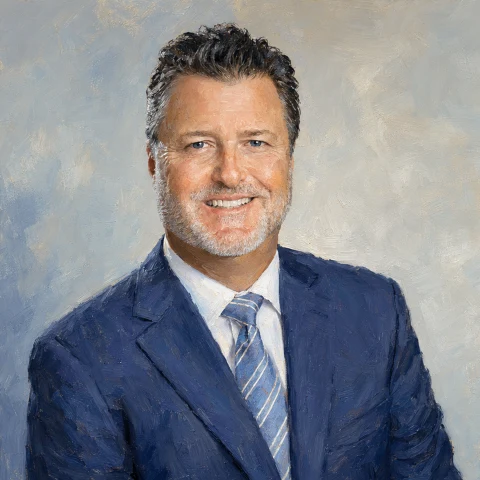
Jeff Anderson
Child Sexual Abuse Litigation · Clergy Abuse · Diocesan Bankruptcy
When we embark on this journey together we don’t engage in secrecy, or confidential settlements. We expose the offenders, and the culture that protected them.
Doe 1 v. Archdiocese of Saint Paul and Minneapolis: A Public-Nuisance Claim and the Ramsey County Order Releasing 46 Priests’ Names
Jeff Anderson’s first clergy-abuse case ended in 1988 with a settlement that carried no confidentiality clause, after his client had refused a $1 million offer that required one. In 2013, in the first suit under Minnesota’s Child Victims Act, he alleged that two dioceses’ refusal to name accused priests was a public nuisance, and a Ramsey County judge ordered 46 names made public.
Thomas Adamson was 80 when Jeff Anderson questioned him under oath in 2014. The former priest, removed from ministry in 1985 and laicized in 2009, admitted in the deposition that he had sexually abused at least ten boys in the Diocese of Winona and the Archdiocese of Saint Paul and Minneapolis from the 1960s to the 1980s. Anderson asked whether, at the time, Adamson had understood that he was an adult committing a crime against a child. “Never,” Adamson said. “I looked at it more as a sin than a crime.” Over five decades, he testified, church officials confronted him about particular boys, sent him to counselors and moved him to new assignments, and none of them called the police or asked him who else he had abused. “There would be meetings of specific cases, but I was never asked to list names.”
Anderson had first gone after Adamson’s superiors about thirty years earlier, in his first clergy-abuse case. In that case the Archdiocese of Saint Paul and Minneapolis offered his client, Greg Riedle, $1 million with what its lawyers called “the usual confidentiality agreement.” Riedle turned the offer down, and Anderson filed the case in public. The suit in which Adamson was now testifying was the first filed under Minnesota’s 2013 Child Victims Act. Anderson brought it on May 29, 2013, for a man identified only as Doe 1, and in it he alleged that the archdiocese and the Diocese of Winona had created a public nuisance by refusing to release the names of priests accused of abusing children.
That December a Ramsey County judge ordered the names of 46 priests made public. Before it settled in October 2014, the case also produced Archbishop John Nienstedt’s sworn testimony and more than 50,000 pages of church files, and the settlement bound both dioceses to report abuse allegations to the police and to disclose the accusations against their clergy. Three months later the archdiocese filed for bankruptcy, and in 2018 Anderson announced the $210 million settlement that resolved the claims against it.
“I want the priest out”
As a student at William Mitchell College of Law, Anderson worked in the legal aid clinic run by Rosalie Wahl, later a justice of the Minnesota Supreme Court. Assigned to defend a St. Paul man charged with indecent exposure after he was caught urinating in public, Anderson argued in court that his client would not be facing a sex charge if he were not Black. The charge was dropped. “The judge dismissed it, and I felt a surge of power; like, ‘Oh my God, I can do something.’ That was transformational,” Anderson said in 2003.
Anderson was admitted to the Minnesota bar in 1975. He worked part-time for the Ramsey County public defender’s office while he built a small private practice, and in those years, long-haired and bearded, he won murder cases that drew wide attention, represented gay activists fighting bathhouse raids, and sued on behalf of Black firefighters in St. Paul. He was five feet five, often wore a three-piece suit, and idolized Clarence Darrow.
His first clergy case reached him through another lawyer, whom a family had asked for help after learning that a priest had abused their son. As Anderson recalled it, the other lawyer told the family he could not take them on but knew “a rotten little bastard that might.”
John and Janet Riedle told Anderson that Adamson had sexually abused their son Gregory, and that when they met with Robert Carlson, the archdiocese’s chancellor, he refused to remove the priest from his parish. They showed Anderson a check for about $1,500 that they had received after going to the archdiocese and asked whether they should cash it. “Go ahead,” Anderson said. “But we also need to call the police, and I need to look into this.” He had never heard of a priest raping a child, and when he looked for earlier lawsuits of that kind he found none. He looked up the full name of the local Catholic Church and wrote it down: the Archdiocese of St. Paul and Minneapolis.
He drafted a lawsuit and walked it over to the chancery. The next day, as Anderson later recalled, a church lawyer called and asked what he wanted. Anderson said he wanted the priest out, and the lawyer said Adamson would be removed that day. Anderson asked who was in charge. When the lawyer named Archbishop John Roach, Anderson said he needed to take Roach’s deposition. “That’s impossible,” the lawyer said. “That will never be done. That has never been done.” Anderson answered that he would file the case and get a court to order it. Faced with the threat of publicity, Roach agreed to be questioned.
The Memos Behind Adamson’s Transfers
By threatening to make the lawsuit public, Anderson forced the church to turn over dozens of internal memos. They showed that Adamson had been accused of sexual misconduct in 1974 while serving at a parish in the Diocese of Winona. No one called the police. Winona Bishop Loras Watters sent Adamson to a private psychiatric hospital in Connecticut and then to the Twin Cities for therapy with a priest the archdiocese had hired. Watters did not think Adamson was ready for a parish assignment, but Roach did, and in 1976 Roach sent him to St. Thomas Aquinas in St. Paul Park. Three years later Roach moved him to Immaculate Conception in Columbia Heights, where Adamson coached boys’ basketball and held sleepovers in the rectory.
Two altar boys later told the Rev. Joseph Wajda that Adamson had taken a friend of theirs to the YMCA and tried to grab the boy’s penis in the whirlpool. Wajda reported it to Carlson, who asked him to make sure Adamson stayed away from children. Again no one called the police. When the boy’s father came forward, Roach sent Adamson to a hospital for treatment and then transferred him to another parish, where he remained until Anderson demanded his removal.
Archbishop Roach Under Oath, May 8, 1986
Roach had never been questioned under oath. On the afternoon of May 8, 1986, he walked into Anderson’s St. Paul office wearing a clerical collar and a large crucifix. Asked what he had known about Adamson’s sexual problems in Winona, Roach said he had known nothing. He acknowledged knowing that Adamson had been in therapy but said that was confidential. He refused to say whether priests in the archdiocese had been accused of abuse—“I don’t see it’s relevant to this question at this point”—and refused to explain why he had not called the police after the YMCA report.
Anderson then produced a memo Carlson had written in 1984 after meeting with Greg Riedle’s parents. “The statute of limitations does not run out for two and a half years,” it said. “The mother and father are considering reporting this to police.” Roach said he did not know what Carlson meant. When Roach offered to rephrase Anderson’s questions, Anderson refused. “No,” he said. “I’m asking the questions, Archbishop. You’re answering.” Watters, the Winona bishop, later admitted under oath that Carlson had advised him on how to handle a deposition: “The best thing you can say is, ‘I don’t remember.’”
“The usual confidentiality agreement”
Then the archdiocese’s lawyers called Anderson. “We want to offer a million dollars—with the usual confidentiality agreement,” they said. “Did you say usual?” Anderson asked. “You mean you’ve done this before?” Yes, of course, the lawyers said. Anderson suspected that Adamson had abused dozens of children and that Adamson was not the only priest Roach was protecting. A secret settlement would keep all of it hidden.
Anderson could not sleep that night. In the morning he went to see Riedle, then 22, and asked him to turn down the money and expose the cover-up in a public lawsuit. “That’s a ton of money,” Riedle said. “I know,” Anderson said. “It’s huge. But it’s wrong, and what they’ve done is wrong. And there’s other kids, Greg.” Riedle thought it over. “OK, I trust you, I trust you,” he said. “Turn it down, but turn it down quick before I change my mind.” Anderson went to the courthouse, filed the lawsuit, and called every reporter he knew. The next morning Roach’s handling of Adamson was front-page news across Minnesota. “When I went to the media and it hit the news, all these other people started coming out of the woodwork,” Anderson said in 2003.
Carlson, by then an auxiliary bishop, told the St. Paul Pioneer Press Dispatch that three years earlier church leaders had not understood that pedophilia could not be cured, and that the church would no longer allow abusive priests to return to parishes. Two days after the news broke, he sent Roach a confidential memo about two other priests who had remained in ministry for years despite allegations of child sexual abuse. “As the Adamson case develops my concern regarding two other cases is on the rise,” he wrote, adding that the information on them was “probably in the secret archives.” In the weeks that followed, Roach secretly moved several offenders to out-of-state treatment centers and made some priests sign contracts that prohibited contact with children.
In March 1988 the archdiocese settled with Greg Riedle for $1.1 million. The settlement carried no confidentiality clause. “I knew that was wrong, my client knew that was wrong, and so we turned down a million dollars and went public,” Anderson said in 2008.
The Limitations Barrier and Minnesota’s 2013 Revival
By the mid-1990s, Anderson has said, he could make the church pay but could not stop what it was doing. In 2002 the abuse scandal in Boston brought hundreds of documents to light, some laying out allegations from the early 1960s, and Cardinal Bernard Law resigned. “So I embark on a mission, to sort of take this on nationally,” Anderson said in 2010. “So I start to sue every bishop in the U.S.” In many states the statutes of limitations remained a barrier for survivors. “It often takes years for victims to break their silence, and restrictive statutes of limitations frustrate our efforts to get relief for those wounded at the hands of authority figures,” he said in 2008. In Minnesota he pressed to change the limitations statute, which the legislature revised several times from 1988 to 2013.
Minnesota’s Child Victims Act, signed on May 24, 2013, took effect the next day. It rewrote the limitations statute so that most suits over the sexual abuse of a minor could be brought at any time, and it gave survivors whose claims had already expired three years to sue. The revival carried one exclusion. It did “not apply to a claim for vicarious liability or respondeat superior,” though it did apply to other claims, “including negligence.”
Because of that exclusion, a survivor who sued a diocese over decades-old abuse had to prove a wrong by the diocese itself, such as negligence, and a negligence claim turned on what the diocese’s officials knew or should have known about the priest and what they did about it.
Nondisclosure Pleaded as a Public Nuisance
Anderson filed Doe 1’s complaint in Ramsey County on May 29, 2013, four days after the law took effect, and announced it that day at a news conference in his St. Paul office. Doe 1, then 51, said Adamson had abused him in 1976 and 1977, when he was a teenage altar boy at St. Thomas Aquinas in St. Paul Park, the parish to which Roach had assigned Adamson in 1976. The complaint listed more than 15 job assignments Adamson had held in southern Minnesota and the Twin Cities between 1958 and 1985. It accused Adamson of sexual battery and accused the archdiocese and the Diocese of Winona of creating a public nuisance by refusing to release the names of 46 “credibly accused child molesting priests,” and it asked the court to order the names released. “Our kids remain at great peril because we do not know who these offenders are, and they do,” Anderson said. “The archbishop knew; the bishop of Winona knew,” he told reporters. “Even though the crimes happened years ago, the concealment of them happens to this day, and the wounds are still alive.”
The fight over the list had begun in 2004, when the archdiocese told researchers at the John Jay College of Criminal Justice that it knew of 33 priests accused of sexually abusing children. In a 2009 lawsuit, Anderson and Mike Finnegan, lawyers for survivors, asked a judge to order those names released. Ramsey County Judge Gregg Johnson ordered the archdiocese to give the list to the lawyers for use in the case and immediately placed it under seal.
The archdiocese had refused to release the names, saying most of the priests were dead, already known to the public, or falsely accused. Survivors’ lawyers argued that the public was at risk as long as the names stayed secret. In November 2013, after an MPR News investigation found that church leaders had protected a priest who admitted sexually abusing boys and had not disclosed his abuse to the police or the public, Nienstedt announced that he would begin releasing the names of priests with substantiated allegations of child sexual abuse if a judge permitted it. The Diocese of Winona continued to oppose releasing its list.
“A little push from the court”
Judge John Van de North of the Ramsey County District Court, who was presiding over Doe 1’s case, heard the request for the names on Monday, December 2, 2013. Thomas Wieser, the archdiocese’s lawyer, told him that all 33 archdiocesan priests on its list had been out of ministry since at least 2005 and that nine were dead. Nienstedt was prepared to name 30 of them, Wieser said, and Tom Johnson, a former Hennepin County attorney, was reviewing files to decide about others. Thomas Braun, for the Diocese of Winona, opposed naming its 13 priests, arguing that the church had used a “very low threshold” in compiling the list and that the accusations were “absolutely unsubstantiated.” Van de North said reviews of that kind had to be done by a neutral party. “They need a little push from the court,” he said. “We’re going to get justice for everybody.”
That day Van de North ordered that the names of 46 priests—33 from the archdiocese and 13 from Winona—be made public no later than December 17. He also ordered the archdiocese to release by January 6 the names of priests who had sexually abused children since 2004. For each priest the dioceses were to give his birth year and age, the year he was ordained, whether he was living or dead, the parishes where he had served, his current status and, where known, the city and state where he lived. Victims’ names were to stay confidential. He left the archdiocese room to show why four of its names, three of them involving allegations it said it could not substantiate, should be withheld, and a diocese could hold back a name only with a “detailed explanation” the judge accepted.
There was a “fierce urgency,” Anderson said, in knowing who the abusers were, where they had worked and where they lived. “What the survivors want most, and what we want most, is the kids to be protected and not to have happen what happened to them in the future,” he said. “Today we made a stride in that direction.”
“Why wait? Kids are at risk.”
On December 10 Van de North refused to dismiss the public-nuisance claim, clearing the way for Doe 1 to pursue the documents the two dioceses had kept confidential. “Relief and truth can be known in the legal system in a way it couldn’t before,” Anderson said. He said he would next seek to question Nienstedt and other church officials under oath and to obtain the archdiocese’s internal documents about abusive priests. Van de North ordered the depositions. The archdiocese asked the Minnesota Court of Appeals for an emergency order blocking them, arguing that they were not relevant to the Adamson case and would be used to harass, oppress and embarrass the witnesses and to generate negative publicity against the archdiocese. On March 5, 2014, Chief Judge Edward Cleary denied the requests in a three-page order, leaving in place the depositions of Nienstedt, former vicar general Kevin McDonough, and the Rev. John Brown.
Anderson and Finnegan questioned Nienstedt for four hours on April 2, 2014. The archbishop acknowledged that he had never provided complete files to police. He testified that he had followed a subordinate’s advice to keep no written notes of certain discussions, in case those notes should later become public in legal proceedings; the advice, he said, had come from McDonough. “You followed his advice, didn’t you?” Anderson asked. “In terms of?” Nienstedt said. “Not putting certain things into writing,” Anderson said. “Yes,” said the archbishop. He said it “didn’t occur” to him to ask for a list of abusive priests when he arrived in 2007, and that he had not reviewed any clergy files. He said he had not publicly disclosed which priests were being monitored, and that he had relied on others to keep parish trustees informed. Asked whether public pressure had led him to begin releasing names in 2013, he said it had been “conversion” on his part.
Near the end, Anderson took the archbishop through who was reviewing the files. Kinsale, the outside company going through them, had been hired by him, Nienstedt agreed, and the clergy review board had been appointed by him. Anderson asked why the archdiocese had not privately turned the priests’ files over to law enforcement so that professionals could review them. “My answer would be, we are prepared to do what we have to do when the Kinsale file review has been done,” Nienstedt said. When the archdiocese’s lawyers objected again, Anderson told them, “We’re trying to protect kids here, we’re trying to protect kids, counsel. Give me a legal objection about it.” Nienstedt began to repeat his answer. “Why wait?” Anderson asked. “Kids are at risk.” The archdiocese’s lawyer, Daniel Haws, said, “Counsel, we’re done,” and Anderson answered, “What do you mean we’re done? We’re not done with this deposition.” The videographer put the time on the record at four hours, seven minutes and five seconds. Haws told Nienstedt he did not have to stay, and Anderson stated for the record that he considered the deposition open. On April 22 Anderson released the transcript.
“The record is littered”
Adamson’s own deposition, which Anderson released on June 11, 2014, reached back past the memos the church had turned over in the 1980s. Adamson testified that in 1964 he had admitted to Bishop Edward Fitzgerald of Winona that he had abused a 14-year-old boy. “All I remember him saying is, ‘This is serious,’ and he was disappointed,” Adamson said. Church officials sent him to a series of counselors, among them the head of Rochester State Hospital, and he said he kept abusing boys while he was in therapy. In 2012 the Winona diocese barred him from its property as a potential threat to children.
On July 15 Anderson filed a 107-page affidavit from Jennifer Haselberger, a canon lawyer who had been the archdiocese’s chancellor for canonical affairs from 2008 until she resigned in 2013. She described a “cavalier attitude toward the safety of other people’s children” among church officials. She said she had told Nienstedt in 2009 about the sexual-misconduct history of the Rev. Curtis Wehmeyer. Nienstedt then made Wehmeyer pastor of Blessed Sacrament in St. Paul, where Wehmeyer sexually abused two boys; Wehmeyer pleaded guilty in 2012. Anderson called the affidavit the “most stinging and broad-ranging indictment I’ve ever seen of these practices.”
The nuisance claim had also opened the files of every priest accused of abuse, over the objections of church lawyers who argued that the material was irrelevant and could damage the reputations of innocent men. Anderson obtained more than 50,000 pages, among them handwritten notes by high-ranking officials, letters from victims asking that abusers be removed from ministry, psychological evaluations, and records running from the 1970s to the middle of 2014.
The dioceses moved for summary judgment. Public-nuisance suits had historically been brought by governments, and under Minnesota Supreme Court precedent a private plaintiff had to allege a “special or peculiar injury”; at a July hearing the church’s lawyers argued that Doe 1 had not shown one. Van de North ruled that month that the negligence claims would go to a jury. “Doe 1 deserves his day in court on this important case,” he said.
On September 2, 2014, Van de North denied the defendants’ motions for summary judgment. He treated a public nuisance as an unreasonable interference with a right common to the general public, and he found that failing to disclose information about an accused priest was “akin to, and conceivably more offensive and dangerous” than conduct already held to be a public nuisance, from keeping “worrisome dogs” to “maintaining houses of prostitution” to swearing in public. Adamson and Wehmeyer, he wrote, were “unfortunate examples” of “the horrendous consequences that can flow from intentional and misguided efforts to protect pedophile priests at the expense of minors.” He concluded that Doe 1 had standing and that the claim was not time-barred. On negligence, he pointed to a letter from the Winona diocese to the archdiocese that referred to Adamson’s pedophilic tendencies, found the alleged abuse reasonably foreseeable, and left disputed questions of the dioceses’ duty and knowledge for trial. He found that “the record is littered with documentary evidence of the Diocese concealing Father Adamson’s sexual abuse of minors, both before and after his alleged abuse of Doe 1.” Trial was set for November 3. “This is a breakthrough in child-protection efforts,” Anderson said.
Seventeen Protocols and Twenty-Four Files
The parties settled on Monday, October 13, 2014, and announced it that morning outside Van de North’s chambers, ahead of a news conference at the Landmark Center in St. Paul. “Doe 1 has settled,” Anderson said. “It’s good to be on the same side,” said the Rev. Charles Lachowitzer, the archdiocese’s vicar general. The judge approved the terms after meeting with both sides. At Doe 1’s wish, the financial terms stayed confidential. The child-protection terms were public: the archdiocese and the Winona diocese each adopted a seventeen-point plan. Neither would recommend for ministry or work with children any cleric facing a credible or substantiated abuse claim. Each would report abuse allegations to law enforcement and investigate internally only after law enforcement authorized it; disclose all accusations and the status of claims; disclose documents on substantiated abuse once church proceedings concluded; adopt a whistleblower policy; and seek signed statements from clergy that they had not abused minors. Anderson said it was the first child-protection agreement he had reached with a diocese in more than thirty years of litigation.
The seventeenth protocol fixed the order of events. Once the archdiocese made a mandated report, it “shall not conduct an internal investigation” and could not interfere with the police until law enforcement finished, closed its file, or authorized the archdiocese to go ahead. For decades church officials had handled Adamson themselves, through counselors and transfers, without calling the police.
Doe 1 had taken part in developing the protocols, and a letter he wrote to Lachowitzer was released with them. “We all must do everything we can to protect children,” he wrote. “My dream for the future is that child sexual abuse will one day be known only in our history books.”
On October 23 the archdiocese added 17 names to its list of priests with substantiated claims of child sexual abuse, and on November 5, under the settlement, the files of 24 priests with substantiated claims were made public. “Because this information has been made public, our children and communities are now safer,” Anderson said. In 2019 The Catholic Spirit, the archdiocese’s newspaper, wrote that the Doe 1 settlement had ushered in seventeen child-protection protocols and “an era of collaboration between the archdiocese and law enforcement.”
The Archdiocese’s Bankruptcy and the $210 Million Plan
On January 16, 2015, the archdiocese filed for Chapter 11 reorganization. It cited 21 pending clergy-abuse cases, the prospect of more than 100 more lawsuits, and insurance that it said would not fully cover verdicts. When the revival window closed on May 25, 2016, more than 900 people had sought damages for abuse the old law would have barred—more than 400 against the archdiocese and more than 100 against the Diocese of Duluth. Anderson filed the first case under the act and hundreds more after it. Other people who had accused Adamson became claimants in the bankruptcy.
On May 31, 2018, at a news conference in his St. Paul office, Anderson announced that the survivors and the archdiocese had reached a consensual agreement the night before. He wrote the total in red marker on a white easel pad: $210,290,724. The archdiocese’s first proposed plan had offered $65 million, and the final figure was $50 million more than its most recent proposal. Insurers would pay about $170 million, and the archdiocese and its parishes about $40 million. Survivors stood with him, and at times Anderson choked up. “I’m almost at a loss for some words,” he said. “There are some feelings that are overwhelming me at this moment.” Archbishop Bernard Hebda, who also spoke, said, “The church let you down.”
Jim Keenan, a survivor who chaired the creditors’ committee, said that by rejecting the archdiocese’s first offer and presenting their own, the committee had “changed the playing field. They have to listen to victims now, and that is huge.” He added, “It’s worth more than the red number on the bottom of that page.” Marie Mielke, a survivor and committee member, said, “I just want to reach out to you now to say you are not alone, you are worth it, you are enough, you are beautiful.”
On September 25, 2018, U.S. Bankruptcy Judge Robert Kressel signed off on the plan, which drew near-unanimous approval from the 400 survivors who cast ballots out of 450 with claims. The plan resolved abuse litigation against the archdiocese, its 187 parishes and related entities. It set a minimum award of $50,000 per claimant, required the archdiocese to pay $1 million a year for five years into the trust that would distribute the money, and assigned a claims reviewer to divide the funds under the plan’s terms.
The Scouts’ Files and a New York Nuisance Claim
In January 2019 Janet Warren, a University of Virginia medical school professor who had worked for five years under contract with the Boy Scouts of America evaluating how the organization handled sexual abuse from 1944 to 2016, testified in an unrelated Minnesota case that the Scouts’ files identified 7,819 scout leaders accused of sexual abuse and 12,254 victims. At two news conferences, Anderson released the names of 130 former scout leaders in New York and 50 in New Jersey whom the organization had removed and whose names appeared in its ineligible volunteer files; his firm had compiled the list from legal settlements, news accounts and other public documents. “They may have removed them from scouting, but the Boy Scouts of America have never alerted communities that this scout leader, this coach, this teacher is known to be a child molester,” he said.
The Scouts apologized to anyone harmed in Scouting and said, “At no time have we ever knowingly allowed a sexual predator to work with youth, and we mandate that all leaders, volunteers and staff members nationwide immediately report any abuse allegations to law enforcement.” The organization said that all the names on what it called the “Anderson List” were already public and that everyone on it had been removed from Scouting and reported to law enforcement.
In August 2019 nine survivors represented by Anderson’s firm sued the Boy Scouts and its Greater New York Councils for negligence and public nuisance, alleging that the organization “has created and continues to maintain a nuisance by concealing sexual abuse of scouts by its present and former leaders in its secret Perversion Files.” The firm sought the release of 1,538 of those files, about 48,000 pages from 1999 to 2008, that were part of a Boy Scouts lawsuit in Ramsey County, Minnesota.
New York’s $800 Million Proposal
On May 1, 2026, survivors’ lawyers, Anderson among them, announced a proposed $800 million settlement with the Archdiocese of New York covering about 1,300 claims brought under New York’s 2019 Child Victims Act, which opened a window for claims the statute of limitations had barred. The archdiocese would pay about $615 million in a first installment and $185 million within about fifteen months. It would have to keep its list of credibly accused clergy on its website, updated with any new substantiated claims, and give Iona University copies of documents about the abuse allegations. Survivors could also pursue the archdiocese’s insurers, with any recovery going to a survivors’ trust.
The settlement required every survivor’s agreement. In a letter to their clients, Anderson and Trusha Goffe wrote that “if there are any holdouts, the global settlement will not be consummated.” Anderson said of the terms: “It is far from full accountability, but it is a measure of responsibility and required transparency by the archdiocese that also requires the release of documents pertaining to sexual offenders.”
Verdicts in Adamson’s First Diocese
The Diocese of Winona-Rochester, Adamson’s original diocese, filed for bankruptcy in 2018. In February 2021 it agreed to a $28 million settlement covering the diocese, its parishes and schools, and two insurers, LMI and Interstate. The agreement left out the diocese’s largest insurer, United States Fire Insurance Company, and under the diocese’s bankruptcy plan U.S. Fire was responsible for paying the jury verdicts that followed.
In June 2025 an Olmsted County jury, in a trial before Judge Christina Stevens, returned a $7.6 million verdict against the diocese for Doe 254, a 68-year-old Rochester man whom the Rev. Joseph Cashman abused in the 1970s, when Doe 254 was a student at Lourdes High School. Cashman had been the school’s principal; he was suspended from ministry in 1992 and died in 2018. The diocese had admitted negligence before trial, and U.S. Fire’s refusal to pay had drawn the case out for nine years. The seven jurors were unanimous. Anderson and Josh Peck represented Doe 254. “He stood up in court, and a jury heard the evidence about the harm that had been done, and returned a verdict,” Anderson said after the verdict. “He feels that he has done something real to expose the problems in the diocese and in the Catholic church hierarchy,” he added, “so that other kids will be protected.”
In October 2025, juries in Winona and Olmsted counties returned two further verdicts against the diocese—$4.5 million, with St. Mary’s Parish also found liable in the Winona County case, and $4.8 million in Olmsted County. A separate suit against U.S. Fire, brought on behalf of the diocese’s bankruptcy and set for trial in Winona County on September 28, 2026, sought to make the insurer pay more than $27 million in judgments that the diocese had admitted it was responsible for, on behalf of nine survivors of Adamson. Tim Burns and Jesse Bair of the Burns & Bair firm represented the survivors’ interests in that suit. In a settlement announced on September 3, 2026, U.S. Fire agreed to pay $30 million, affecting more than 145 survivors who filed claims in the diocese’s bankruptcy.
“Each survivor that stood up with courage, sacrifice, and patience can know that there is now a reckoning,” Anderson said of the U.S. Fire settlement. Adamson had died in Rochester on February 25, 2019, at 85, five years after he told Anderson under oath that in five decades no church official had asked him to list the boys he had abused.