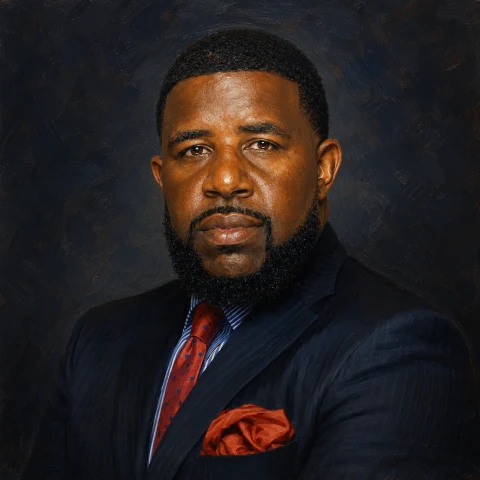
John L. Burris
Police Misconduct · Civil Rights · Court-Enforced Police Reform
The important part is to implement it and that it’s followed, and that people are held accountable if they, in fact, do not follow the rules and procedures set forth.
Allen v. City of Oakland: The Riders Settlement and Twenty-Three Years of Federal Court Enforcement
In 2000 John L. Burris and Jim Chanin sued Oakland for people who said four officers known as the Riders beat them, planted drugs on them and wrote false reports. The settlement put the Oakland Police Department under a federal court order in 2003, and Burris enforced it until Judge William H. Orrick ended the oversight in September 2026.
When John L. Burris filed suit against the City of Oakland on December 7, 2000, he showed photographs of Delphine Allen, twenty-one. One showed Allen with a bloodied right eye. Allen’s suit accused two Oakland officers, Francisco Vazquez and Jude Siapno, of kidnapping him on June 27 after he objected to false drug charges and beating him at a remote spot in the city while he was in handcuffs. The criminal complaint that prosecutors had filed against the officers alleged that their report falsely stated that Allen had discarded drugs and was drinking beer.
Allen was one of twelve named plaintiffs, all of them African American men, in the federal class action Burris filed with Jim Chanin and Chanin’s associate Julie Houk. The defendants included the four officers known as the Riders and Police Chief Richard Word. Another plaintiff, Bobby Jackson, forty-two, said that on May 18 Vazquez “reached into his front pocket and came out with a rock,” and that Vazquez and Siapno offered to drop the matter if he would become an informant in a murder case: “we’ll let this go.” When he refused, Jackson said, the officers beat him. Asked what he wanted from the suit, he said, “Justice served—because war was waged against African Americans by these officers, and it’s not going to stop.” Burris asked the court to certify a class, saying he believed there were many more victims, going back at least five years, and called on the U.S. Justice Department to investigate the department’s “pattern and practice of police misconduct against African Americans.”
The case settled in January 2003 with an agreement, entered as an order of the federal court, that required the Oakland Police Department to complete fifty-one reform tasks, among them deadlines for internal-affairs investigations, rules for taking citizen complaints, use-of-force reporting and review, an enhanced field-training program and a consistent-discipline policy. The city agreed to finish in five years. Burris and Chanin enforced the agreement for twenty-three years, in the courtrooms of Judge Thelton E. Henderson and then Judge William H. Orrick of the U.S. District Court for the Northern District of California. On September 29, 2026, Orrick ended the oversight.
Seventeen Days on the Dogwatch
In 1999 St. Martin’s Press published Burris’s book Blue vs. Black: Let’s End the Conflict Between Cops and Minorities, which laid out a plan for changing the culture of police departments. After he returned from the book tour, an Oakland police officer told his superiors that a group of officers known as the Riders were framing minority residents.
The officer was Keith Batt. He graduated from the police academy on June 2, 2000, at twenty-three, and on June 18 began working the dusk-to-dawn dogwatch in West Oakland under his field training officer, Clarence “Chuck” Mabanag. Mabanag worked with Officers Jude Siapno, Matthew Hornung and Francisco “Frank” Vazquez, and the four called themselves the Riders. Batt’s account started the case. He said the Riders beat suspects, planted drugs on them, made unjustified arrests and wrote false reports, and that he was forced to follow their lead.
Among the allegations: on Batt’s first night, the officers arrested a twenty-year-old named Kenneth Soriano on his family’s property and beat him, and after Soriano had signed a statement that said only that he had resisted arrest, Mabanag filled the blank lines above the signature, in Soriano’s voice, with the words “The officers were not the ones who beat me.” Soriano was never charged.
On June 26, on Thirty-Fourth Street, Mabanag had Batt handcuff a pedestrian who protested that he had done nothing wrong, looked over the ground and bushes nearby, and came up with two small rocks he said were crack cocaine. Mabanag wrote the report and handed it to Batt to copy. When Batt reached the line saying he had seen the man throw the drugs down, he stopped. “I didn’t see that,” he said. Mabanag told him that prosecutors needed a direct link between the man and the drugs, and that Batt should write the report as though he had seen the man drop them.
Batt resigned on July 5, 2000, seventeen days after his first shift, and reported the Riders to the department’s Internal Affairs Division. On November 2 the Alameda County District Attorney’s Office charged all four officers. None was convicted. Vazquez fled before trial and is still sought by the FBI, and the prosecutions of the other three ended in acquittals, deadlocked juries and dismissals. At least seventy-five people the Riders had arrested had their convictions vacated.
Police Witnesses on the Stand
Burris was born in Vallejo in 1945, one of six children, and picked fruit alongside his father, who also worked at the Mare Island shipyards. “My interest [for law and justice] was sparked by what I saw working in the fields—the disparity,” he said in 2024. In the fourth grade he was moved out of the Black school he attended and into a white school, where, he has said, he and his sister were essentially the only Black students on the campus. He was ten when Emmett Till was killed in 1955. “I’m a 10-year-old at the time, and I couldn’t understand it,” he said. “How could this happen? Could this happen to me?”
He earned an accounting degree from Golden Gate University in 1967 and took a job with the accounting firm Haskins & Sells in San Francisco. “An accountant doesn’t have much to say,” he said later. “And in those days, I had a lot of things to say.” At Berkeley’s business school, where he finished an MBA in 1970, he helped found the National Black MBA Association and led its local chapter. That year he entered Boalt Hall, the law school at UC Berkeley, and became president of the Black Law Students Association. Henry Ramsey, who taught at Boalt and served as a Superior Court judge, remembered him leading a weeklong strike in support of affirmative action, and Burris credits Ramsey with channeling his energies toward civil rights. Ramsey’s statement of the choice was blunt: “Either you are a social engineer,” he said, “and make the world better, or you are a parasite.”
After law school Burris joined Jenner & Block in Chicago, where as a summer associate he had worked on a commission investigating police-brutality complaints in the city. “That piqued my consciousness,” he said, “and so when I was in Chicago, it sort of gave me a chance to develop that undercurrent of what I wanted to do with my life as a lawyer.” After two years at the firm he spent about a year as an assistant state’s attorney in Cook County, then returned to the East Bay and prosecuted cases in the Alameda County District Attorney’s Office for about two years. As a prosecutor he was often troubled when his own witnesses, police officers, lied on the stand. “It was clear if you wanted to survive in a police department, you had to keep your mouth shut,” he said. “You had to go along with whatever story was the best one to convict someone.”
He then opened a practice with two friends, Dave Alexander and Elihu Harris, who later became mayor of Oakland. Most of the work was criminal defense, and it did not satisfy him. “It was never enough for me just to do the case,” he said. “In my criminal defense work, I couldn’t see changes coming about; all I could see was that you do a case, the case gets done, and then you do another case.” He left to build a police-litigation practice of his own.
On March 17, 1979, three Oakland police officers shot and killed Melvin Black, a fifteen-year-old, in front of his apartment. They shot him several times as he was running away. After a public outcry, Mayor Lionel Wilson appointed Burris, then thirty-three and a few months into his own practice, to investigate the killing independently of the police department.
Burris hired an investigator and worked the case for five months. His report ran to 700 pages. It found that the officers had failed to follow procedures and that the physical evidence did not match their statements. “At the end, I concluded that the shooting was unjustified, poor tactics, poor judgment, etc.,” Burris said in 2016. As he understood the assignment at the time, he said, it was meant to give the police and city officials some comfort that they had acted properly. “But once I finished my investigation and gave my report about it, they never spoke to me again.” Jim Chanin, who would later sue Oakland beside him, described the episode this way: “They thought John would go along with the program. Instead, he gave them the truth that they didn’t want to hear, and that took courage.” The firm Burris founded in 1985 is now John Burris Nisenbaum & Curry, with offices in Oakland and Minneapolis.
The Tiebreaker
Burris has said that people for the most part want to believe the police, and he builds a case around what he can prove and how he can prove it. “The issue of the case to me when I’m dealing with the police is: what is the tiebreaker?” he said in 2016. He took the idea, he said, from a magistrate years earlier. “When I talk to my lawyers, I want to know what the tiebreaker is. The cops are going to lie – they’re going to tell their story. I say that because if they’re not lying, then I shouldn’t have the case. If they’re telling the truth, then that means my (client) is not truthful.”
In court his aim is to show that the client’s rights were violated, and he keeps race out of it when he can because, he has said, it turns jurors off. “I’m probably geared more toward liability than damages,” he said. “For me, it’s about the wrong and proving that wrong, and then the money will flow where it flows.” Before police abuse could be captured on video, those cases were harder to win. “The big advance is cameras, body cams, cell phones,” he said in 2024. “So now you don’t have people who are afraid to acknowledge that police do bad things.”
In 2025 he said that the use of force against people in mental-health crisis troubles him most. “Those kinds of cases have really stuck with me,” he said. He had set out the standard years earlier: “My view on this is we want to save lives and get the police to start thinking that every confrontation is not one that necessarily should result in death, particularly when you’re dealing with mentally impaired people. Even if that person is holding a knife – because the knife in itself should not be a death warrant.”
Once the scandal broke, people the Riders had arrested called Burris’s office. “It was the case I’d been looking for,” he said. From the first twelve, the plaintiffs in Allen grew to 119, almost all of them African American. Most were young men with criminal records, largely for drugs. “These men are the most vulnerable,” Burris said in 2003. “They have prior convictions; they have served time in prison; they are on parole. They are not generally believed to be victims in a case like this.”
Fifty-One Tasks
The civil and criminal cases ran side by side. In January 2003, with the first criminal trial of the officers still under way, Oakland settled. It agreed to pay $10.9 million in damages and attorneys’ fees to the 119 plaintiffs, and it agreed to a Negotiated Settlement Agreement, which Judge Thelton E. Henderson entered as an order of the court. The city admitted nothing: the agreement provides that neither it nor the complaints may be construed as an admission of liability, and the city denied the allegations. What Oakland accepted was fifty-one tasks, set out in fifteen articles, to be completed within five years under an outside monitor. The agreement was modeled in part on the consent decree imposed on the Los Angeles Police Department after its Rampart scandal.
The agreement states that the parties entered into it “to promote police integrity and prevent conduct that deprives persons of the rights, privileges and immunities secured or protected by the Constitution or laws of the United States.” Several of its tasks reach conduct alleged against the Riders. Task 38 requires a citizen who signs a written statement to draw a diagonal stripe from the end of the written statement to the bottom of the page and to sign along it. Task 37 prohibits retaliation against any officer who reports misconduct by another and warns that “retaliation may be informal and subtle, as well as blatant.” Task 42 required a plan, within 323 days, to enhance the field-training program. Task 2 set timeliness standards for internal-affairs investigations: “Fairness to complainants, members/employees and the public requires that internal investigations be completed in a timely fashion.” Other tasks govern the taking of citizen complaints, use-of-force reporting and review, a personnel information system for tracking officers, and consistency of discipline.
The agreement kept Burris and Chanin in the case as the plaintiffs’ enforcers. For their monitoring work during the first five years they agreed to be paid at substantially reduced hourly rates, capped at $5,000 a year each, and they received $10,000 a year each during the extension that followed. “I represent the plaintiffs and ensure the department lives up to their end of the deal,” Burris said. In August 2003 the court appointed the first monitoring team: Rachel Burgess, Kelli Evans, Charles Gruber and Christy Lopez.
Nine Years In
Oakland missed the five-year deadline. Judge Henderson extended it to January 2010, and at the end of 2009 the monitors found the department in compliance with 30 of the 51 tasks. He extended it to January 2012, and then, in June 2011, to January 20, 2014, to allow time for the ten tasks still open. The monitors kept documenting failures. In 2011, in 80 incidents, 215 officers drew and pointed firearms at 177 people. In 22 of the 80, an officer pointed a firearm without justification.
Henderson held a hearing on September 22, 2011. He spoke of “a city that has still not complied with the reforms that were proposed by its own experts nearly a decade ago,” and said the city and its police “still don’t get it.” “A lot has remained the same and there’s an attitude and a culture of resistance,” he said. Of the firearm findings he said “the number of times they drew their weapons was astounding.” The department had named a summer sweep of parole violators Operation Tune-Up, which Henderson said was a known euphemism for beating suspects, and he faulted “a culture that allows this name to be chosen.” Chief Anthony Batts agreed that the name should not have been used: “it should not have happened.”
Chanin asked for a deadline. “The only way to make things happen is for you to give them a deadline to make the necessary changes,” he told Henderson, “and let them know that if they don’t meet it someone else will be brought in to do it for them.” Burris said, “It’s a tragedy to spend all this money and time and not be further along in making reforms.” For the city, Chief Assistant City Attorney Randolph Hall said, “The city is committed to making changes,” and acknowledged that “there are attitudinal issues and systemic issues that need to be addressed.” Mayor Jean Quan told the judge, “I’m the person responsible to you.” Henderson answered, “Thank you for that commitment,” and added, “I’m encouraged.” He did not place the department under federal control that day, and he set another hearing for January.
“Too many times investigators have not addressed serious complaints because they claim they are unfounded or not credible,” Burris said in 2011. “This system was created to monitor police behavior, and it’s not functioning as it should.” He set a limit in public: “Enough is enough. Eleven years is too much time. If OPD doesn’t comply by 2014, it will be placed in receivership, period.”
Henderson canceled the January hearing. In an order of January 24, 2012, he found that “much significant work remains.” “The Court remains in disbelief that Defendants have yet – nine years later – to achieve what they themselves agreed was doable in no more than five years,” he wrote, and “as the Court has explained time and time again, words and promises are not enough.” Because a court considering a receiver must ask whether “less extreme measures have been exhausted or proven futile,” he tried a lesser one first. The chief would have to consult the monitor on every major decision that could affect compliance, and where the chief went against the monitor’s advice, the monitor would take it to the city administrator and the mayor, and the city would carry “the burden of persuading the Court” on that choice. Henderson also ordered the parties to set a schedule for receivership proceedings, with the plaintiffs’ motion due no earlier than August 1, 2012. The schedule they filed on February 22 put Burris and Chanin’s opening papers on October 4 and the hearing on December 13.
In June 2012 Henderson took up the 180-day deadline for internal investigations, the standard Task 2 set. He adopted the city’s plan for finishing the department’s internal investigations arising from the Occupy Oakland protests as an order of the court, named the commanders and officials responsible for each stage of review and discipline, and directed the monitor to report any missed deadline. He recognized that the 180-day deadline “has already passed for many of the cases identified in the Investigation Plan.” “Nothing in this order shall be construed to excuse noncompliance with the 180-day deadline in any case,” he wrote, though the two commanders he put in charge of the overdue cases would not be held responsible for missing it unless the record showed “avoidable delay.”
A Receiver in Everything but the Name
He did not wait for 2014. On October 4, 2012, Burris and Chanin moved for a partial federal receivership of the department to force completion of the last dozen reforms, in a fifty-seven-page motion supported by more than seventy exhibits. Nine years in, the monitor rated the department about 85 percent compliant, a figure the department did not dispute. The motion argued that “organizational dysfunction and lack of leadership will doom the (court-ordered) reforms to failure,” and it asked for a receiver who “would be able to issue enforceable commands to the city and (police).” “In [OPD’s] mind, the Oakland way was the proper way,” Burris said at the press conference announcing the motion. “We don’t know ultimately if this is going to work. But we can’t keep going down the same path. We have to make a change.”
Mayor Jean Quan defended Chief Howard Jordan as a chief she had picked because she knew he could get the job done. In November the city answered the motion. City officials said in sworn statements that a receiver with power to fire top commanders and raise police spending “would cripple the city,” hurting its credit rating and officers’ morale, and the city’s lawyers argued that a receiver could need “months or even years” to learn how the department worked, slowing compliance. The city offered instead to hire an assistant chief for constitutional policing and a compliance director of its own, approved by Henderson. Chanin replied, “Their version of a compliance director would just be more of the same,” and said, “We want direct control of the command staff by the court or a court-appointed receiver.”
The city resisted the title of receiver; Burris said it saw a stigma in the word. After three negotiating sessions in late November, the parties agreed on a court-appointed compliance director who answered to the court, with power to oversee the reforms, to approve spending of up to $250,000 without the city’s approval, and to discipline, demote or remove the department’s senior officers, including the chief, subject to an appeal to the court. Burris described the office as a federal receiver in every way but the name. Chanin said the city had needed “to be ordered to comply rather than asked to comply.” “We got tired of waiting,” he said.
Judge Henderson approved the agreement on December 12, 2012, writing that he hoped a compliance director “with significant control over the OPD will succeed” where city and department leaders had failed. City officials called the agreement a better alternative to a receivership. In March 2013 the court appointed Thomas Frazier, a former commissioner of the Baltimore Police Department, and in February 2014 it combined the compliance director’s role with the monitor’s, held by Robert S. Warshaw.
Under the court’s orders, no discipline in Class I misconduct cases could be imposed without the compliance director’s direction or approval. In 2014 Oakland’s city administrator imposed a different level of discipline in such a case without consulting him, and the city did not even tell him it would depart from the action he had approved. On July 22, 2014, Henderson wrote: “Orders of this Court must be followed, and appropriate sanctions shall be imposed when they are not.” If the city ignored the warning, he added, it should expect an order to show cause.
Substantial Compliance
Judge Orrick took over the case in 2017. In August 2021 Burris and Chanin wrote to the court, “After years of backsliding, there is real momentum toward substantive compliance with multiple outstanding NSA tasks.” In May 2022 Orrick found the department in substantial compliance and began a one-year sustainability period. It did not hold. In 2023, after a critical report on mishandled misconduct investigations, Mayor Sheng Thao fired Chief LeRonne Armstrong, and the court kept the monitor in place.
At a hearing before Judge Orrick on January 27, 2026, Chanin said he was “very excited about the people in place at the current time.” Burris was more guarded. “We have not got there yet,” he said. “And I’m hopeful that we will in the near future—because we’d like to leave too.”
On May 22 Warshaw wrote in a court filing: “For the first time in the history of the NSA, the Department has achieved compliance with all 51 Tasks.” The last three had been consistent discipline, timely internal-affairs investigations and the handling of citizen complaints. Burris filed his own statement with the court, focused on the department’s efforts against racism in its ranks. “It is critical that the Department does not backslide in this area,” he wrote. “OPD’s racial bias was the original reason for the NSA,” he added. In 2024 he had spoken about discipline inside the department: “I know that Black officers were being disciplined at a higher rate than white officers,” he said, and “I’ve been able to put a finger on that and make a real change.”
At the hearing on May 27, Judge Orrick found the department in compliance with all fifty-one tasks and said he would close the case on September 29 if compliance held. “It’s never going to be mission accomplished,” he said. “It is something that just has to be done every day.” Burris said, “What we tried to do here is pave the way for the next generation of people. And I hope, hope, hope, that when this is done, whenever that is, we have done exactly that.”
Seventy-Seven of Ninety-Three
In a progress report in September, Warshaw found the department short on Task 2, which requires it to complete at least 85 percent of its most serious internal-affairs investigations within 180 days. From January through March 2026 it completed 77 of 93 on time, about 83 percent; two more timely completions would have met the standard. The city called the result “a two-case shortfall” and argued that keeping the court involved would create a new oversight arrangement instead of concluding the existing agreement.
In its written argument the city said that a 2 percent variance did not amount to the “extraordinary circumstances” that would warrant more oversight, and that “OPD today bears virtually no resemblance to the OPD prior to 2000.” Before 2000, the city wrote, supervisors rarely disciplined officers for excessive force, and “some of them actually encouraged such activity.”
Burris and Chanin answered that the 85 percent requirement was an objective standard the department had to meet. They proposed that Judge Orrick keep jurisdiction for another year, with the department and the Oakland Police Commission reporting directly to him and the case open to dismissal in 2027, while their own participation in the case ended. “Under my proposal, we’d stay in the case in name only because there has to be a plaintiff and a defendant,” Chanin said. Judge Orrick took up both positions at 3:30 p.m. on September 29, at 450 Golden Gate Avenue in San Francisco.
Police Chief James Beere said many of the late cases were complex officer-involved shootings. “We did slip a little bit,” he told the judge. “But we own our mistakes.” Chanin said he was “cautiously willing to end the NSA today.” Burris said, “We have been involved in pushing this rock up the hill for 23 years, and every time we got close, it’s fallen back down.” He and Chanin both said they were disappointed by the lapse in investigation times, and both supported ending the agreement.
“I have concerns. I am not of the view that everything is perfect,” Burris said. “But at this point, it’s the city’s turn.” If things went wrong, he said, “I’ll sue.” He also said, “I hope the commitment to the NSA puts me out of business.” Orrick ruled from the bench. “I have decided to end federal court oversight of OPD,” he said. He thanked “the men and women of the Oakland Police Department” for achieving substantial compliance, said the “season for judicial oversight is over,” and said it was time for the court “to get out of the way.” Federal oversight ended the next day, September 30.
On October 8 Orrick dismissed the case in an eight-page order. He listed sixteen things the department had achieved, among them fewer officer-involved shootings, more internal accountability and new attention to racial disparities. Black people had made up 62 percent of the department’s non-dispatch stops in 2016 and an average of 45 percent from 2022 through 2025, which he counted as “less opportunity for bias.” He blamed the length of the case in part on “the instability and inconsistency of leadership at OPD and in City Hall,” and wrote that “Mayor Barbara Lee has changed all that”; her commitment, with the chief’s and the civilian Police Commission’s, “makes federal court involvement superfluous.” He also warned the department’s leaders that “the cover-up is almost always worse than the crime itself.” Warshaw had until October 16 to close his Oakland office.
Antioch, Twenty-Two Years Later
Twenty-three Antioch residents, represented by Burris, sued forty-five officers of the Antioch Police Department. They alleged beatings and dog attacks, the widespread use of racial, homophobic, gender and ethnic slurs, and a lack of supervision, discipline and accountability. An FBI investigation into officers in Antioch and Pittsburg had turned up a trove of racist and violent text messages. One plaintiff, Trent Allen, alleged that officers knocked him unconscious during his 2021 arrest and kept kicking him; former officer Eric Rombaugh sent messages saying he had kicked Allen’s head like a field goal. Rombaugh pleaded guilty to conspiracy in 2025, and former officer Morteza Amiri was convicted of using excessive force with his police dog.
The city agreed to pay the plaintiffs $4.6 million. Burris then negotiated a second agreement, carrying no money, that changes the department’s rules. Signed on December 19, 2025, it prohibits head strikes with hands, feet or hard objects unless no reasonable alternative is available and the force is justified; requires a database of every incident in which force was “used and/or displayed, articulated, or suggested,” including dog deployments; requires that complaints of discriminatory policing, use of force or unbecoming conduct reach the chief within three days, with the city manager informed; and adds an independent review board for complaints, an early-warning system to identify problem officers and an independent monitor. The agreement ends after two years of compliance. If the city has not complied within five years, a court will decide the extension.
Burris signed it at a news conference at his Oakland law office with City Manager Bessie Scott and Police Chief Joe Vigil, and he drew the comparison to Oakland himself. “I think we didn’t have this sense of cooperation at the time in Oakland,” he said. “It was us telling them what they were going to do, which was rejected in large measure. But I don’t see that here.” “I’m much more optimistic than I was with Oakland,” he said, “that there’s a real commitment to do what we’ve agreed to have done.” He called the Antioch conduct “as severe as any,” though no one died. “It was a sense of disrespect for the community in terms of the manner in which these officers performed and did not perform their jobs,” he said.
Both Allen and the Antioch case were brought by private lawyers. In 2025 Burris said the federal government had left such cases to lawyers like him. “The Trump administration has decided that the Justice Department is not gonna enforce civil rights laws against police departments,” he said. “Any cases that are brought to the court have to be brought individually by people like myself.”
Burris said he did not expect the Antioch reforms to take more than five years. He tied the agreement to the handling of complaints, the same work on which Oakland would fall two investigations short in the first months of 2026: “The community, when they make a complaint against an officer … they need to know that matter is going to be investigated timely and objectively, fairly. That doesn’t always happen.”