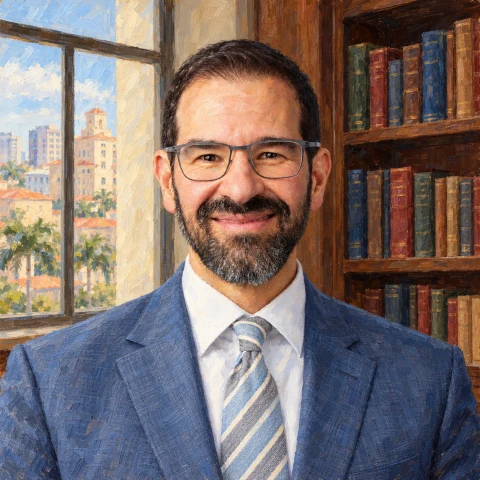
John J. Uustal
Tobacco Litigation · Product Liability · Catastrophic Injury
After eight years of litigation and six years of appeals, the tobacco companies finally face judgment for what they did to Matthew Buonomo.
Buonomo v. R.J. Reynolds: A Broward Engle Verdict, Affirmed in the Fourth District and Paid
John J. Uustal cross-examined R.J. Reynolds’s medical experts, questioned the widow, and argued punishment to the Broward jury that heard Connie Buonomo’s Engle claim over her husband’s COPD in 2010. The jury returned $25 million in punitive damages; after two appeals, RJR paid approximately $42.8 million, including attorneys’ fees and interest, in satisfaction of the judgment in the first quarter of 2017.
Todd McPharlin of Kelley | Uustal opened for the Buonomo family in the spring of 2010 by telling a Broward County jury how Matthew Buonomo smoked. He smoked first thing in the morning, McPharlin said, and while he shaved, while he ate, and on his way into church; when he ran out, he went through ashtrays for butts. For more than twenty years he had tried to quit, and the longest he had gone without a cigarette, McPharlin told the jurors, was about five days.
Steven Geise of Jones Day opened for R.J. Reynolds Tobacco Company. “Mr. Buonomo smoked because he wanted to, not because he was addicted,” he said. “He made his own decisions.” Buonomo had quit cold turkey in the mid-1990s and never smoked again, Geise told the jurors, and the medical evidence would show that he died of congestive heart failure, “a disease that is not caused by smoking.”
Before his death in 2008, Buonomo sued R.J. Reynolds Tobacco Company in Broward County. His widow, Connie Buonomo, carried the case forward for his estate, and John J. Uustal, a founding partner of the Fort Lauderdale firm Kelley | Uustal, was her lead counsel, working with Todd McPharlin and Eric Rosen of the same firm. At trial Uustal questioned two of the family’s medical witnesses, cross-examined three of RJR’s experts, took Connie Buonomo through her testimony, and gave the family’s closing arguments in both phases. The jury found that Matthew Buonomo had been addicted and that his addiction caused his disease. It placed 77.5 percent of the fault for the disease on RJR and returned $25 million in punitive damages. RJR took the case to the Fourth District Court of Appeal twice. On September 22, 2016, that court affirmed the judgment for Connie Buonomo, and RJR satisfied it the following year.
What Engle Left Each Smoker to Prove
Buonomo’s claim was one of the individual suits that followed Engle v. Liggett Group. The Engle class, certified in 1994, took in Florida citizens and residents who had suffered or died from diseases and medical conditions caused by their addiction to cigarettes containing nicotine. The class trial ran in phases. The first, a year-long trial of questions common to every smoker, opened in October 1998 and ended in a verdict on July 7, 1999, and the jury later assessed $145 billion in punitive damages for the entire class. In 2006 the Florida Supreme Court vacated that award, holding it excessive as a matter of law and faulting the trial court for letting the jury fix a lump sum before compensatory damages for the class had been determined. The court decertified the class going forward.
It kept the jury’s Phase I findings. In each member’s own suit, the cigarette companies would be bound by the class jury’s determinations that smoking causes the diseases at issue, that nicotine is addictive, that the companies sold defective cigarettes, that they concealed material information and conspired to conceal it, that they breached warranties, and that they were negligent. The first of those findings named sixteen diseases, and chronic obstructive pulmonary disease was among them, along with lung cancer and coronary heart disease. Members had one year from the court’s mandate to file.
Those findings fixed what the companies had done. Each smoker still had to prove membership in the class—that he was addicted to cigarettes, that the addiction was a legal cause of his disease, and that he had the disease before November 21, 1996, the date the trial court recertified the class. A jury then had to set damages and divide the fault between the smoker and the company. For Buonomo, the questions were whether five decades of three packs a day had been an addiction, and whether that addiction caused the COPD that began in 1995. Geise told the jurors that the family could not prove Buonomo had COPD or emphysema before the 1996 date.
Addiction or Choice, COPD or Heart Failure
Matthew Buonomo began smoking at thirteen. He was addicted by the time he left to fight in Korea, and in the war he kept smoking the cigarettes that came in his rations. His lawsuit alleged that he tried to quit many times over the years, including after the Surgeon General’s report on the dangers of smoking. He stopped only when he was hospitalized in 1993. In 1995, after more than fifty years of smoking three packs a day, he began suffering from chronic obstructive pulmonary disease.
The case was tried in 2010 in the Circuit Court for the Seventeenth Judicial Circuit in Broward County, before Judge Jeffrey E. Streitfeld. The trial ran in two phases, and the first asked only whether Buonomo belonged to the Engle class. Uustal began the family’s medical proof with Dr. Edgar Bolton, a pulmonologist whose testimony the jurors watched on video, and later presented the oncologist Dr. Lyle Feinstein. McPharlin examined the internist Dr. Moises Issa; Jack Henningfield, Ph.D.; and K. Michael Cummings, Ph.D., who testified about the tobacco industry and was cross-examined for RJR by Benjamine Reid of Carlton Fields.
RJR’s case was that Buonomo had smoked by choice and died of congestive heart failure. Geise called a pulmonologist, Dr. Edward Klotz; a mental-health expert, Dr. Neville Marks; a radiologist, Dr. Lawrence Dautenhahn; and a cardiologist, Dr. Royce Yount. Uustal cross-examined Klotz, Marks, and Dautenhahn, and McPharlin cross-examined Yount.
Uustal also put Connie Buonomo on the stand and conducted her direct examination. The jurors heard from her and from Matthew Buonomo’s daughters and granddaughters about the debilitating effects of his COPD and the toll his illness took on the family. The Fourth District later wrote that the toll fell particularly on “his wife of nearly sixty years and, in the end, his caregiver.”
Uustal gave the family’s closing argument on the membership questions, and after Geise’s closing he gave the rebuttal. The jury found that Matthew Buonomo had been addicted to cigarettes containing nicotine, that the addiction was a legal cause of his COPD, and that he had the disease before November 21, 1996, and Judge Streitfeld polled the jurors on the verdict. Those answers made Buonomo a member of the Engle class, and the Phase I findings now bound RJR in his case.
A Broward Jury Divides the Fault
In the second phase the jurors heard extensive testimony about the tobacco industry’s efforts to conceal the harmful effects of smoking. They found RJR guilty of negligence, gross negligence, and intentional misconduct, and found that its negligence and intentional misconduct were a legal cause of Buonomo’s COPD and his death.
Uustal gave the closing argument on damages and punishment on May 19, 2010. He told the jurors that R.J. Reynolds had designed its cigarettes “to be as addictive as possible, while targeting children, sending people to schools, knowing this was a deadly product,” and he estimated RJR’s profits at about $3.5 million a day. The family asked for about $13 million in compensatory damages and $62 million in punitive damages. Whether RJR needed to be punished, he told the jurors, was for them to decide: “That is your decision.”
Geise answered for RJR. “This case is not a referendum on cigarettes or smoking,” he said. Cigarettes are legal to make, sell, and smoke, he argued, and RJR could not be held liable simply for selling them. He told the jurors there was no evidence that Buonomo started smoking because of anything Reynolds did or said, or that anyone forced him to keep smoking in the 1940s; Buonomo smoked Camels, Geise said, because his wife preferred their smell and he liked their taste. “It was his own decision.” RJR’s lawyers proposed $405,000 for medical expenses, $250,000 for Connie Buonomo’s loss of her husband, and $250,000 in punitive damages.
On May 20 the jury apportioned 77.5 percent of the fault to RJR and 22.5 percent to Matthew Buonomo. It awarded $405,000 for medical and funeral expenses and $4.83 million for Connie Buonomo’s past and future pain and suffering and her loss of companionship, a compensatory total of $5,235,000.
The jury then set punitive damages at $25 million, nearly five times the compensatory award. With the $145 billion class award vacated, punishment for the conduct behind the Phase I findings was decided case by case, by juries hearing about individual smokers.
The Trial Court’s Cap and the 1995 Statute
After the verdict, the trial court cut the punitive award to $15,705,000, three times the compensatory damages the jury had awarded, on the view that section 768.73 of the Florida Statutes required the reduction. Its order cited subsection (1)(a)1 of the statute, a provision that did not exist until the 1999 amendments. RJR appealed (No. 4D10-3543), with appellate lawyers from Carlton Fields in Miami and Jones Day in Washington and Atlanta, Gregory G. Katsas among them. Connie Buonomo, represented on appeal by Bard D. Rockenbach of Burlington & Rockenbach in West Palm Beach together with Uustal and McPharlin, challenged the reduction.
Writing for a panel with Chief Judge Damoorgian and Judge Conner, Judge Stevenson began the punitive-damages analysis by finding that neither the jury’s $25 million nor the reduced $15,705,000 was “so excessive as to violate due process.” The panel cited R.J. Reynolds Tobacco Co. v. Martin, in which the First District had affirmed $25 million in punitive damages for a smoker’s widow whose compensatory award came to $3.3 million after the jury apportioned fault. The panel then agreed with Connie Buonomo that the statute had not compelled the cut. The 1995 version of section 768.73, which both sides accepted as governing her claim, set a cap of three times compensatory damages but left the trial court free to exceed it “if the claimant demonstrates to the court by clear and convincing evidence that the award is not excessive.” The court sent the punitive award back to the trial court for the exercise of that discretion.
The court upheld the jury’s verdicts on strict liability and negligence, the two claims that rested on the Phase I findings that RJR’s cigarettes were defective and that the company was negligent. The opinion issued in September 2013 and was replaced by a substituted opinion on rehearing that December.
Affirmed in 2016, Paid in 2017
In 2015 the circuit court reinstated the jury’s $25 million punitive award, and RJR appealed again (No. 4D15-1938), with new counsel from Sedgwick LLP—Gordon James III, Eric L. Lundt, and Robert Weill—along with Katsas of Jones Day. Rockenbach, Uustal, McPharlin, and Rosen appeared for Connie Buonomo. On September 22, 2016, a panel of Judges Gerber and Conner and Associate Judge Janet Croom affirmed. The court’s per curiam decision said only: “Affirmed.”
Matthew Buonomo had filed suit in 2008. After the second affirmance Uustal counted eight years of litigation and six years of appeals, and said the tobacco companies “finally face judgment for what they did to Matthew Buonomo.”
In the first quarter of 2017, R.J. Reynolds Tobacco Company paid approximately $42.8 million in satisfaction of the judgment, including attorneys’ fees and interest.
A Single-Digit Multiplier and the Cost of a Fix
The Buonomo jury had set punishment at nearly five times the compensatory award, and the trial court had cut it to three times. In a 2018 interview with Corporate Crime Reporter, Uustal said the U.S. Supreme Court had found that corporations have a constitutional right not to be subject to punitive awards “of more than a single digit multiplier of the compensatory damages.” “And the corporations do the math,” he said. A company sets what it expects to pay for each person who dies or is injured against what a fix would cost, he explained, and when a product is sold in large numbers and the fix runs $30, $40, or $50 apiece, “it quickly becomes cheaper to let those people die.”
That year he offered a $100,000 reward for evidence that corporations were behind frivolous lawsuits filed against corporations, beginning with a consumer class action over how McDonald’s priced its Quarter Pounders. Asked why, he said: “It came down to the sick feeling I get day after day telling people that the law can’t help them. It wasn’t like that when I first started as a lawyer.”
He was then writing a book, Corporate Serial Killers, built on cases from his practice in which, he said, companies made decisions they knew would lead to deaths; one chapter takes up the tobacco industry’s internal memos. “The courtroom is the only place in the world where the people hold powerful corporate interests to account,” he said.
Georgetown, Argentina, Fort Lauderdale
Uustal grew up in Fort Lauderdale. His mother was a teacher and his father a coach. He earned his undergraduate degree at Georgetown University’s School of Foreign Service. He was threatened in Argentina after antagonizing government officials who had been complicit in that country’s dirty war. The day after he started law school at the University of Miami, Hurricane Andrew hit the campus and closed the school, and his first-year class finished a year of coursework in far less time while living without electricity or telephone service. He ranked first in the student body that year, was prosecuting criminals in Miami courtrooms before he graduated, and earned his law degree summa cum laude. He coaches competitive soccer for Fort Lauderdale Select.
The Florida Bar has certified him as a specialist in civil trial law. He has chaired the Broward County Bar Association’s trial and appellate sections and served on the board of directors of the Florida Justice Association. By his own account, he fought Ford and Firestone for families whose relatives died in crashes involving defective vehicles and tires, facing a crowd of corporate lawyers with a young firm’s resources, posting people outside a judge’s chambers so the case would not be dismissed on a technicality, and going months with almost no sleep. In 2019, after serving on a jury himself, he wrote about the experience for the Attorneys Information Exchange Group’s magazine.
The words of Clarence Darrow are painted on the walls of his firm: “I have lived my life, and I have fought my battles, against power. I have asked no odds from them, and I never will.” Uustal has described his own practice this way: “I feel like my whole life has prepared me to take the case that can’t be won, for the family who can’t afford to lose.”
From Cigarettes to Social Media Platforms
In 2025 Uustal tried the talc mesothelioma case of Dr. Alberto A. Casaretto’s estate against Johnson & Johnson with Levin Papantonio’s trial lawyers, and on October 28 a jury in Fort Lauderdale awarded the family $20 million.
Uustal took the direct examination of Dr. Gilberto Lopes, an expert for the family, on September 25, 2025, and he gave the family’s closing argument, asking the jurors for $15 million to $20 million. After the verdict he called it “vindication for this amazing family” and said, “Baby powder with asbestos, even at low levels, should not be sold.”
Early in 2026, with a social media addiction trial under way in Los Angeles on allegations that major social media companies intentionally designed addictive platforms that harm young users, Uustal discussed the case for a CNN feature that set it beside the tobacco litigation of the 1990s. The plaintiffs there say the companies engineered infinite scroll, algorithmic amplification, and persistent notifications to maximize engagement among adolescents, and they frame the claims as design defects.
He founded the Impossible Case Institute, and in 2026 he leads the faculty of the Built Different Trial Academy, which the institute runs with Trial School. “Too many lawyers accept the limits of a case instead of pushing beyond them, leaving victims with less than justice demands,” he said when the academy launched in July 2026. The academy trains mid-career lawyers in its Fellows Program and law students on scholarship in its Scholars Program, and Andrew Finkelstein of Finkelstein & Partners teaches alongside him.