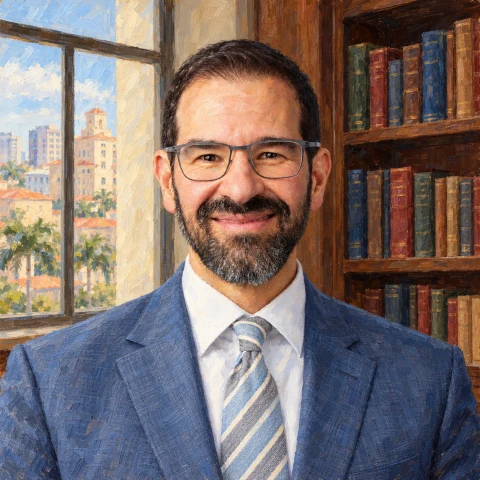
Khaldoun A. Baghdadi
Product Liability · Wrongful Death · Catastrophic Injury · Mass Torts
You can’t pretend to be someone you are not in front of a jury, and juries can figure that out pretty quick.
Kransky v. DePuy: An $8.3 Million ASR Hip Verdict in Los Angeles, Affirmed on Appeal
A retired Montana prison guard’s failed metal hip went before a Los Angeles jury in 2013, and the Court of Appeal upheld the verdict three years later. Khaldoun Baghdadi was on the trial team and stayed on as counsel through the appeal; in 2018 a San Francisco judge named him liaison counsel for the individuals suing PG&E over the North Bay fires.
In February 2012, a surgeon named Jeffrey Hansen opened Loren Kransky’s hip to take out an artificial joint implanted a little more than four years earlier. The device was an ASR XL, a metal-on-metal hip made by DePuy Orthopaedics, a Johnson & Johnson subsidiary: a metal cup set into the hip, a metal ball turning inside it, and a stem attached to the ball. The tissue around it had turned black. A year later, DePuy would tell a Los Angeles jury that infection explained the failed hip, or that Kransky’s first surgeon had set the cup at a steeper angle than DePuy’s guidelines called for. Hansen saw no infection in the joint, and he testified that the black material could only have come from metal ions staining the tissue.
Kransky was a retired Montana prison guard, sixty-five by the time of trial, with diabetes, cancer, kidney disease, heart disease, and vascular disease, none of which either side blamed on the hip. He had received the ASR XL in December 2007. Afterward came a lot of pain, a clicking and popping in the joint, falls for no apparent reason, weight loss, and blood tests showing elevated cobalt and chromium. His primary care physician believed that none of his other health problems was causing the pain. A biomedical engineer who examined the removed implant found much more than normal metal wear and black-stained tissue attached to the back of the cup, and concluded that the device was defective because of excessive rim loading—the engineering term for the head of the implant getting too close to the rim of the cup—which released a harmful amount of metal debris. After the revision, Kransky’s pain decreased and his mobility improved.
Before the revision his chromium and cobalt levels had at times run more than twenty-five times normal, and the debris had caused a pseudotumor to form in the hip joint. Kransky was a Vietnam veteran who had served in the Air Force, and he lived in Miles City, Montana. Because he had been diagnosed with metastatic cancer and was expected to live less than six months, his case received a preferential trial date in Los Angeles. He, his wife, and their two grown daughters moved from Miles City to Los Angeles for the trial, and they were in court every day.
What Was Supposed to Happen
Baghdadi has described preparing a case for trial as developing two accounts, one of what happened and one of what was supposed to happen. “And the difference between what happened and what was supposed to happen is defined in the jury instructions,” he said in 2025.
In Kransky’s case the instructions came from Montana law: Kransky lived in Montana and had his implant surgery there, and the trial court found that Montana had the strongest interest in having its products liability law applied. The jury had to decide whether the ASR XL was defectively designed and, under Montana’s causation rule, whether the defect helped produce his injury and whether the injury would have occurred without it. By the time the case reached a jury, the device had been off the market for more than two years. As early as 2006, surgeons had begun to see an unusually high rate of problems with the ASR XL. Australian data showed a five-year revision rate of 22 percent for the device, against roughly 4 percent for DePuy’s other metal-on-metal hips. In 2010, with the failure rates widely known, DePuy recalled the ASR—a recall covering some 93,000 hips—and on the form it filed with the Food and Drug Administration it gave the reason as a “defective product that would affect product performance and/or could cause health problems.”
Infection, or the Angle
The trial ran five weeks in Los Angeles Superior Court before Judge J. Stephen Czuleger, case number BC456086, and it was the first of more than 10,000 ASR suits filed against Johnson & Johnson to reach a jury. Kransky’s lawyers came from several firms. Brian Panish of Panish, Shea & Boyle and Michael Kelly of Walkup, Melodia, Kelly & Schoenberger delivered the closing arguments; Kelly, Matthew Davis, and Baghdadi were the Walkup lawyers on the trial team, and John Gomez and Dean Goetz also represented Kransky.
Kelly gave the opening statement for Kransky on January 25, 2013. He took the jurors through the ASR XL’s design and the testing it had not received before it went on the market, and they heard about an email in which Graham Isaac, a DePuy scientist, told other employees that clinical data comparing metal ion levels showed the ASR susceptible to extreme levels under certain conditions, while a competing hip, the BHR, did not have that problem in the same surgeon’s hands. “The concern, it has the potential to seriously affect our business,” Isaac wrote. Kelly followed the email with a comment of his own: “There is no mention in this email anywhere, which you’ll have in evidence, of a concern about the potential of hurting people.” Alexander Calfo opened for DePuy and Johnson & Johnson, telling the jury that the ASR had been thoroughly tested and researched, that its cobalt and chromium had not poisoned Kransky, and that it had not caused his illnesses. DePuy would also blame an infection and the angle of the cup.
Kransky’s side answered both explanations with his own doctors and with witnesses who knew the device. Dr. Robert Harrison, a toxic chemicals specialist who had treated patients with high cobalt and chromium levels from the ASR XL, testified that Kransky’s white blood cell counts, sedimentation rates, and temperature readings ruled out infection, that cobalt and chromium are poisonous, and that the blackish hole visible in the surgical photographs was a classic picture of metallosis. Dr. Craig Swenson, an orthopedic surgeon who had implanted 207 ASR XLs and performed 70 revision surgeries to remove the device, testified that the popping and grinding Kransky felt was not consistent with infection, that clicking and popping come from the implant’s surfaces rubbing together, that black material like that found in Kransky’s revision surgery is unique to metal debris, and that the device failed independent of the angle at which it sat. John Dennis Bobyn, a professor and researcher in artificial joint replacement at McGill University, testified that design features unique to the ASR XL increased wear and that Kransky’s explant showed wear far beyond historical norms. Kransky’s treating physician, Dr. Trotsky, told the jury the implant was poisoning him.
Kransky testified on February 19. Gomez began by asking how it had felt to walk up the steps and take his seat that day. “Very good,” Kransky said. Had there been a long period when he could not? “A very long period of time. About five years.” Did it feel good to be able to do it again? “Yes. Absolutely.” He told the jurors about his work, about the pain from the hip and what it had done to his life, and Zellers cross-examined him about his health. Away from the courthouse during those weeks he visited an automotive museum and walked down to the beach and put his toes in the ocean, which he could not have done with the ASR in his hip.
Some of the medical evidence came by video. On February 20 the jurors watched the videotaped depositions of Trotsky, of Dr. Troy Fiddler, another of Kransky’s treating doctors, and of Hansen, along with deposition testimony from DePuy’s people, among them its worldwide president, Andrew Ekdahl. By the end of the trial the jury had heard nineteen lay witnesses and eighteen experts.
DePuy’s experts carried its explanations. Dr. Gonzalo Ballon-Landa, an infectious-disease specialist, testified that Kransky’s hip was infected, that the infection had caused his pain, and that it had led to the hip’s removal. Dr. Cyrus Rangan, a medical toxicologist, testified that Harrison was wrong about which cobalt and chromium levels are toxic, and Kelly cross-examined him. Kelly also cross-examined Dr. Thomas Schmalzried, one of the surgeons who designed the ASR and who received royalties from it, and Dr. John Cuckler, a defense expert who agreed that DePuy’s obligation was to be “proactive and aggressive in following up on information about complaints.”
The lawyers closed on February 28. Michael Zellers, for DePuy, told the jurors that there is no perfect hip design—“There are always trade-offs”—and put the company’s two other explanations to them: the angle at which Kransky’s surgeon had set the cup, and an infection that, DePuy said, was what had forced the revision. Panish told the jury that Kransky’s compensation should not be reduced because his illnesses had left him more susceptible to injury than a healthy person, and Kelly argued that DePuy had put its profits ahead of its patients’ safety. On DePuy’s testing, Panish told the jurors, “They just wanted to play Russian roulette and take the risk.”
In March 2013, after almost six full days of deliberation, the jury found the ASR XL defectively designed under Montana law and found that the defect had caused Kransky’s injury. It awarded $338,136.12 for his medical expenses and $8 million for his pain and suffering; Panish had asked the jury for roughly $5 million in pain and suffering. DePuy moved for judgment notwithstanding the verdict and for a new trial, arguing that the evidence was insufficient and that the verdict contradicted itself. By the end of May 2013, Czuleger had denied both motions. “I think there is more than sufficient evidence here,” he said, and “it would be highly inappropriate to set aside the plaintiff’s verdict.”
Baghdadi has said that trying hip-implant cases taught him how well lawyers can work as a team when they combine their efforts and stop worrying about who gets the credit. The advice he gives comes down to a line: “Work hard, be honest and don’t worry so much about who gets credit.”
Nothing to Shock the Conscience
DePuy appealed to the Second District Court of Appeal. Kransky died on February 26, 2014, while the appeal was pending, and his wife, Sheryl Kransky, carried the case forward as personal representative of his estate. Kelly and Baghdadi remained counsel for the estate, with Panish, Gomez, Goetz, and Martin Buchanan; O’Melveny & Myers represented DePuy.
DePuy’s first argument was that Czuleger had wrongly kept from the jury the fact that the FDA had cleared the ASR XL for sale. Division Seven answered that the clearance had come under section 510(k), an abbreviated review focused on a device’s equivalence to one already on the market rather than on its safety, and that under Montana law a manufacturer’s compliance with product safety regulations is irrelevant and inadmissible on whether the product is defective. Admitting the clearance would have required a mini-trial on the adequacy of the FDA’s review process and on whether DePuy had met its post-market reporting duties, and Evidence Code section 352 let Czuleger keep that out.
DePuy then went after the witnesses. Trotsky, it argued, was not a toxicologist and lacked the knowledge and training to testify that the implant was poisoning Kransky and that Kransky would die without a revision surgery. The court held that a treating physician may testify to opinions formed on facts learned in caring for the patient, and that Trotsky’s opinion rested on his ruling out other medical causes of Kransky’s poor health, his understanding of Kransky’s hip pain and elevated cobalt and chromium levels, and his consultations with the revision surgeon and Kransky’s nephrologist. DePuy also argued that Swenson’s testimony about five other patients whose ASR XLs he had removed was anecdotal, and that Kransky had not disclosed the photographs of those surgeries or details about the patients until a few days before trial. The court pointed out that Swenson had told DePuy’s lawyers at his deposition, five weeks before he testified, that he might use photographs from his patient files; that Czuleger had delayed Swenson’s cross-examination so DePuy could depose him again during the trial; and that Swenson had based his causation opinion on his clinical experience with the device, including 207 implantations and 70 revision surgeries, the five being patients he had chosen as representative of the problems he saw.
On causation, DePuy argued that Montana law required Kransky to rule out with certainty every alternative cause, infection and the implant’s angle among them. The court read Montana’s standard differently: a defendant’s conduct causes an injury if it helped produce the injury and the injury would not have occurred without it, and Montana law does not require a plaintiff to eliminate all possible causes. It was undisputed that Kransky’s implant had been inserted at a relatively high angle and that hip implants in general wear faster at higher angles, but the jury had heard Hansen, Harrison, and Swenson on infection and on angle, and under Hagen v. Dow Chemical Co. conflicting evidence on causation is for the jury to resolve.
DePuy also argued that $8 million for pain and suffering was excessive. Montana’s rule, which the court applied, bars a court from substituting its judgment for the jury’s unless the award is so grossly out of proportion as to shock the conscience, and it forbids using one case’s award as a measuring rod for another’s. The court recited what the jury had heard: constant, debilitating, stabbing pain that kept Kransky from getting any rest; about five years in which he could barely walk, and nine months confined to a wheelchair; the end of keeping up and mowing his own yard, of playing with his grandchildren, and of going to their athletic events; a stretch when he could not shower or use the bathroom without help from his daughters, who were nurses; his doctor’s warning, “There’s a good chance you will die if the hip is replaced,” and the funeral arrangements Kransky made before the surgery; and mobility problems that kept him from rehabilitating after a stroke. The panel—Justice Segal writing, Presiding Justice Perluss and Justice Zelon concurring—found nothing in the verdict to shock the court’s conscience and affirmed the judgment on July 21, 2016, with costs to the estate. By then post-judgment interest had added more than $2.75 million to what DePuy owed.
The Position of Individual Plaintiffs
The wildfires of October 2017 burned more than 245,000 acres of Northern California and killed at least 44 people, 24 of them in Sonoma County. The Tubbs fire alone killed 22 people and destroyed more than 5,600 structures in Sonoma and Napa counties. The suits against Pacific Gas and Electric were coordinated in San Francisco Superior Court as the California North Bay Fire Cases, Judicial Council Coordination Proceeding No. 4955, before Judge Curtis E.A. Karnow. On March 6, 2018, Karnow signed Case Management Order No. 1. It appointed Michael Kelly, Frank Pitre of Cotchett, Pitre & McCarthy, and Bill Robins III of Robins Cloud as Individual Plaintiffs’ Lead Counsel, and Baghdadi, Amy Eskin of Levin Simes, and Steven Skikos of Skikos, Crawford, Skikos & Joseph as Individual Plaintiffs’ Liaison Counsel.
Karnow had heard the parties at a case management conference on February 27, 2018, and his order sorted the litigation into individual plaintiffs, public entities, class-action plaintiffs, insurers bringing subrogation claims, and defendants. Scott Summy of Baron & Budd led for the public entities; Elizabeth Cabraser and Lexi Hazam of Lieff Cabraser chaired the class-action committee; Cravath, Swaine & Moore, Wilson Sonsini Goodrich & Rosati, and Clarence Dyer & Cohen appeared for the defendants. The individual plaintiffs’ executive committee had twenty members, Brian Panish and Rahul Ravipudi among them, and the court named a sixteen-lawyer steering committee besides. The order called for master complaints, discovery in stages, and no duplication: “Plaintiffs shall not serve duplicative or cumulative discovery on Defendants.” Lead counsel were to direct the committees’ work, direct the briefing and argument of motions, and manage the selection of cases for trial.
Liaison counsel sat on the Plaintiffs’ Executive Committee, and the order set out their job: “Upon the designation of Individual Plaintiffs’ Lead Counsel,” appear before the court and present the individual plaintiffs’ position at case management conferences, status conferences, and other court-ordered hearings; keep an up-to-date service list of all the individual plaintiffs’ lawyers available to the court and to counsel on both sides; receive the court’s orders, notices, and correspondence and distribute them; maintain a complete set of the filed pleadings and orders for the other plaintiffs; and coordinate the plaintiffs’ filings, encouraging a single set of papers where they shared a position.
Every Fire Except Tubbs
The Tubbs fire started on October 8, 2017. Cal Fire’s investigators attributed the 2017 fires to PG&E’s equipment one after another, with a single exception. In January 2019 the agency concluded that the Tubbs fire had started at a private electrical system in Calistoga, and PG&E, which was not disputing that its equipment had caused many of the 2017 and 2018 fires, stood on the finding.
Cal Fire announced the Tubbs finding on January 24, 2019. A private electrical system next to a house at 1128 Bennett Lane had caused the fire, and investigators had found no violation of state law. The lead investigator, Battalion Chief John Martinez, wrote that the privately owned hardware had been destroyed in the fire and that no evidence of an electrical event was observed. PG&E said a handyman doing unlicensed electrical work may have started it. Its stock closed that day at $13.35, up nearly 75 percent. Five days later, on January 29, PG&E filed for bankruptcy, putting its potential wildfire liabilities at up to $30 billion.
Baghdadi and Alison Cordova of Cotchett, Pitre & McCarthy were co-trial liaison counsel in the Tubbs cases. Baghdadi stated the plaintiffs’ position: “The Cal Fire investigation concluded they couldn’t identify any PG&E infrastructure with igniting that fire. PG&E seized on that to claim they were therefore absolved of responsibility. We (and our experts) disagreed.” The day the report came out, Kelly said, “We’re going to stick by our guns.” The victims’ lawyers pointed to two photographs of damaged copper wires that, they said, showed arcing on a power line near the Bennett Lane property and outside it, and to security video from the nearby Bennett Lane Winery, time-stamped 9:20 p.m., which they said showed the spark. Cal Fire had reported strong winds blowing south and west that night. “Fires do not go downhill into a wind,” Kelly said. Kelly described the plaintiffs’ theory of origin: “We know that the origin of the fire actually happened somewhere else and burned uphill.” He added that the agency’s conclusion did not bind a court: “Cal Fire’s obligation is to determine the cause and origin of wildfires in the state. But their decisions are not binding in court.”
A Tubbs Trial Looming
Karnow had been preparing to set a September 2019 trial date when PG&E filed for bankruptcy in January 2019, and the automatic stay stopped the state case. On July 2, 2019, the Official Committee of Tort Claimants asked the bankruptcy court to lift the stay, and lawyers for the fire victims argued that the Tubbs claims should go to a state jury, telling Judge Dennis Montali that a trial could start as early as January 2020. PG&E opposed the motion, arguing that a state trial would cause delay and jeopardize its ability to emerge from bankruptcy by June 30, 2020, the deadline for access to a state-sponsored $21 billion wildfire fund. On August 16, 2019, Montali granted relief. A trial on the Tubbs fire, he wrote, “moves toward liquidating these tort claims,” and although a handful of plaintiffs going to trial would not resolve many claims, it advanced the goals of the bankruptcy “far better than stayed, stagnant proceedings.” The pressure to adjudicate the claims promptly, he added, came from “bankruptcy considerations, moral duties and even legislative deadlines.”
Letting the suits go forward, Montali wrote, “will definitively bring a resolution as to debtors’ liability in the Tubbs fire.” Victims could seek as much as $18 billion for Tubbs alone, about a third of the roughly $54 billion in claims from the 2017 and 2018 fires. On Monday, August 19, PG&E’s stock fell from Friday’s close of $14.28 to $10.67. Mike Danko, another lawyer for fire victims, said the best way to force reasonable negotiations was “to have a Tubbs Fire trial looming.”
In San Francisco Superior Court, Judge Teri Jackson set January 7, 2020, for the first Tubbs trial, on the claims of eighteen plaintiffs, each of them elderly or seriously ill or both. Kelly said those clients needed some sense of finality—an award to pay for rebuilding their houses and reforesting their property—before old age or illness brought a premature death.
PG&E wanted the trial moved to Sonoma County. Jackson kept it in San Francisco and kept the eighteen cases together; she did not “want to see 18 courtrooms taken up here.” PG&E had also tried to move the dispute to U.S. District Judge James Donato, who said he was unlikely to halt the state trial unless it was delayed too long. Jackson set the trial for eight weeks in phases—PG&E’s responsibility first, then each plaintiff’s harm, then punitive damages—and said she was inclined to seat one jury for all of it. When PG&E’s lawyer, Kevin Orsini, asked her to restrain the lawyers’ public statements, saying, “This case needs to be litigated in this courtroom, not through the media,” Jackson declined to do it that day. “I want both sides to receive a fair trial,” she said. She later announced a narrower order than PG&E had sought, barring both sides from arguing the merits of the Tubbs case or assigning blame for the fire in public.
The trial did not happen. “If PG&E wasn’t going to acknowledge responsibility, we were going to do our best to persuade a jury to acknowledge it for them,” Baghdadi said. “And then, weeks away from our trial date …” In December 2019, PG&E agreed to pay $13.5 billion in cash and stock to the victims of the fires; Kelly said the figure was probably the maximum the company could afford to pay. PG&E announced the agreement on Friday, December 6. It covered the 2015 Butte fire, the 2016 Ghost Ship fire in Oakland, the 2017 North Bay fires, Tubbs among them, and the 2018 Camp fire; PG&E admitted no fault for Tubbs. Five days later, at the request of both sides, Judge Andrew Y.S. Cheng of the San Francisco Superior Court paused the Tubbs proceedings for fifteen days.
Montali confirmed PG&E’s reorganization plan on June 20, 2020, and the company completed its reorganization on July 1. That day the PG&E Fire Victim Trust, with retired judge John K. Trotter as trustee, held 476,995,175 shares of PG&E common stock, 24.6 percent of the company.
Baghdadi said of the outcome: “I’m hopeful the impact of all of this is you end up with a PG&E that isn’t focused on private profit and public harm, but end up with some accountability. Because typically, when big California businesses make mistakes, there’s a means of holding them accountable. But here, PG&E continued the same pattern of cultural mistakes to the point of bankruptcy, and forced victims to face an uncertain and unfortunate process.” “A lot of elements of climate change are true,” he said; using the idea of a “new normal” fire season as an excuse for poor management, he added, was unfair to California: “Maintaining infrastructure and making sure electrical lines don’t cause fires can be done during drought as well as during the rainy season.” He went on: “But I do agree that future cases of this magnitude will require coalitions being formed and the careful and cooperative dedication of many attorneys.”
Where Uber Is Headquartered
In October 2023 the Judicial Panel on Multidistrict Litigation centralized the federal suits of Uber passengers who said they had suffered sexual assault or harassment because the company “failed to implement appropriate safety precautions to protect passengers.” Uber opposed centralization, arguing that “individual and state-specific factual and legal issues will predominate.” The panel sent the cases to Judge Charles R. Breyer in San Francisco. Sixty-two of the seventy-nine actions then pending were in the Northern District of California, “where Uber is headquartered,” and California’s coordinated proceeding for the state-court cases, JCCP No. 5188, was pending in the same district, so centralizing the federal cases there allowed “coordination between the courts and parties.”
On December 6, 2023, Breyer signed Pretrial Order No. 4. It appointed Rachel B. Abrams, Sarah R. London, and Roopal P. Luhana as co-lead counsel, made London liaison counsel, and named a Plaintiffs’ Steering Committee whose members, the order said, were each personally responsible for their duties. Baghdadi’s seat on the committee carried a title of its own: Plaintiffs’ Federal/State Liaison Counsel.
After the Second Eviction
Baghdadi was born in Jordan and came to the United States at about seven months old; he grew up in Orange County. His father had stopped school around the sixth grade and worked a series of labor jobs; his mother, who had earned a master’s degree in Syria, taught Arabic, and the family spoke it at home. His mother’s story began in a Palestinian refugee camp in 1948, and he has said that this history is hard to keep out of your mind when you are deciding what to do with an education and whether you want to help people. At sixteen, working as a movie theater usher, he tried to start a union over insufficient overtime pay and was fired. “I thought if we had some sort of organized response to it, it would go well,” he has said. “Management didn’t take too kindly to that, shockingly.” Losing the job sharpened a worry he carried as a first-generation Palestinian immigrant: if his family or community ever had to advocate for themselves, there were hardly any Palestinian or Muslim lawyers in Orange County to stand up for them. “I thought part of an admission ticket to empowerment was a law degree,” he has said. “I wanted to be able to know that at least one of us had access to understand the rules, know when they’re being broken, and know when they can be enforced.”
He graduated cum laude from UC Irvine and, in 1997, from UC Hastings, now UC Law San Francisco. His first job was with a firm in Orange County and Newport Beach whose work included unlawful detainers. After his second eviction, walking from the courtroom back to his car, he told himself, “This is not what you studied for.” He went on: “This is not why you tried to take the bar. You want to help people who need you.” He interviewed with the Walkup firm in San Francisco—“I remember interviewing with every single attorney in the firm before I got the job,” he said—and started there in October 1998. In about 2003 the firm let him try a medical negligence case in Modesto alone, his first solo jury trial. “I can still remember every witness and every examination in that trial,” he said, recalling the responsibility he felt for his client and an opponent with decades more experience.
Mayor Willie Brown appointed him to the San Francisco Human Rights Commission, Mayor Gavin Newsom reappointed him, and in 2006 the commission elected him its chair. He teaches trial advocacy at UC Law San Francisco and UC Berkeley School of Law, has taught trial technique and deposition practice for the National Institute for Trial Advocacy, and has guest-lectured at Stanford and NYU. He co-chairs the Bay Area chapter of the Arab American Attorneys Association and sits on the board of Shades of Mass. “My goal is to identify, mentor, and help create excellent lawyers with diverse backgrounds,” he said in 2025.
An Imperfect Tool
“There’s no such thing as a self-made trial lawyer,” he said in 2018. “All of the best things I’ve done in trial have been as a result of inspiration or lessons I’ve learned from those who have trained me.” Of juries, in 2025: “I really think your primary currency in trial is your credibility and your sincerity.” And in 2018: “Make sure the focus is on the client and not on you, because it’s not about you.”
“I think some of my best results have been when I’ve had the fortitude to admit that I just didn’t have all the answers, that I hadn’t foreseen everything, but that at least I was there with the right faith and belief in my client,” he said in 2019. The case he has called probably the most emotional experience he has had in a courtroom involved the wrongful death of a child. “Our challenge is to maintain the dignity of the case and afford our client the respect for their loss that they deserve,” he said. “It’s an unspeakable loss, and so how do you stand for that person in a way that doesn’t diminish it, that doesn’t make it appear as if you’re grabbing or overreaching in terms of damages?”
Asked in 2025 how he first thinks about a new case, he put it this way: someone breached the standard of care and caused harm, “and as a result of that harm, my client is no longer where they were.” “My job is to try to get them as close as possible to where they were, to the extent the law has the tools to be able to do that, which is not easy,” he said. “Our law is an imperfect tool. It is not designed to provide a restorative emotional sense. And several of my clients could be offered 10 times the amount of their recoveries in exchange for not going through what they went through, and it wouldn’t have been enough.”