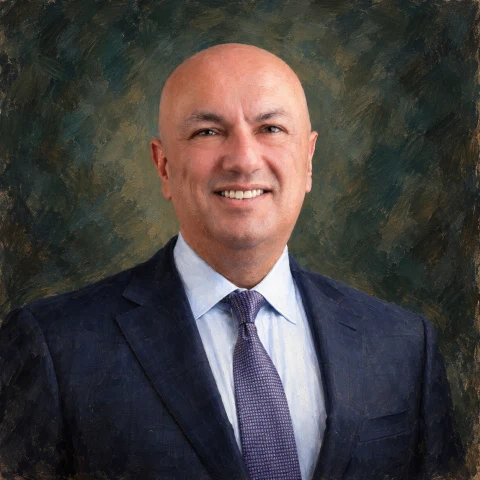
Michael L. McGlamry
Product Liability · Multidistrict Litigation · Mass Torts
This verdict confirms the viability and effectiveness of our civil jury system.
Michael L. McGlamry Built the Wright Conserve Litigation From Its First Filings to Its First Jury
McGlamry’s firm filed some of the first suits over Wright Medical’s metal-on-metal hip, and he argued for their consolidation before the national panel in Miami. As co-lead counsel he led the trial team in the first federal bellwether, where an Atlanta jury assigned Wright all of the fault; in the NFL concussion litigation he co-led the discovery committee.
In November 2015, in a federal courtroom in Atlanta, Dr. Lynn G. Rasmussen told a jury what a Wright Medical Technology employee had told him about a decade earlier. In 2005 and 2006, before Rasmussen discussed a new hip with his patient Robyn Christiansen, Wright’s Patrick Fisher described an A-Class metal that the company had treated to a hardness comparable to ceramic, with much lower wear than typical cobalt-chromium. It was, Fisher told him, “a metal that shouldn’t have metal wear debris or metal ion debris.” Fisher would not explain how the metal was hardened, out of concern that competitors might learn the process, and he said testing proved what he claimed.
Rasmussen had treated Christiansen since 1995. She spent forty-seven years as a ski instructor and taught children at a resort in Alta, Utah. On April 24, 2006, Rasmussen replaced her right hip with a Wright Conserve Plus cup and a Conserve Total A-Class head, seated on a Wright ProFemur stem and neck.
A metal-on-metal hip joint turns a cobalt-chromium ball inside a cobalt-chromium cup. Every step sheds microscopic debris from both. When the particles and metal ions collect in the tissue around the implant, surgeons who open the hip can find fluid, dead tissue, and the dark staining known as metallosis.
Wright Medical Technology built its Conserve hip line on that pairing and brought it to market through the FDA’s expedited 510(k) clearance rather than new clinical trials. According to the patients who later sued, Wright sold the Conserve as a durable, bone-preserving choice for active people, an implant expected to last fifteen to twenty years. The plaintiffs put its revision rate at 8.36 percent within five years, and described the debris it shed producing metallosis, pseudotumors, and dead tissue.
Christiansen would allege that Rasmussen chose the Conserve for her because Wright had presented it as a good option for active patients like her, with a cobalt-chromium cup “touted to last longer than a polyethylene liner” and no known issues with cobalt and chromium ions. She would also allege that the Conserve Plus cup itself had no FDA clearance until 2012, and that Wright sold it before then under an internal “Wright letter to file.”
About six years after the implant, around October 24, 2012, Christiansen was doing yoga when she felt and heard a crunch in her right hip, followed by immediate, severe pain in the hip and groin. The cup had come loose and shifted out of place. When Rasmussen removed it five days later, he recorded necrotic tissue, a buildup of cloudy fluid, and signs of a metallosis reaction with an inflamed joint lining, and he cut away the damaged soft tissue. Hers would become the first of nearly two thousand Wright Conserve suits to reach a jury, and Michael L. McGlamry, co-lead counsel for the plaintiffs, would lead the team that tried it.
Miami, Then Atlanta
McGlamry’s Atlanta firm, Pope McGlamry, filed some of the first suits over Wright’s hip devices. DePuy had recalled its own metal-on-metal ASR cup in August 2010. On May 6, 2011, the Food and Drug Administration ordered the makers of metal-on-metal hips to conduct postmarket surveillance and asked Wright and the others for more information about the metal their devices released. More than two hundred adverse event reports had been filed on the Conserve since its 510(k) clearance. In November 2011 the firm sued over the Conserve in the Southern District of Georgia, and on November 29 it asked the Judicial Panel on Multidistrict Litigation to gather the federal Conserve cases before one judge in Georgia. By the end of December it had filed three more suits, two in the Northern District of Georgia and one in the Southern District of Illinois, and at least thirteen others were pending in nine federal district courts across eight states.
McGlamry argued for consolidation before the panel at its January 2012 hearing in Miami. On February 8, 2012, the panel sent the first four actions, pending in Arizona, California, Georgia, and Utah, to the Northern District of Georgia, finding that they shared questions of fact about the design, manufacture, marketing, and performance of the Conserve and that one court would serve the parties and witnesses and make the litigation more efficient. The new docket was In re: Wright Medical Technology, Inc., Conserve Hip Implant Products Liability Litigation, MDL No. 2329, before Judge William S. Duffey Jr. With some thirty cases pending, Duffey convened the lawyers in Atlanta on April 23, and on May 3, 2012, he appointed Pope McGlamry co-lead and co-liaison counsel. McGlamry carried the co-lead duties alongside Raymond P. Boucher of Los Angeles, and McGlamry’s partner William Usher Norwood III served as co-liaison counsel with Helen E. Zukin.
The same claims were coordinated in California. In May 2012 the Los Angeles Superior Court approved a coordinated proceeding for the Wright hip cases, JCCP No. 4710, before Judge Jane Johnson, and McGlamry held a co-lead position there too, so the defect case and the marketing case had to be built for two court systems at once.
Rasmussen’s Operative Note
On May 23, 2013, Duffey allowed new cases to be filed directly in Atlanta on an abbreviated short-form complaint. Christiansen’s had been filed on January 30, 2013, and by the summer of 2015 roughly 440 cases were pending in or transferred to the MDL. By April 2015 the parties had produced and reviewed millions of pages of documents and taken about fifty depositions, largely completing general discovery for every plaintiff and individual discovery for ten bellwether cases. Christiansen’s was one of the ten cases selected for a mediation and trial program. When mediation failed, McGlamry said, her case was picked to go to trial first.
Wright’s defense began with the record of her revision surgery. No tissue or bone samples were taken, and no pathology tests, histology slides, photographs, or blood-ion measurements existed. Without them, Wright argued, every expert who tied her loosened cup to metal debris was building on Rasmussen’s operative note and could only speculate. The surgeon who wrote that note had been engaged by Wright itself in 2006 as a consultant and device designer; his consulting agreement called him “an orthopaedic surgeon and inventor with extensive knowledge and expertise” in hip and knee replacement. He had revised multiple metal-on-metal hips and had seen metallosis in many of those patients, and Wright did not challenge his credibility.
Duffey ruled on August 31, 2015. “The Court specifically determines that Rasmussen’s observations, conclusions, and opinions were not required to be corroborated by laboratory or other corroborating testing,” he wrote. Wright could challenge the observations at trial; its objections went to their weight. Duffey then admitted the opinions of Christiansen’s experts: Dr. Elizabeth Laposata, a forensic pathologist, who concluded that the Conserve generated cobalt and chromium nanoparticles that caused tissue reactions and loosening, and who relied on joint registry data showing that “metal-on-metal hip orthopedic implants have a higher failure rate than metal-on-polyethylene devices”; Dr. John Jarrell, a biomedical engineer, who examined the removed implant twice and found corrosion, scratching, carbides pulled from the metal, and little bone grown into the cup; and Dr. John Waldrop, an orthopedic surgeon, who read X-rays from 2011 and 2012 as showing “evidence of bone resorption on the back of the acetabular cup.” Dr. Jay Vincelli’s measurement of 1.6 cubic millimeters of wear on the explanted head and cup went unchallenged.
The First Jury
Trial opened in Atlanta on November 9, 2015. McGlamry and his partner Kirk Pope led the trial team, with Neal Pope, Kim Johnson, and Jill Cassert of Pope McGlamry, Ray Boucher of Boucher LLP, and Helen Zukin and Cherisse Cleofe of Kiesel Law. The case ran on two lines: that the metal-on-metal design itself was defective, and that Wright had misrepresented the device’s safety to Christiansen’s physician and to surgeons generally. Rasmussen testified to the second. He recounted Fisher’s description of the hardened metal, and said his conversations with other Wright representatives, Irina Timmerman among them, had confirmed that treating the metal would significantly reduce wear. Wright’s answer reached toward the patient. It asked the jury to consider whether Christiansen bore part of the responsibility for the failure of her hip.
All of the Fault
The jury deliberated for three days. On November 24, 2015, it found that the Conserve was defectively designed and unreasonably dangerous and that Wright had made negligent misrepresentations about it, and it assigned one hundred percent of the fault to Wright and none to Christiansen. It awarded $1 million in compensatory damages, $550,000 on the design claim and $450,000 on the misrepresentations, then found that Wright’s conduct showed a knowing and reckless indifference to the rights of others, Christiansen’s among them, and awarded punitive damages.
“This verdict confirms the viability and effectiveness of our civil jury system,” McGlamry said. “We were honored to represent Ms. Christiansen, and we are honored to represent the many other plaintiffs” in the federal litigation and the California coordinated proceeding, he added. “We appreciate the hard work of the court and the jury in coming to this resolution.” Christiansen was seventy-three and lived in Salt Lake City, and her lawyers said the injury limited her in the things she had always loved to do, water-skiing and hiking among them. McGlamry told a reporter that the team was “especially pleased for Ms. Christiansen,” who “saw this not just as her case but the first of all of the rest of the cases.” Hundreds more similar claims were pending before a state judge in Los Angeles. Duffey entered judgment for Christiansen on December 2, 2015, and denied Wright’s motions for judgment as a matter of law and for a new trial, and Wright took the case to the Eleventh Circuit.
Three Hundred Forty Million Dollars
The Christiansen verdict bound no other Conserve case, but it showed both sides how an Atlanta jury received evidence that would recur in nearly two thousand of them. On November 2, 2016, Wright announced that it had signed the first settlement, reached after extended negotiations before retired judge Diane M. Welsh: $240 million, $180 million in cash and $60 million from insurance, for about 1,300 claims over the Conserve and Wright’s Dynasty and Lineage metal-on-metal hips. It covered patients whose hips had been revised at least 150 days and no more than eight years after implant. Each claimant with the monoblock Conserve cup, the device with the most frequent failures, was to receive $170,000; each claimant with a Dynasty or Lineage metal liner, $120,000; and a capped fund was set aside for discrete, defined extraordinary injuries. Claimants prequalified without registering, through a simple administrative process, and the program would go forward only if 95 percent of eligible claimants accepted. McGlamry was among the plaintiffs’ leadership counsel on the agreement, with Boucher, Zukin, Peter Burg, Christopher Yuhl, Sean Jez, and Ellen Relkin.
More than six hundred claims were still pending, and the plaintiffs’ leaders had studied what Wright could pay. “As part of Plaintiffs’ Leadership Counsel, we retained financial analysts who had been evaluating Wright Medical’s ability to settle these pending cases for years,” McGlamry said when the final agreements were announced on September 29, 2017. Wright would pay over time because of its financial condition, at values discounted from the first program, with an enhanced injury fund for more significant injuries; Wright was working to collect $35 million from insurance carriers it had been litigating with for three years, and it expected to finish paying by September 2019. A separate pool was set aside for claimants who had missed the first program. Claims over hips that had never been revised would be dismissed under a tolling agreement, and plaintiffs who opted out would be remanded to the courts where they had filed. With the second and third programs, Kirk Pope said, the total for all the settlements came to $340 million.
On October 18, 2017, Duffey closed the MDL to new claims, finding “the purposes of the MDL fulfilled.” By June 2018 the docket was in what his order called “a final wind-up phase as a result of a global resolution addressing all cases in the MDL,” and the cases of 204 claimants under the master settlement agreement were resolved and could be administratively closed. After roughly six years on its two tracks, the Conserve litigation resolved through settlement programs that paid $340 million to patients in the federal and California proceedings.
The Discovery Committee
On December 7, 2011, eight days after Pope McGlamry asked the panel to consolidate the hip cases, the firm hosted more than forty retired National Football League players at The Palm in Atlanta. McGlamry presented with his colleague Gino Brogdon and Ryan Stewart, a former Detroit Lions safety. On December 21 the firm sued the League in federal court in Atlanta for four former players: Jamal Lewis, thirty-two, who had played for the Baltimore Ravens and Cleveland Browns until 2009; Dorsey Levens, forty-one, of the Philadelphia Eagles, New York Giants, and Green Bay Packers; Fulton Kuykendall, fifty-three, who had played for the Atlanta Falcons in the 1970s; and Stewart, thirty-eight. Each reported memory loss, headaches, and sleeplessness from repeated brain injuries during his playing days, and Stewart also had tingling in his arms and hands. Knowing the risks, Stewart told CNN, “probably would have made me at least play a little bit different.” “I would have used my head a whole lot less, or not at all, when it came to trying to make plays,” he said. “I was coached to do that.”
“We do believe the NFL knew and had that available information with them for many years now,” McGlamry told CNN. “Only recently had they come and acknowledged that concussions and multiple concussions do have this effect.” He acknowledged that taking on the League was hard, since most of the players had played the same way in high school and college. The League answered that it had long made player safety a priority: “Any allegation that the NFL intentionally sought to mislead players has no merit.”
The retired players alleged that the League had known since the 1920s that repeated blows to the head caused lasting neurological harm, had taught players to tackle with their heads, and had not adequately warned them until 2010. The Judicial Panel on Multidistrict Litigation heard the NFL’s motion to consolidate in Miami in January 2012, the same month McGlamry argued the hip cases there, and on January 31 it sent the suits, the Georgia cases among them, to Judge Anita B. Brody in the Eastern District of Pennsylvania as MDL No. 2323. McGlamry sought the discovery assignment. In April 2012 he joined the plaintiffs’ steering committee, which the Third Circuit later described as “charged with performing or delegating all necessary pretrial tasks,” and took charge of discovery as co-lead of the discovery committee, then styled the Discovery and Document Repository Committee, the group responsible for developing the medical and organizational record behind the players’ claims. He also served on the communications committee.
The fraud and negligence claims never reached formal discovery. The NFL moved to dismiss them on the ground that federal labor law preempted the players’ state-law claims, and on July 8, 2013, with that motion pending, Brody ordered the parties to mediate. On August 29, after more than twelve days of formal mediation, they reached a settlement in principle. By then, the Third Circuit later found, class counsel had “undertaken significant informal discovery”: they “had obtained a comprehensive database of the claims and symptoms of retired players,” “had enlisted the assistance of medical experts,” and understood the legal obstacles the claims faced, preemption above all.
Pope McGlamry represented nearly five hundred retired players and their families. On November 19, 2014, McGlamry was in Brody’s Philadelphia courtroom, in support of the settlement, for a fairness hearing that ran about five and a half hours. Christopher Seeger presented the settlement for the players, Brad Karp presented for the NFL, and objectors, retired players, and family members addressed the court. Brody approved the settlement in April 2015, and on November 19, 2015, while McGlamry was trying Christiansen’s case in Atlanta, the Third Circuit heard the appeal from that approval.
The settlement created an uncapped Monetary Award Fund for retired players diagnosed with Level 1.5 or Level 2.0 neurocognitive impairment, Alzheimer’s disease, Parkinson’s disease, ALS, or — for deaths through April 22, 2015 — chronic traumatic encephalopathy; a $75 million Baseline Assessment Program for neurological examinations, with counseling and prescription benefits for players found at Level 1.0; and a $10 million education fund. On April 18, 2016, the Third Circuit affirmed, holding that the class met Rule 23, that its subclasses protected players with different exposure to CTE, and that the settlement’s value was reasonable against the risks a trial would have faced on preemption and causation. The settlement, valued at $1 billion, took effect on January 7, 2017. Its award fund has no cap and runs for sixty-five years.
The communications committee, where McGlamry also sat, had a task that ran alongside the discovery work: explaining a settlement keyed to six specific neurological diagnoses to a class that included men already living with the impairment it compensates.
Biomet, Stryker, and WellNx
The Conserve was one of three metal-hip dockets McGlamry worked at the same time. On December 26, 2013, Judge Robert L. Miller Jr. of the Northern District of Indiana appointed him to the plaintiffs’ steering committee in the Biomet M2a Magnum litigation, MDL No. 2391, which the panel had centralized in October 2012 and which then held about 780 cases. He also held a leadership role in the Stryker Rejuvenate and ABG II hip litigation, in the District of Minnesota and in New Jersey’s Superior Court in Bergen County. His first national committee seat had come earlier, on the plaintiffs’ steering committee in the WellNx marketing and sales practices litigation in the District of Massachusetts, where sixteen actions over the company’s marketing claims resolved with changes to those practices and partial refunds to consumers who took part.
Diminished Value
Asked to name the most interesting case of his career, McGlamry chose Mabry v. State Farm, “a statewide class action involving coverage of diminished value under a person’s automobile policy.” Diminished value is the worth a car loses even after it has been repaired. Neal Pope of Pope McGlamry brought the suit. “We asserted that Georgia law required the carrier to assess for diminished value for its policyholders and offer to pay it or deny it,” McGlamry said. In 2001 the Supreme Court of Georgia held that an auto policy obligating an insurer to pay for loss to the car also obligated it to pay for any lost value of the repaired vehicle. The court wrote that “value, not condition, is the baseline for the measure of damages in a claim under an automobile insurance policy,” and that repair “serves only to abate, not eliminate, the insurer’s liability.” “We were successful 7-0 before the Georgia Supreme Court on at least three occasions before the case settled,” McGlamry said. “As a result, every major carrier doing business in Georgia followed suit.” By July 2003 the Alliance of American Insurers put the cost of diminished-value settlements to insurers doing business in Georgia at more than $358 million.
His Father’s Profession
McGlamry became a lawyer because his father was one. “My dad was a lawyer and I looked up to and admired him; it seemed the right thing to do,” he said. He earned his B.A. in history magna cum laude at Wake Forest University in 1978 and his J.D. cum laude at the University of Georgia in 1982; he chose Athens because it was the in-state school he believed most Georgia lawyers attended. His favorite professor there was Michael Wells, and his most memorable experiences were meeting his future wife and winning the campus intramural football title. He is admitted before the U.S. Supreme Court, the Eleventh Circuit, and the U.S. Court of Federal Claims, has chaired the State Bar of Georgia’s Judicial Procedure and Administration Committee and serves on other rules committees of the bar, lectures for the American Association for Justice, the Georgia Trial Lawyers Association, and the State Bar, and is a former board member of the Georgia Legal Services Foundation. He and his wife, Anne, have three daughters, Caroline, Kate, and Elizabeth; Caroline, a Georgia Law graduate, is a shareholder at Pope McGlamry.
To law students, McGlamry, whose cases have set him against manufacturers, insurers, and a football league on behalf of injured people and policyholders, offers a caution. “Don’t go into the practice with a preconceived notion that one side or the other, plaintiff or defendant, is either good or bad,” he said. “Both sides have the right and the need for access to our courts.” To lawyers in his own field he says: “Be patient. Work hard and always try to do the right thing for your client.”